
Banrai Tei belongs to Nagoya’s serious ramen circuit, with Yokohama-style Iekei technique transplanted into a city better known to visitors for miso-led local cooking. Its Tabelog 100 Ramen Aichi 2025 selection, compact 20-seat format, and low everyday pricing put it in the practical, queue-and-counter side of Nagoya dining rather than the reservation-led restaurant tier.
Pearl is the En Primeur Club membership app — saves, bookings, and concierge access live there. Same editors, same standards.
- Address
- Japan, 〒458-0038 Aichi, Nagoya, Midori Ward, Sakunoyamacho, 230 メゾン作の山 1階
- Phone
- +81 52-892-1110
- Website
- banraitei.tonkotsu.jp
 Saves & bookings on Pearl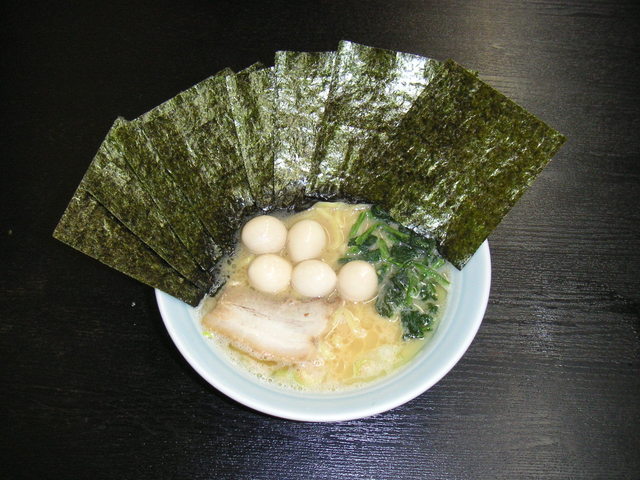
Approaching ramen in Nagoya often means leaving the central hotel-and-station orbit and paying attention to quieter residential wards, where small shops carry the city’s daily eating habits more clearly than polished dining rooms. In Midori Ward, Banrai Tei sits inside that category: a compact ramen room where the counter is part of the format, table seating keeps families in play, and the point is turnover rather than ceremony.
That matters because Nagoya’s food identity can be misread by visitors. The city is associated with local staples such as miso katsu, kishimen, hitsumabushi, and tebasaki, but its ramen culture has also absorbed outside regional methods with unusual directness. Yokohama-style Iekei ramen, built around thick noodles and a soy-sauce tonkotsu base, is not native Nagoya cooking. Its arrival here shows how a local dining scene can adopt a format from another city and make it part of ordinary neighbourhood eating.
Yokohama Iekei technique in a Nagoya neighbourhood
Iekei ramen began in Yokohama as a firmer, richer counterpoint to lighter regional bowls, with thick noodles designed to hold a pork-and-soy broth rather than disappear beneath it. Banrai Tei is tied to that migration story: it opened in 1998 and relaunched in 2003 around Yokohama-style Iekei, with the restaurant describing itself as Nagoya’s first Iekei ramen shop. The detail that its noodles are sourced directly from Yokohama is the key point, because this is not merely a Nagoya shop borrowing a label. The method carries a specific regional grammar into Aichi.
The broader comparison is useful. In Nagoya’s ramen bracket, Ramen Burai and Komugi to Yakiago Sugure sit in the sub-JPY 999 range, while Ramen mellow and Shurakutei Kuan occupy the JPY 1,000 to JPY 1,999 band. Banrai Tei prices in that latter everyday tier for dinner, with lunch listed below JPY 999, so the value proposition is not luxury. It is specialization: a low-cost, high-frequency meal built around a recognizable regional style rather than a tasting-menu interpretation.
Tabelog’s 2025 Ramen Aichi 100 selection gives that positioning external weight. It is not a Michelin-style dining signal, and it should not be read as one. It is a ramen-category signal inside Aichi, useful because ramen in Japan is judged as much by repeat local traffic and format discipline as by destination polish. A 3.59 Tabelog score places the shop in serious local territory without turning it into a formal dining event.
The room rewards diners who understand ramen as infrastructure
The physical format tells the story as clearly as the broth category. The room has 20 seats, divided between 8 counter seats and 3 tables for 4. That split is practical: solo diners can eat quickly at the counter, while families and small groups are not excluded from the ramen experience. In Japan, that matters. Ramen is often treated by travelers as a cult pursuit, but locally it functions as infrastructure, something between habit, comfort, and fast meal.
The operating rhythm reinforces that point. Service runs in lunch and dinner blocks from Wednesday through Sunday, with Monday and Tuesday closed. Reservations are unavailable, so the experience belongs to the walk-in ramen tradition rather than the planning-heavy end of Japanese dining. A self-service touch-panel register and stated emphasis on fast rotations indicate a shop built to move customers through without stripping the meal of its identity.
For travelers, the location changes the calculation. This is not a station-adjacent ramen stop designed around a spare 30 minutes between trains. Narumi Station is the nearest rail reference, with bus access to Nakaasaide from Narumi or Naruko-kita. There is also parking, including 13 designated spaces in a monthly lot across the street, which makes the shop more legible for diners moving through Nagoya by car than for those confined to the Sakae-Meieki corridor.
How to place it within a Nagoya eating itinerary
The restaurant works well as a ramen-specific detour rather than an all-purpose Nagoya dining recommendation. The city’s more formal restaurant decisions sit elsewhere, and visitors comparing broader categories can start with Our full Nagoya restaurants guide, then branch into hotels, bars, wineries, and experiences through Our full Nagoya hotels guide, Our full Nagoya bars guide, Our full Nagoya wineries guide, and Our full Nagoya experiences guide. Within the restaurant archive, nearby planning can also include 1022, 451, Aaron, Alan., and All Day Dining Montmartre, though those belong to different dining decisions.
The smarter reading is cultural rather than checklist-driven. Nagoya’s ramen scene does not need to mimic Tokyo’s competitive density or Sapporo’s regional branding to be worth attention. Its value lies in the way imported formats settle into local routines. Here, Yokohama’s Iekei structure arrives in a Midori Ward shop with counter seats, family tables, wheelchair accessibility, no private rooms, non-smoking policy, QR-code payment options, and prices low enough for repeat use. That is a cleaner signal than grand claims: a regional technique has become ordinary Nagoya food.
For readers building a wider Japan dining map, the contrast is instructive. A sukiyaki room such as -Grilled beef Sukiyaki- KAMAKURA TANUKIAN 鎌倉 たぬき庵 in Kamakura, a Tokyo charcoal-and-tuna address like. 鮪と炭火焼き うお炭 秋葉原店 in Tokyo.cafe in Osaka.know in Kumamoto, (Shoku) Vietnam in Kawasaki, and [Curry Senmon Ten] Maruyama Kyoju. in Sapporo each show a different relationship between category and place. Even abroad, Japanese formats shift with context, as seen at Jōdo Saké Bar in Los Angeles and Onigiri Time in Pasadena. The restaurant belongs to that same conversation, but at a humbler scale: not export cuisine, not fine dining, simply a Yokohama method absorbed into Nagoya’s everyday table.
A Pricing-First Comparison
Comparable venues to calibrate price, style, and recognition.
| Venue | Cuisine | Price | Notes |
|---|---|---|---|
| Banrai Tei | Midori, Traditional Yokohama Iekei Ramen | $ | Not listed |
| Menya Tamagusuku | Not listed | $ | Chikusa, Okinawan-style Ramen & Soki Soba |
| Taylor Tail | Higashi, Japanese Bakery-Cafe | $ | Not listed |
| Ramen Daruma Shokudo | Nakagawa, Ramen and Japanese curry diner | $ | Not listed |
| Ramen Dai Nagoya ten | Naka, Jiro-style Ramen Shop | $ | Not listed |
| Men Senmon Ten Ajiyoshi | Kita, Udon and curry udon specialist | $ | Not listed |
Recognition history
Dated appearances from independent guides and award organizations, with the underlying list record or original source where available.
Tabelog 100 #91 · No. 91
Tabelog · Tabelog 100 - Ramen - AICHI - 2025
Continue exploring
More in Nagoya
Restaurants in Nagoya
Browse all →
At a Glance
- Lively
- Cozy
- Classic
- Solo
- After Work
- Casual Hangout
- Family
- Group Dining
- Late Night
- Standalone
- Local Sourcing
Current opening hours
- Monday
- Closed
- Tuesday
- Closed
- Wednesday
- 11 AM–2 PM, 6–10 PM
- Thursday
- 11 AM–2 PM, 6–10 PM
- Friday
- 11 AM–2 PM, 6–10 PM
- Saturday
- 11 AM–2 PM, 6–10 PM
- Sunday
- 11 AM–2 PM, 6–10 PM
Hours can change for holidays and private events. Last verified .
Casual neighborhood ramen shop with a compact mix of counter and table seating, fast turnover, and an efficient, energetic atmosphere rather than a lingering, quiet space.