Where Bali's Oldest Ritual Meets the Roadside There is a particular kind of eating in Bali that has nothing to do with ocean views or hotel dining rooms. It happens in the morning, in simple open-fronted warungs, where the ritual has been set in...
Pearl is the En Primeur Club membership app — saves, bookings, and concierge access live there. Same editors, same standards.
- Address
- Bali, Indonesia
- Directions
- Get directions
 Saves & bookings on Pearl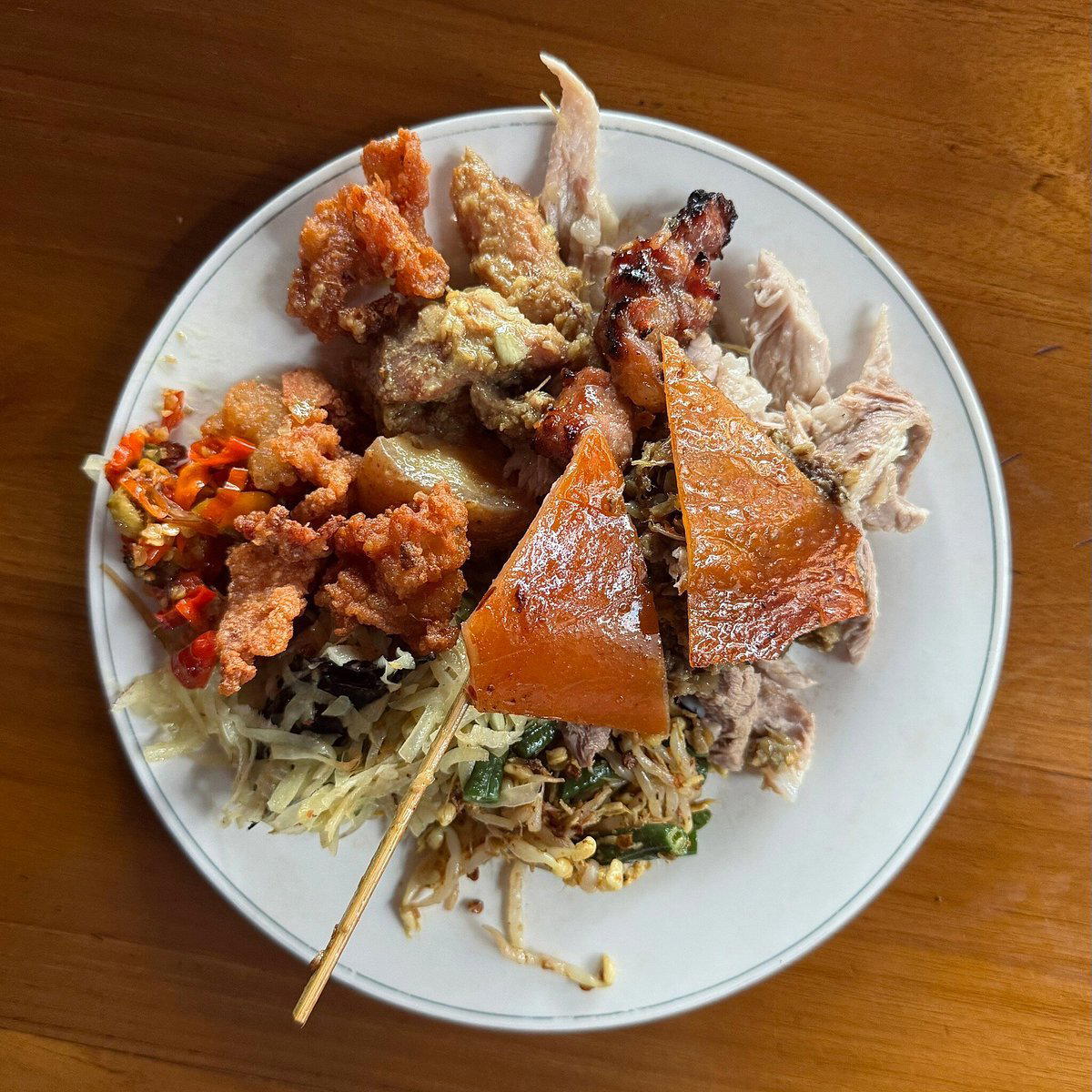
Where Bali's Oldest Ritual Meets the Roadside
Babi Guling Pak Dobiel is a restaurant in Bali serving traditional Balinese roasted suckling pig. There is a particular kind of eating in Bali that has nothing to do with ocean views or hotel dining rooms. It happens in the morning, in simple open-fronted warungs, where the ritual has been set in motion hours before the first customer arrives. Babi guling, the island's ceremonially rooted spit-roasted suckling pig, belongs to that register. It is food with a liturgical backstory, originally prepared for temple offerings before it migrated into everyday eating, and it remains one of the clearest windows into Balinese food culture that a visitor can find. Babi Guling Pak Dobiel sits inside that tradition, operating as a specialist address in a category where regulars arrive early, portions sell out, and the midday crowd is largely an afterthought.
The Place and What It Tells You About the Area
Bali's babi guling circuit is genuinely geographic. Certain districts have long-standing reputations for the dish, and well-regarded spots tend to draw from a tight local catchment before tourist interest layers on leading. The preparation itself demands proximity to supply chains, specific wood-fire infrastructure, and the kind of early-morning operational discipline that doesn't translate easily to resort corridors. Venues operating in this format are embedded in their neighbourhoods in a way that hotel restaurants simply cannot replicate. Babi Guling Pak Dobiel operates in that embedded mode, drawing on a neighbourhood identity that the address itself signals to those already familiar with the Bali babi guling circuit.
Contrast that positioning with venues like Kayuputi, which anchors the luxury resort tier, or Locavore, which represents Ubud's fine-dining ambitions with a tasting-menu format and sustained international recognition. Those addresses operate in a different competitive set entirely. What Pak Dobiel offers is the opposite: inherited technique, unchanged format, and a daily sell-out cycle that functions as its own credibility signal. This is a different category of eating with its own standards and its own measure of quality.
The Dish: What Babi Guling Actually Is
Babi guling is defined by the whole roasting process. A suckling pig, typically rubbed with a spice paste built from turmeric, galangal, lemongrass, shallots, chilli, and a cluster of other aromatics, is rotated slowly over a wood or coconut-husk fire until the skin reaches a lacquer-like crispness. The meat underneath, cooked through gently by the slow rotation, retains moisture in a way that quick-roast methods cannot achieve. What is served is rarely just sliced pork. A standard Balinese babi guling plate involves a composition: rice, the roasted meat, lawar (a minced vegetable and coconut preparation that can include blood), crispy crackling, sate lilit, and a ladleful of spiced broth or gravy. Each component is made fresh that day, which is precisely why the leading operations run out before noon.
The spice profile here reflects the broader character of Balinese cooking, which is distinctly different from the Javanese food that dominates much of Indonesia. Where Javanese cuisine tends toward sweetness in its sauces, Balinese cooking is more aromatic and more aggressive with fresh spice. For visitors moving across Indonesia, including through the restaurant scenes of August in Jakarta or the Ubud-based Locavore NXT, babi guling represents an opportunity to eat something that is specifically, irreducibly Balinese.
Ordering and Timing
The operational logic of a babi guling warung runs counter to how most travellers plan their days. Supply is finite, set by the size of the pig prepared each morning. Doors open early, sometimes by 8am, and the leading cuts move quickly. By the time a tourist makes their way over at noon after a hotel breakfast, the crackling may be gone, the lawar may be depleted, and what remains is whatever the morning crowd left behind. Arriving early is important if you want the full plate as intended.
This is a walk-in-friendly, point-and-serve format. There is no tasting menu consultation, and casual dress is appropriate. You arrive, you see what is available, you indicate your preference, and you sit. That simplicity is the format's structural advantage, the same logic that applies to the leading hawker centres in Singapore or the market-adjacent lunch counters in Lyon. The absence of ceremony is not a deficiency. It is the form.
Situating Pak Dobiel in Bali's Broader Food Scene
Bali's dining scene in 2024 runs a wide range. At one end, plant-forward venues like Moksa and Kynd Community have built genuine followings among the island's health-conscious resident and visitor base. Peloton Supershop positions itself at the intersection of cycling culture and plant-based eating. These venues represent one trajectory for Bali's food identity: outward-facing, Instagram-literate, and broadly accessible to international palates.
Babi guling warungs occupy the opposing pole. They are inward-facing by design, rooted in technique that predates the island's tourism economy, and indifferent to photographic staging. The ideal way to understand Bali's food culture is not to choose between these poles but to move across them. Spending one morning at a babi guling specialist and one evening at a venue like Jungle Fish Bali in Gianyar or Bikini Restaurant Bali in Badung covers genuinely different registers of what the island does well. Full Bali restaurants guide maps both ends of that spectrum and the territory in between.
For travellers who have been working through Indonesia's fine-dining circuit, including spots like Kita in Kecamatan Menteng, Hwang Fu Dimsum in Tangerang, or Chongqing Liuyishou Hotpot in South Jakarta, the shift to a babi guling warung represents a deliberate change of mode. It is not a lesser experience. It is a different grammar of eating.
Planning Your Visit
Babi Guling Pak Dobiel is typically found through local referral rather than digital infrastructure. Asking your accommodation staff, a local driver, or a longer-term Bali resident will yield more reliable directions than a search engine. Once you have the location confirmed, treat arrival before 10am as non-negotiable. Bring cash, expect a short queue at peak hour, and do not attempt to pre-order or phone ahead. The format does not accommodate those expectations, and you will be better served by working within the rhythm the venue has established over years of operation rather than importing habits from booking-dependent fine dining.
The Short List
Comparable venues nearby, for context on price, style, and recognition.
| Venue | Cuisine | Price | Notes |
|---|---|---|---|
| Babi Guling Pak DobielThis venue — the venue you are viewing | Not listed | $ | Not listed |
| TRI DATU RESTOURANT | Baturiti, Indonesian Warung | $$ | Not listed |
| Apéritif Restaurant & Bar | Ubud, Borderless Fine Dining Degustation | $$$$ | Not listed |
| Kynd Community | Seminyak, Plant-Forward Vegetarian Cafe | $$ | Not listed |
| Locavore | Not listed | $$$$ | Lodtunduh, Ubud, Modern Indonesian Fusion |
| Peloton Supershop | Berawa, Plant-Based Cafe | $$ | Not listed |








At a Glance
- Lively
- Rustic
- Well Known
- Casual Hangout
- Group Dining
- Standalone
- Open Kitchen