Azay
Our verdict
Azay occupies a calculated position in Los Angeles's fine dining tier, where French technique and serious wine curation converge at a Downtown address. Positioned against peers like Kato and Hayato in the city's upper-bracket dining set, it draws a crowd that comes as much for the cellar as the kitchen. A reservation here is a considered choice, not a casual one.

Pearl is the En Primeur Club membership app — saves, bookings, and concierge access live there. Same editors, same standards.
- Address
- 226 1st St, Los Angeles, CA 90012
- Phone
- (213) 628-3431
- Hours
- Mon ClosedTue–Fri 11 AM–1:45 PMSat–Sun 9 AM–1:45 PM
- Website
- azaylittletokyo.com
- Directions
- Get directions
- Booking
- Book on Resy
The menu
What to order
- Japanese Breakfast
- Pork belly omelette
Downtown Los Angeles and the French Fine Dining Tier
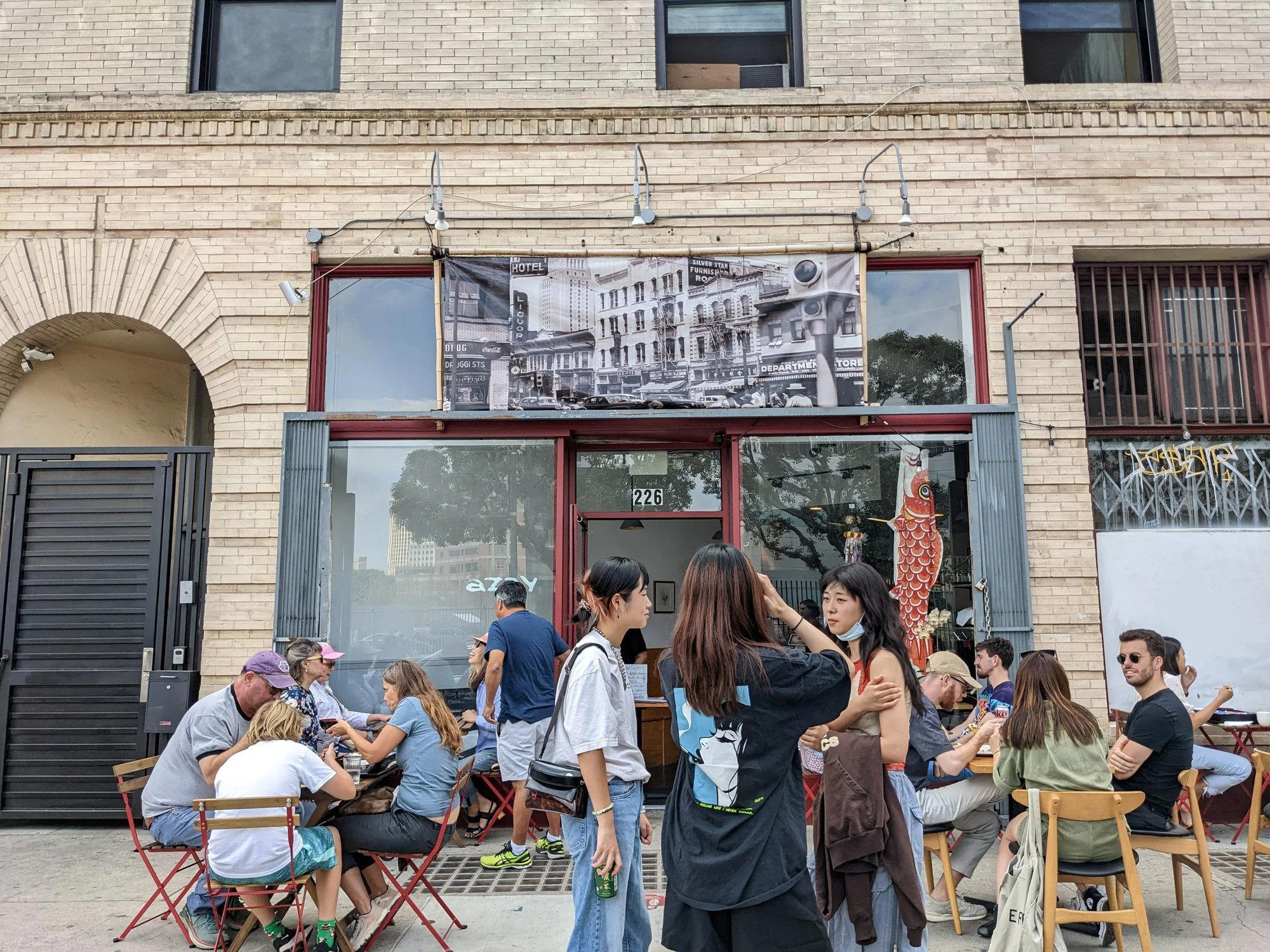
Downtown Los Angeles has never been the obvious address for formal French dining. That distinction has traditionally belonged to the Westside, where decades of expense-account culture built the infrastructure for white-tablecloth rooms and deep wine programs. But the last several years have seen a quiet redistribution of serious dining into the city's older neighborhoods, and the stretch around Little Tokyo and the Arts District has absorbed some of that shift. Azay, at 226 1st Street, sits in this redrawn geography, a French-leaning address in a part of the city still better associated with Hayato's kaiseki discipline than Gallic restraint.
That positioning matters because it tells you something about the current state of Los Angeles dining more broadly. The city no longer concentrates its ambition in a single ZIP code. Restaurants like Kato and Somni have demonstrated that a considered, technically demanding program can find its audience in locations that would have seemed improbable a decade ago. Azay operates within that same logic. The address is deliberate, not accidental.
The Wine Program as Primary Lens
French fine dining in America has always been inseparable from the question of wine, and the restaurants that have maintained relevance in this category tend to be the ones that treat the cellar as a co-equal to the kitchen. At the highest end of the American dining spectrum, this is increasingly how the division runs: kitchens with serious technique are common enough, but a wine program with genuine depth, curatorial intelligence, and a sommelier who can position bottles within a broader tradition is considerably rarer.
Azay's Downtown location places it in a peer conversation with the serious wine rooms of its city. Across the broader US fine dining tier, the benchmark for this approach is set by a handful of properties: Le Bernardin in New York City, where the wine list has long been calibrated to the precision of the seafood kitchen; The French Laundry in Napa, which operates with one of the most comprehensively stocked cellars in American dining; and Frasca Food and Wine in Boulder, a room that has built an entire identity around Friulian wine culture and won significant recognition for it. These are the rooms against which any serious French-inflected program in America is implicitly measured.
In Los Angeles specifically, the comparison set includes Providence, which has maintained one of the city's most respected cellar programs alongside its contemporary seafood kitchen. The dynamic between food precision and wine depth is well-established there, and it creates a useful benchmark for understanding where other formal programs in the city sit. Azay belongs to that broader conversation about how seriously a Los Angeles kitchen takes its cellar.
What the French Tradition Demands at This Level
French fine dining, in its American expression, carries a set of inherited expectations that persist even as individual rooms adapt them. The format tends toward multi-course progression, classical technique applied with modern restraint, and a service register that prioritizes knowledge over performance. The wine list, in this tradition, is not an afterthought assembled from distributor allocations. It reflects a point of view about region, vintage, and the relationship between the glass and the plate.
The American restaurants that have held this standard most consistently share a few structural commitments. Single Thread Farm in Healdsburg pairs an omakase-adjacent tasting format with a wine program that draws explicitly on both California and European references. Blue Hill at Stone Barns in Tarrytown has built a cellar that mirrors its farm-driven sourcing philosophy. Smyth in Chicago positions its list in deliberate relationship to the tasting menu's seasonal arc. In each case, the wine program is conceptually integrated with the food, not simply available alongside it.
That integration is the standard a French room in a city like Los Angeles must meet if it is competing in the upper bracket. Osteria Mozza has demonstrated on the Italian side of the ledger that Los Angeles diners will invest in a wine list with genuine depth and specificity. The appetite is present. The question for any new entrant in the formal dining tier is whether the cellar can sustain the promise the kitchen makes.
Dining Context: Downtown, Logistics, and the Reservation
The 226 1st Street address places Azay in a part of Downtown Los Angeles that rewards orientation. Little Tokyo sits immediately adjacent, and the broader Arts District dining corridor is walkable. For those arriving by car, the neighborhood has the parking infrastructure that central Downtown often lacks. Metro access via the Gold Line at Little Tokyo/Arts District station makes the address reachable from across the city without a vehicle, which is worth noting in a city where that option rarely applies to formal dining rooms.
Downtown's dining character has diversified considerably. The same blocks that house Azay sit near the serious Japanese dining concentration that includes Hayato and the broader Little Tokyo restaurant cluster. That adjacency means the neighborhood now holds multiple competing claims on a serious diner's evening, which is a marker of how much the area has changed in half a decade.
For reference, the peer tier in other cities occupies comparable positions in their respective dining ecosystems: Addison in San Diego, Lazy Bear in San Francisco, and The Inn at Little Washington all represent regional French-influenced fine dining that has built its reputation on the wine-kitchen relationship as much as on any individual dish. Internationally, rooms like Atelier Moessmer Norbert Niederkofler in Brunico demonstrate how a wine program rooted in Alpine production can define an entire dining identity. These are the rooms shaping the standard.
See our full Los Angeles restaurants guide for broader context on where Azay sits within the city's current dining tier, and how the Downtown corridor compares to the Westside and mid-city rooms that have historically dominated the upper end of the market.
Reservations: Contact directly via the 226 1st Street location; advance booking is advisable for formal dining rooms at this address. Dress: Smart casual to formal is appropriate for the tier. Location: 226 1st St, Los Angeles, CA 90012, with Metro Gold Line access at Little Tokyo/Arts District station.
Frequently asked questions
Where do I go for Azay?
Azay is located at 226 1st St, Los Angeles, CA 90012, Los Angeles.
How does Azay's location in Downtown Los Angeles compare to other French fine dining addresses in the city?
Azay's address at 226 1st Street places it in a part of Downtown Los Angeles that has historically sat outside the Westside corridor where formal French dining established its strongest foothold in the city. That positioning is substantive: the surrounding blocks border Little Tokyo and the broader civic core, giving the room a different guest profile and neighbourhood context than comparable French addresses in Beverly Hills or West Hollywood. For diners based in or visiting central Los Angeles, the Downtown location removes a significant geographical barrier that makes Westside fine dining impractical on weeknights.
What's the best thing to order at Azay?
Azay positions itself within the French fine dining tier in Downtown Los Angeles, where the wine program functions as a primary editorial lens rather than a secondary offering. At this category of restaurant, the tasting menu format is typically where the kitchen's French technique is most fully expressed, and pairing that with the cellar selection is the most direct way to engage with the room's defining philosophy. Given the 226 1st Street address and its proximity to Little Tokyo, the dining room draws guests who come with intention rather than impulse, which suggests the full menu experience is the expected approach.
Do they take walk-ins at Azay?
French fine dining rooms operating at Azay's tier in Downtown Los Angeles almost universally require advance reservations. The format at this price point, with its structured service and tasting menu pacing, depends on known covers. For 226 1st Street specifically, contacting the restaurant directly ahead of your visit is the reliable approach rather than arriving without a booking.
The Quick Read
Comparable venues nearby, for context on price, style, and recognition.
| Venue | Cuisine | Price | Notes |
|---|---|---|---|
| AzayThis venue — the venue you are viewing | Japanese Breakfast and Home Cooking | $20–30 | Not listed |
| Yuko Kitchen | Japanese Comfort Food | $20–30 | Miracle Mile, Japanese Comfort Food |
| Tsuri | Contemporary Japanese Sushi | $30–50 | Hollywood, Contemporary Japanese Sushi |
| Niko Niko Sushi | Japanese Sushi | $20–30 | Rancho Park, Japanese Sushi |
| Roji Sushi | Traditional Japanese Sushi | $30–50 | Los Feliz, Traditional Japanese Sushi |
| Hide | Traditional Japanese Sushi | $30–50 | Sawtelle, Traditional Japanese Sushi |
Continue exploring
More in Los Angeles
Restaurants in Los Angeles
Browse all →
Bars in Los Angeles
Browse all →
Hotels in Los Angeles
Browse all →
Wineries in Los Angeles
Browse all →
Details
- Cozy
- Intimate
- Modern
- Casual Hangout
- Brunch
- Historic Building
- A La Carte
Current opening hours
- Monday
- Closed
- Tuesday
- 11 AM–1:45 PM
- Wednesday
- 11 AM–1:45 PM
- Thursday
- 11 AM–1:45 PM
- Friday
- 11 AM–1:45 PM
- Saturday
- 9 AM–1:45 PM
- Sunday
- 9 AM–1:45 PM
Hours can change for holidays and private events. Last verified .
Cozy and intimate atmosphere in a historic building ground floor.