
Au Pied de Cochon is a traditional French brasserie in a historic building with an open kitchen, lively room, and late-night service. OAD recommended in 2026.
Pearl is the En Primeur Club membership app — saves, bookings, and concierge access live there. Same editors, same standards.
- Address
- 6 Rue Coquillière, 75001 Paris, France
- Phone
- +33 1 40 13 77 00
- Website
- pieddecochon.com
- Directions
- Get directions
 Saves & bookings on Pearl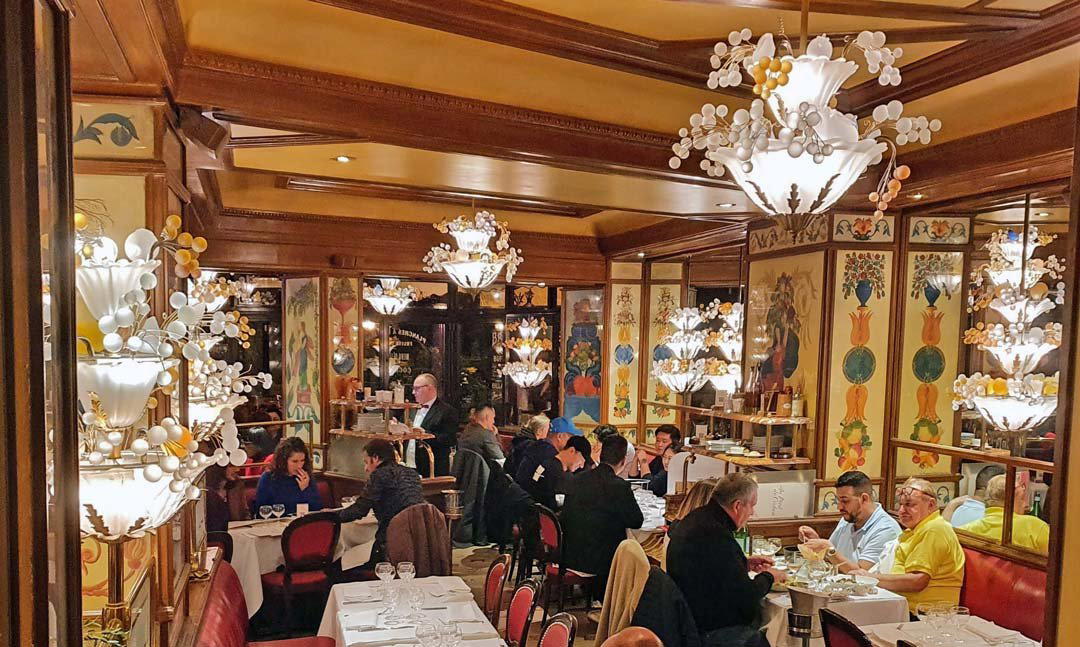
After Midnight in the First Arrondissement
Approach 6 Rue Coquillière at two in the morning and the scene announces itself before you reach the door. The dining room glows against the dark street, the brass and tile interior still busy with the kind of crowd that only assembles when the rest of the city has gone to bed. Au Pied de Cochon has been serving this neighbourhood continuously through the night for decades, and its location beside the old Les Halles market, once the stomach of Paris, as Zola called it, gives the place a historical logic that no amount of urban redevelopment has fully erased. The market is gone, replaced by the Forum des Halles shopping complex, but the brasserie that fed its butchers and porters endures, and the hour-by-hour flow of its dining room still maps loosely onto the rhythms of an all-night city.
The grandes brasseries of the first and second arrondissements inherited the tradition of feeding the market trade, but most now close before midnight. Au Pied de Cochon is among the few that operates through the night without interruption, making it a practical anchor for anyone arriving on a late train, finishing an evening at a nearby theatre, or simply looking for a serious kitchen at an hour when most alternatives have shut down their stoves.
What the Room Tells You
The interior reads as a document of a particular Parisian brasserie era: banquette seating, tiled surfaces, mirrored walls, and a set of service stations that allow a large brigade to run the floor without the kind of theatrical choreography you find at the €€€€ end of the city's dining market. Compare this with the formal procession of service at Le Cinq at the Four Seasons Hôtel George V or the restrained modernism of L'Ambroisie on the Place des Vosges, and you understand that the brasserie tradition is doing something structurally different. The room is not a backdrop for a tasting menu narrative; it is a working dining hall, and the service model reflects that.
The front-of-house discipline at a venue operating around the clock is a different kind of challenge from what faces the brigade at an establishment serving a single dinner service. Shift changes have to be invisible to the guest. The institutional knowledge required to sustain consistent pork preparation and classical brasserie execution through every hour demands a floor team that communicates laterally, with the kitchen, the sommelier, and between itself, in a way that is less like theatre and more like logistics. The coordination between sections is, in this context, the product itself.
The Pork-Led Kitchen and What It Represents
Name translates directly: the pig's foot. In the canon of French brasserie cooking, trotters, andouillette, boudin noir, and whole-animal pork preparations occupy the same serious register that prime cuts hold elsewhere. This is a kitchen tradition built around parts that demand technical confidence: long braises, precise charcuterie work, the kind of preparation that cannot be rushed. French regional kitchens that have pursued this lineage, from Auberge de l'Ill in Alsace to Georges Blanc in Vonnas, share a commitment to classical technique applied to produce that requires the cook to earn the result rather than rely on premium ingredient cost alone.
Onion soup is the other marker. It belongs to the same culinary category as the trotters: a preparation so apparently simple that its execution is immediately legible. The quality of the stock, the caramelisation depth, the bread-to-cheese ratio, these are not details that hide behind complexity. They stand exposed. In the context of a kitchen that runs through the night, the ability to deliver a technically sound onion soup at four in the morning is a more demanding standard than it appears.
For calibration against what Paris's leading kitchen investments look like at the formal end of the spectrum, consider Alléno Paris au Pavillon Ledoyen or the precision-led approach at Arpège. The distance between those models and the brasserie format is not a hierarchy of seriousness, it is a difference in what seriousness means. At the Michelin three-star level, the kitchen answers to a critic's framework. At a brasserie operating continuously, the kitchen answers to the city's schedule.
The Sommelier's Role in a 24-Hour Room
Wine service at a brasserie running through the night faces a specific editorial challenge: the cellar must work across a wider register of use occasions than most restaurants encounter. A couple finishing dinner at eight in the evening has different requirements from a group that has come in from a concert at midnight, or a solo traveller eating at the counter at three in the morning. The sommelier, and the wine list structured around their choices, has to be capable of calibrating recommendations across all of those scenarios without defaulting to a single mode. The classic pairings here are well-established: Alsatian Riesling with charcuterie, Burgundy with the longer preparations, Beaujolais for the lighter brasserie dishes. The bottle list at a venue like this operates as a direct extension of the kitchen's register, and the floor team's ability to read the table and make a confident short recommendation is part of what separates a well-run brasserie from a venue that happens to serve wine.
Placing It in the French Dining Context
France's dining culture still sustains a tradition of serious cooking outside the formal tasting-menu format, and the brasserie occupies a specific position in that architecture. Restaurants like Paul Bocuse's Auberge du Pont de Collonges, Bras in Laguiole, or Les Prés d'Eugénie represent the destination end of French regional cuisine. Au Pied de Cochon occupies a different role: urban, continuous, and rooted in a specific neighbourhood history. The comparison set is not the three-star formal establishment; it is the handful of surviving Parisian brasseries that have maintained a genuine kitchen through the decades of consolidation that reduced many of their peers to reheated production and tourist pricing.
For context on what serious contemporary French cooking looks like at the creative end of the Paris market, Kei offers a French-Japanese synthesis that sits in its own distinct category. The full Paris restaurants guide maps the city's dining tiers in more detail. Internationally, the classical French technique that underpins the brasserie tradition travels in different directions: Le Bernardin in New York applies it to seafood with precision, while Lazy Bear in San Francisco reinterprets the communal dining format for a West Coast context. French mountain cooking, which shares a similar appetite for rich, technically demanding preparations, appears at its most refined at Flocons de Sel in Megève. Further south, Mirazur in Menton and La Table du Castellet show how the French Mediterranean kitchen has developed its own distinct formal register. For the full sweep of provincial French ambition, Troisgros in Ouches and Auberge du Vieux Puits in Fontjoncouse anchor the tradition at opposite ends of the country.
Planning Your Visit
| Venue | Style | Price Tier | Late-Night Access | Booking Requirement |
|---|---|---|---|---|
| Au Pied de Cochon | Classic brasserie | Mid-range | 24-hour service | Advisable; walk-ins possible off-peak |
| Le Cinq, George V | Formal French | €€€€ | Dinner service only | Required, weeks in advance |
| L'Ambroisie | Classic haute cuisine | €€€€ | Lunch and dinner only | Required, well in advance |
| Alléno Ledoyen | Creative tasting menu | €€€€ | Dinner service only | Required |
The address, 6 Rue Coquillière, 75001, places the restaurant inside the first arrondissement, accessible by Métro at Les Halles or Châtelet. The timing question is less about when to book and more about when the room suits your purposes.
Peers Worth Knowing
Comparable venues nearby, for context on price, style, and recognition.
| Venue | Cuisine | Price | Notes |
|---|---|---|---|
| Au Pied de CochonThis venue — the venue you are viewing | Traditional French Brasserie | $$$ | Not listed |
| Hollywood Savoy | Modern French Brasserie | $$$ | 2nd arrondissement (Bourse district) |
| Sébastien Gaudard | Classic French Patisserie & Café | $$$ | 9th Arrondissement |
| Sauvage | Modern French Bistronomic | $$$ | Saint-Germain-des-Prés |
| Le Petit Lutetia | Classic French Brasserie | $$$ | 6th Arrondissement |
| Auberge Etchegorry | Traditional Basque & Southwest French | $$$ | 13e Arr. – Gobelins |
Recognition history
Dated appearances from independent guides and award organizations, with the underlying list record or original source where available.
Opinionated About Dining Casual in Europe Recommended
Opinionated About Dining
Continue exploring
More in Paris
Restaurants in Paris
Browse all →
Bars in Paris
Browse all →
Hotels in Paris
Browse all →



At a Glance
- Classic
- Well Known
- Lively
- Late Night
- Special Occasion
- Casual Hangout
- Historic Building
- Open Kitchen
Current opening hours
- Monday
- 8 AM–5 AM
- Tuesday
- 8 AM–5 AM
- Wednesday
- 8 AM–5 AM
- Thursday
- 8 AM–5 AM
- Friday
- 8 AM–5 AM
- Saturday
- 8 AM–5 AM
- Sunday
- 8 AM–5 AM
Hours can change for holidays and private events. Last verified .
Fin-de-siècle decor with old-world charm, black-and-white-clad servers, and a bustling, festive atmosphere.