
Akira Curry places Osaka’s spice-curry culture inside a Kyomachibori room that works by format as much as flavor: counter seating, izakaya function, and a curry identity recognized in Tabelog Curry WEST 100 for 2023 and 2024. It suits travelers reading Osaka beyond takoyaki and sushi, especially those interested in how small urban rooms carry serious regional food movements.
Pearl is the En Primeur Club membership app — saves, bookings, and concierge access live there. Same editors, same standards.
- Address
- 1 Chome-12-6 Kyomachibori, Nishi Ward, Osaka, 550-0003, Japan
- Phone
- +81 90-4641-3271
- Website
- instagram.com
 Saves & bookings on Pearl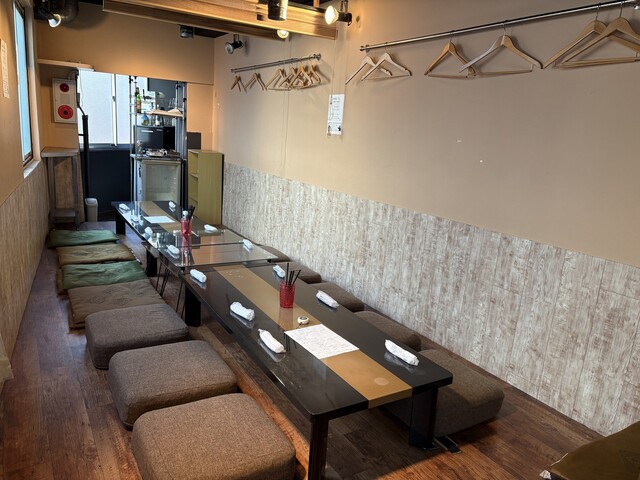
Kyomachibori shifts quickly: office blocks, low-rise restaurants, and Nishi Ward’s quieter edge pull Osaka dining away from Dotonbori neon. Here, the curry room matters. Counter seats compress the meal, group tables turn it toward izakaya use, and spice curry is a serious local language, not a casual lunch fallback.
Akira Curry belongs to that Osaka conversation. Its Tabelog Curry WEST 100 selections in 2023 and 2024 place it among curry specialists across western Japan, not general-purpose restaurants. In Osaka’s broad, crowded, physically modest curry culture, that distinction rewards identity, consistency, and repeat local demand over grand dining-room theatre.
A curry counter with izakaya mechanics
Osaka spice curry has spatial intelligence. Serious addresses often borrow from cafés, bars, standing counters, and late-night taverns rather than formal restaurants. Format changes the meal: curry across a counter feels immediate and functional; the same kitchen with sake, shochu, and group use shifts toward drinking-food rhythm.
That frames Akira Curry: curry specialist by recognition, izakaya by category, compact urban restaurant by room logic. Its listed 40-seat capacity gives more range than a tiny counter-only shop, while counter seating keeps it tied to Osaka’s close-range eating culture. The room is not decorative background; it explains how the restaurant can be both focused curry address and small-group tavern without losing its center.
Compared with Ghar, in Osaka’s leaner curry price tier, Akira Curry is broader-format: lunch stays accessible, while dinner moves into a higher spend band and more social mode. It sits closer to hybrid rooms than pure quick-serve curry. Burgerlion occupies a similar price band from a different comfort-food grammar; STEAK HOUSE NARIKIYO, Sushi Kyomachibori Sato, and Nishino belong to more expensive or formal decision sets. These restaurants do not compete plate-for-plate; Osaka makes travelers choose between category depth, price ceiling, and room style, often within a short walk.
On a wider Osaka map, the restaurant sits beside casual-specialist addresses in the city guide: .cafe, 52CHO-ME BAKERY, 551 Horai (551蓬莱), 99 Pizza Napoletana Gourmet, and a canto (Italian). Together they show a city less interested in one grand dining narrative than in tightly defined formats with loyal audiences.
Why Osaka curry rewards small rooms
Japanese curry is often flattened abroad into one comfort category, but Osaka spice curry is more layered. The city supports shops that treat spice structure, rice, accompaniments, and service rhythm as a complete format. That format does not need white tablecloths or chef biography; it needs repetition, speed, clarity, and a room where regulars read the kitchen’s intent quickly.
Kyomachibori reinforces this. It is not tourist-core Osaka, where foot traffic alone can carry a room. Nishi Ward asks for deliberate movement: office workers at lunch, local diners after work, and travelers who know Osaka’s stronger meals often sit one neighborhood off the obvious route. Higobashi and Yodoyabashi access keep the area practical without making it a spectacle district.
Design here means how seating, payment, group use, and drinking culture shape demand, not marble or ceremony. Credit cards are accepted, while electronic money and QR-code payments are not, a useful signal for travelers assuming cashless uniformity in Japan. Non-smoking status matters in a category overlapping tavern culture. Private-room and private-use options give the address life beyond solo curry eating, especially for groups wanting spice-driven food without formal kaiseki or sushi framing.
Tabelog recognition is a practical trust signal, read correctly. Its 100 selections are category mapping, not universal luxury ranking. For curry in western Japan, where the field is deep and hyper-local, selection in 2023 and 2024 shows attention held across more than one cycle, more meaningful in a crowded casual category than a single novelty burst.
How to place it in an Osaka itinerary
The restaurant is strongest as a category-specific meal, not a generic restaurant booking. It suits travelers with sushi, wagyu, and okonomiyaki covered who want Osaka’s spice-curry vocabulary in a room with more social flexibility than a lunch-only counter. The choice is less luxury chase than recognized specialist in a neighborhood that rewards planned eating.
Opened in 2019, it belongs to the newer wave of Osaka curry rooms with contemporary flexibility: lunch service on selected days, later evening use on others, and a format for counter diners and groups. Temporary changes are announced through social media, so timing discipline matters more than at an all-day restaurant. In Osaka, that is often how serious small-format food survives.
Build a broader itinerary by category, not prestige alone. Start with Our full Osaka restaurants guide, then layer in where to sleep through Our full Osaka hotels guide, drinks through Our full Osaka bars guide, regional producers through Our full Osaka wineries guide, and cultural planning through Our full Osaka experiences guide. For cross-city comparison, Japan’s casual-specialist field stretches from [Curry Senmon Ten] Maruyama Kyoju. in Sapporo to [ki:] in Kyoto.know in Kumamoto, (Shoku) Vietnam in Kawasaki, -Grilled beef Sukiyaki- KAMAKURA TANUKIAN 鎌倉 たぬき庵 in Kamakura, and. 鮪と炭火焼き うお炭 秋葉原店 in Tokyo. Outside Japan, comparable format thinking appears at Jōdo Saké Bar in Los Angeles and Onigiri Time in Pasadena: small rooms, narrow focus, and food categories treated with more seriousness than their casual price points suggest.
The editorial read is clear. The restaurant is not a grand Osaka dining trophy; it is a useful, recognized expression of how the city eats when space is tight, categories blur, and curry carries enough cultural weight to anchor a night as well as lunch.
City Peers
Comparable venues at the same tier.
| Venue | Cuisine | Price | Notes |
|---|---|---|---|
| Akira CurryThis venue — the venue you are viewing | Japanese curry & spice izakaya | $$ | Not listed |
| Osaka Matsushita | Traditional Soba & Sake | $$ | Kita |
| Shibaken | Premium branded-pork tonkatsu & curry | $$ | Miyakojima |
| Yaogen Raikodo Honten | Japanese Traditional Sweets (Wagashi) | $$ | Sakai |
| Saru Shokudo Honmachi honten | Japanese Western (Yoshoku) | $$ | Chūō |
| Yakiniku Horumon Mansen | Yakiniku & Horumon Japanese BBQ | $$ | Chūō |
Recognition history
Dated appearances from independent guides and award organizations, with the underlying list record or original source where available.
Tabelog 100 #4 · No. 4
Tabelog · Tabelog 100 - Curry - WEST - 2024
Continue exploring
More in Osaka
Restaurants in Osaka
Browse all →




Bars in Osaka
Browse all →

Hotels in Osaka
Browse all →




Wineries in Osaka
Browse all →
At a Glance
- Cozy
- Lively
- Trendy
- Casual Hangout
- After Work
- Solo
- Group Dining
- Standalone
- Beer Program
Current opening hours
- Monday
- Closed
- Tuesday
- 11:30 AM–2 PM
- Wednesday
- 11:30 AM–2 PM
- Thursday
- 11:30 AM–2 PM
- Friday
- 6 PM–12 AM
- Saturday
- 6 PM–12 AM
- Sunday
- Closed
Hours can change for holidays and private events. Last verified .
Casual and cozy curry-and-spice bar atmosphere with counter seating, a compact 40-seat room, and a lively vibe that shifts from busy lunch curry house to relaxed evening spice izakaya.