
Ajinoya Honten sits in Osaka’s Namba okonomiyaki circuit, where repeat custom matters as much as guidebook attention. Selected for Tabelog 100 Okonomiyaki 2025 and with roots dating to 1965, it represents the city’s cabbage-forward, griddle-led comfort food tradition rather than a chef-driven tasting-menu model.
Pearl is the En Primeur Club membership app — saves, bookings, and concierge access live there. Same editors, same standards.
- Address
- Japan, 〒542-0076 Osaka, Chuo Ward, Namba, 1 Chome−7−16 現代こいさんビル 2F
- Phone
- +81 50-1809-4021
- Website
- ajinoya-okonomiyaki.com
 Saves & bookings on Pearl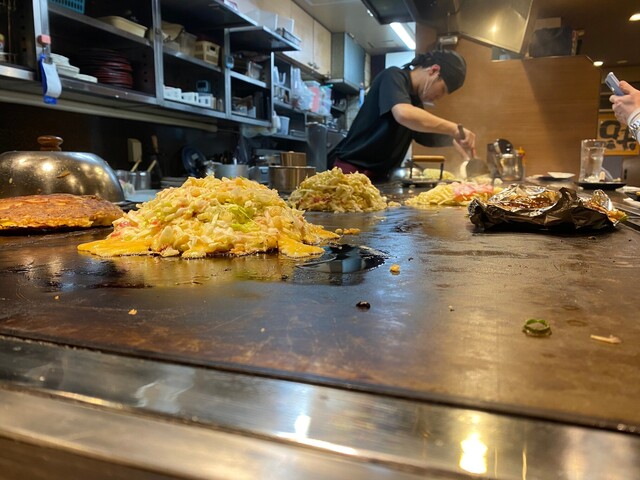
In Namba, the sound of okonomiyaki is not theatrical so much as civic: batter meeting iron, spatulas tapping, cabbage collapsing into heat. The room at Ajinoya Honten belongs to that Osaka register, practical and close to the griddle, with counter seating and a family-friendly rhythm rather than ceremony. This is the part of the city where regulars do not need a speech about Naniwa food culture; they read the iron, the queue, and the pace of service.
Osaka’s okonomiyaki scene rewards places that understand repetition. The dish looks casual, but its local hierarchy is built on small differences: cabbage cut, batter ratio, timing on the teppan, and how much weight the cook gives to the pancake before it reaches the plate. Ajinoya Honten has the signals that matter in that category. It was selected for Tabelog 100 Okonomiyaki 2025, with prior selections listed in 2024, 2023, 2022, 2019, and 2018, and the restaurant traces its history to 1965. Those credentials place it inside a long-running Osaka tradition rather than the city’s newer dining economy.
Namba okonomiyaki for people who already know the drill
The regulars’ perspective is useful here because okonomiyaki is not a cuisine of novelty. Return visits tend to be driven by consistency, not reinvention. The house style is described around cabbage-heavy okonomiyaki with a lighter batter, a useful distinction in Osaka, where the dish can turn leaden when flour becomes the main event. The category also extends beyond the pancake: stir-fried noodles and teppanyaki sit in the same comfort-food lane, which is why groups often treat a meal here as a shared griddle session rather than a single-dish stop.
That format explains the restaurant’s position in Namba. Nearby high-spend beef rooms such as Nikushou Nakata Honten and Hari Ju Doutonbori honten operate in a different register, built around premium meat and longer meals. At the other end, lower-priced everyday counters such as hadoromanchikka compete on speed and habit. Ajinoya Honten sits between those worlds: casual enough for repeat local use, recognized enough to draw visitors who want Osaka’s griddle culture without turning dinner into a trophy hunt.
The room’s 50-seat scale also matters. Okonomiyaki shops can feel either too small for groups or too large to keep the griddle work personal. A mid-sized room with counter seating gives the format enough movement without stripping away the point of watching food finish on iron. Children are welcomed, English menus are available, and take-out is part of the service, all of which keeps the place closer to an everyday Osaka restaurant than a rarefied destination.
The ordering logic: cabbage, noodles, teppan, then drinks
The smart order is not about chasing a secret item. It is about understanding the categories. Start with okonomiyaki if the goal is to read the kitchen’s core technique, then widen into yakisoba or another stir-fried noodle dish if the table needs more weight. Teppanyaki gives the meal its flexible second act, especially for groups who want to keep sharing rather than commit to separate plates. Drinks cover sake, shochu, wine, and cocktails, which reflects a common Osaka pattern: the food is casual, but the table can stretch if conversation does.
Payment and service details reinforce the regulars’ logic. Credit cards and electronic money are not accepted, while PayPay is accepted, so the meal rewards a little preparation. The restaurant is non-smoking, private rooms are not part of the format, and parking is unavailable, which again points diners toward a city-centre, station-linked meal rather than a car-based outing. Reservations are available, but the room is built for turnover as much as lingering.
For a wider read on the city’s dining map, Our full Osaka restaurants guide places Namba’s griddle culture alongside bakeries, cafés, and higher-spend counters. In the same city file, nearby casual references include .cafe, 52CHO-ME BAKERY, 551 Horai (551蓬莱), 99 Pizza Napoletana Gourmet, and a canto (Italian). Osaka planning also benefits from the adjacent city guides: Our full Osaka hotels guide, Our full Osaka bars guide, Our full Osaka wineries guide, and Our full Osaka experiences guide.
Where it fits in Japan's casual-specialist map
Japan’s casual-specialist restaurants often outperform their modest format because they do one thing repeatedly in a district that understands the thing. That is the useful frame for the restaurant. It is not trying to behave like an omakase counter or a luxury kappo room. Its authority comes from category focus, decades of operation, and repeated selection on a national okonomiyaki list.
That same pattern appears across Japan and beyond in different forms: beef sukiyaki at -Grilled beef Sukiyaki- KAMAKURA TANUKIAN 鎌倉 たぬき庵 in Kamakura, tuna and charcoal cooking at. 鮪と炭火焼き うお炭 秋葉原店 in Tokyo, regional dining at.know in Kumamoto, Vietnamese cooking at (Shoku) Vietnam in Kawasaki, curry specialization at [Curry Senmon Ten] Maruyama Kyoju. in Sapporo, Kyoto minimalism at [ki:] in Kyoto, sake-led Los Angeles dining at Jōdo Saké Bar in Los Angeles, and rice-ball focus at Onigiri Time in Pasadena. The common thread is not luxury; it is discipline within a narrow format.
The verdict is simple: for Osaka, okonomiyaki is not a side note to the city’s food culture. It is one of the ways the city explains itself. The restaurant earns attention because it sits where that explanation is still legible: Namba, the teppan, cabbage-first batter, repeat customers, and recognition from a category-specific Japanese dining list.
A Credentials Check
Comparable venues to calibrate price, style, and recognition.
| Venue | Cuisine | Price | Notes |
|---|---|---|---|
| Ajinoya HontenThis venue — the venue you are viewing | Traditional Osaka Okonomiyaki & Yakisoba | $$ | Not listed |
| カドヤ食堂 本店 | Classic Osaka Chuukasoba Ramen | $$ | Nishi-Ku / Nishi-Nagahori |
| Chitose (千とせ) | Osaka-style Okonomiyaki | $$ | Minami Horie |
| KURODARUMA | Creative Japanese standing bar (izakaya-style) | $$ | Chūō |
| Nomiba Umeda Umeda | Modern Japanese Lamb & Soba | $$ | Yodogawa |
| Toriyaki Shogun Eiwa | Traditional Yakitori Izakaya | $$ | Higashi-Osaka |
Recognition history
Dated appearances from independent guides and award organizations, with the underlying list record or original source where available.
Tabelog 100 #29 · No. 29
Tabelog · Tabelog 100 - Okonomiyaki - 2025
Continue exploring
More in Osaka
Restaurants in Osaka
Browse all →




Bars in Osaka
Browse all →


Hotels in Osaka
Browse all →



Wineries in Osaka
Browse all →
At a Glance
- Lively
- Cozy
- Well Known
- Energetic
- Casual Hangout
- Family
- Group Dining
- Solo
- After Work
- Late Night
- Open Kitchen
- Standalone
- Beer Program
- Local Sourcing
- Street Scene
Current opening hours
- Monday
- Closed
- Tuesday
- 11 AM–10 PM
- Wednesday
- 11 AM–10 PM
- Thursday
- 11 AM–10 PM
- Friday
- 11 AM–10 PM
- Saturday
- 11 AM–10 PM
- Sunday
- 11 AM–10 PM
Hours can change for holidays and private events. Last verified .
Bustling, compact upstairs space typical of central Osaka, with teppan grills at tables, close-set seating, and the sound and aroma of okonomiyaki being cooked to order creating an energetic, casual atmosphere.