Afternoon tea in Dublin has moved well beyond finger sandwiches and scones, and the Iveagh Garden Hotel on Harcourt Street sits in the tier of hotel properties taking the format seriously. Set within a Georgian townhouse a short walk from St Stephen's Green, the service draws on the city's growing appetite for considered, occasion-led dining at mid-afternoon hours.
Pearl is the En Primeur Club membership app — saves, bookings, and concierge access live there. Same editors, same standards.
- Address
- 72-74 Harcourt St, Saint Kevin's, Dublin 2, D02 Y282, Ireland
- Phone
- +35314764661
- Website
- iveaghgardenhotel.ie
- Directions
- Get directions
 Saves & bookings on Pearl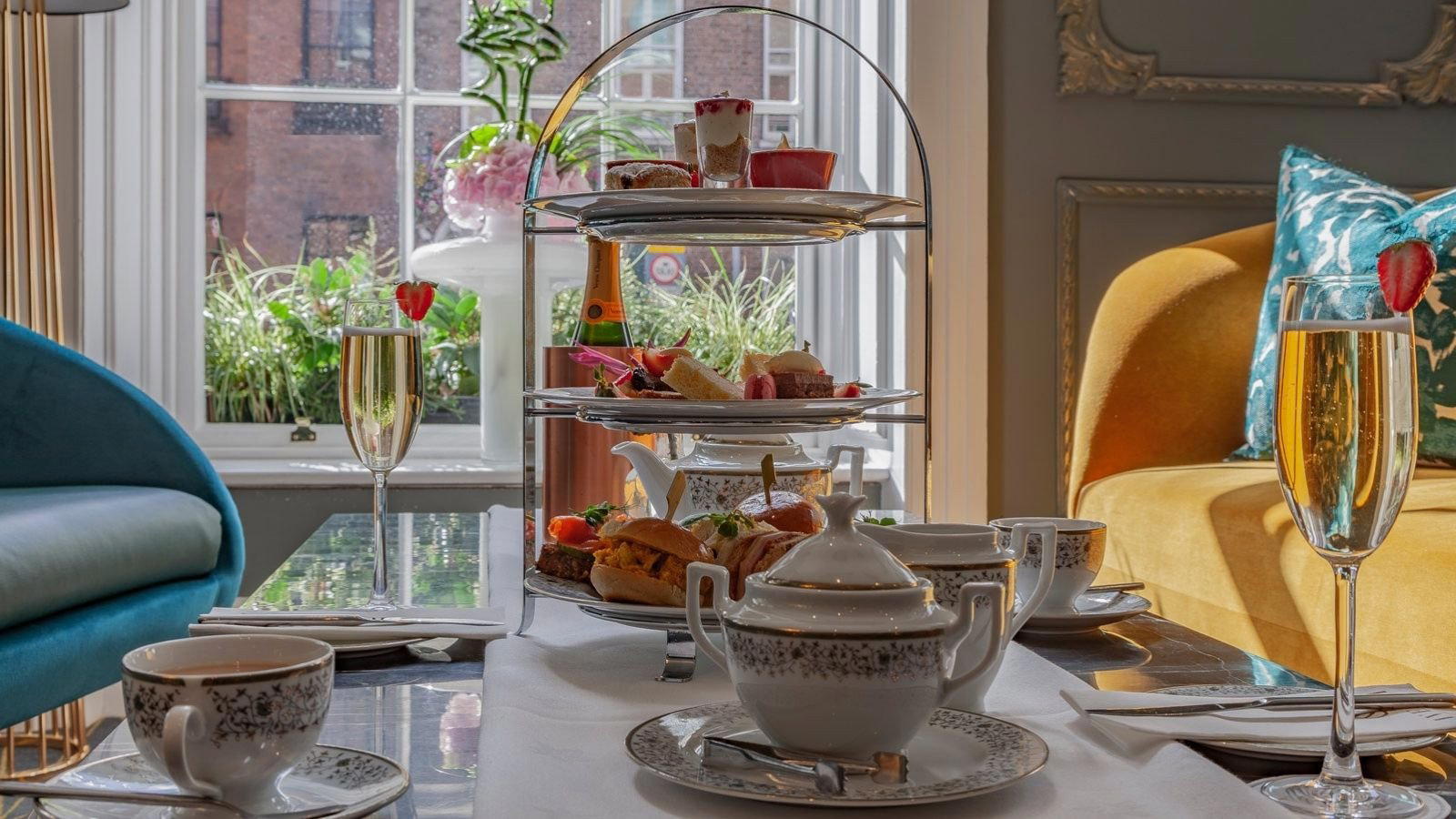
Harcourt Street and the Hotel Afternoon Tea Revival
Dublin's hotel dining has undergone a quiet but persistent shift over the past decade. Where afternoon tea once served primarily as a tourist convenience, a growing number of city-centre properties have repositioned the format as a genuine occasion, calibrated to a local audience that approaches it with the same expectation it brings to a restaurant reservation. The Iveagh Garden Hotel on Harcourt Street in Dublin 2 sits within that repositioned tier. The address places it squarely in the southern city-centre corridor that runs from St Stephen's Green down toward the Grand Canal, a stretch that has accumulated a density of hotel dining, cocktail bars, and neighbourhood restaurants over the past fifteen years.
Harcourt Street itself carries a particular character in Dublin's social geography. The Victorian railway terminus at its southern end closed in 1958, and the street has since evolved through successive identities, from office district to nightlife corridor and, more recently, to a mixed residential and hospitality zone. For a hotel afternoon tea, the Georgian fabric provides the appropriate architectural container: high ceilings, sash windows admitting the flat northern European light, and a sense of occasion that a purpose-built hotel block rarely replicates. The Iveagh Garden Hotel works within that inherited character rather than against it.
The Cultural Architecture of Afternoon Tea
Understanding afternoon tea as a format requires stepping back from any single property and reading it as a tradition with a specific social history. Anna, the 7th Duchess of Bedford, is credited with establishing the ritual in the 1840s as a bridge between a light midday meal and a late dinner, a structural necessity of the Victorian upper-class schedule. The format migrated quickly from aristocratic drawing rooms into hotel lounges and tearooms, where it became one of the first standardised luxury hospitality experiences available to a widening middle-class public.
In Ireland, afternoon tea arrived via the same Anglo-Irish social circuits, but the tradition developed its own inflection. Brown bread, Irish butter, and locally produced preserves became the practical baseline against which any hotel offering would be measured, and seasonal baking, soda bread, barmbrack, porter cake, formed a parallel vernacular that operated alongside the tiered-stand orthodoxy of finger sandwiches and petits fours. The leading contemporary hotel afternoon teas in Dublin navigate between these two registers: they retain the ceremonial structure that gives the format its sense of occasion while sourcing and baking in a way that anchors the experience to place. Dublin's broader dining scene, which now includes Michelin-recognised kitchens like Chapter One by Mickael Viljanen and Patrick Guilbaud, as well as neighbourhood-led cooking at Bastible and Glovers Alley, has raised the general standard against which any hotel kitchen is assessed.
What the Format Demands
A hotel afternoon tea is a format in which execution discipline matters more than ingredient ambition. The structural logic is fixed: savoury first, scones mid-tier, sweet at the leading. What distinguishes one property from another is the quality of the bread work, the consistency of the scone (the single most scrutinised item on any Irish afternoon tea), and whether the sweet tier reflects genuine pastry craft or defaults to uniform, production-line confectionery. Tea service itself is a separate variable: the range of loose-leaf offerings, the temperature of the water delivered to the pot, and the attentiveness of refills determine whether the beverage is incidental or integral to the experience.
Dublin hotel afternoon teas now compete across a spectrum from grand-hotel formality, the Shelbourne on St Stephen's Green sets the historical benchmark for that register, through to smaller, design-conscious properties where the room itself forms part of the proposition. The Iveagh Garden Hotel positions itself in the smaller-property category, where intimacy and room character compensate for the absence of a grand-hotel legacy. That trade-off suits a particular guest profile: those who find the high-volume tea service of a 300-room property impersonal and prefer a setting where the pace is more easily controlled.
For context on how Ireland's wider hospitality and dining culture frames expectations in this category, the country's provincial fine dining circuit is instructive. Properties and restaurants such as Liath in Blackrock, Terre in Castlemartyr, The Oak Room in Adare, and Aniar in Galway have established a baseline of ingredient-led, seasonally attentive cooking that informs what Dublin diners expect when they sit down anywhere with serious hospitality ambitions. The afternoon tea format benefits from that cultural shift even if it operates at a different register than tasting-menu dining.
Planning a Visit
Afternoon tea at Dublin's mid-tier hotel properties typically runs in one or two sittings, most commonly early and late afternoon on weekends and by appointment on weekdays. Harcourt Street is a five-minute walk from St Stephen's Green, which is served by the Luas Green Line at the St Stephen's Green stop and by multiple city-centre bus routes along Leeson Street and Hatch Street. For visitors combining afternoon tea with broader Dublin dining, the Harcourt Street area gives reasonable access to D'Olier Street to the north and the Georgian restaurant corridor around Merrion Square to the east. Our full Dublin restaurants guide maps out the wider dining picture across the city's neighbourhoods.
For occasion bookings, birthdays, pre-theatre gatherings, or visitor itineraries, advance contact with the hotel directly is the practical approach given that hotel afternoon tea sittings across Dublin fill on popular weekend dates several weeks ahead. Weekday availability tends to be more open, and the quieter midweek sitting often gives more attentive service than a fully occupied Saturday. Those planning trips around Irish dining more broadly might also consider extending the itinerary to include dede in Baltimore, Bastion in Kinsale, Chestnut in Ballydehob, Campagne in Kilkenny, Homestead Cottage in Doolin, or The Morrison Room in Maynooth as part of a wider Irish food circuit. For international reference points on what serious hotel and occasion dining looks like at the summit of the market, Le Bernardin in New York City and Lazy Bear in San Francisco represent the kind of format discipline and technical rigour that the leading occasion dining in any category ultimately benchmarks against.
Quick Comparison
Comparable venues nearby, for context on price, style, and recognition.
| Venue | Cuisine | Price | Notes |
|---|---|---|---|
| Afternoon Tea at The Iveagh Garden HotelThis venue — the venue you are viewing | Traditional British Afternoon Tea | $$$ | Not listed |
| 1900 Restaurant | Irish Cuisine with French Influence | $$$ | Saint Kevin'S |
| Ashton's Restaurant & Public House | Modern Irish Gastropub | $$$ | Rathmines East B |
| The Carriage | Contemporary Irish Gastropub | $$ | Mansion House A |
| McGettigan's D9 | Irish Pub with International & Italian Cuisine | $$ | Whitehall D |
| Sophie's @ The Dean Dublin | New York-Italian-Irish Fusion | $$$ | Saint Kevin'S |
Continue exploring
More in Dublin
Restaurants in Dublin
Browse all →
Bars in Dublin
Browse all →
Hotels in Dublin
Browse all →
Wineries in Dublin
Browse all →
At a Glance
- Elegant
- Sophisticated
- Cozy
- Special Occasion
- Celebration
- Family
- Hotel Restaurant
- Garden
- Craft Cocktails
- Local Sourcing
- Garden
Bright and airy lobby with natural light and scenic garden views, creating a tranquil urban oasis.