Accra Express

Our verdict
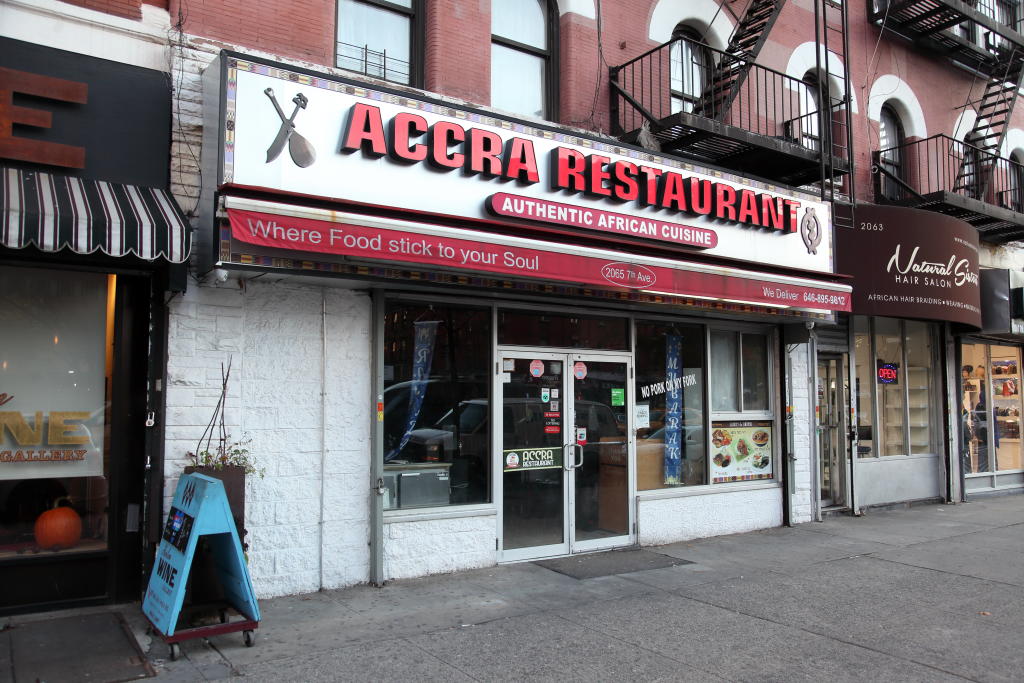
Accra Express gives Harlem’s Ghanaian cooking a direct, steam-table expression: jollof rice, iron-red stew, smoke, heat, and portions built for appetite rather than theatre. The low-price format and “Jollof Rice Champions” trophy matter because they place the room inside New York’s everyday West African food culture, where grain, chile, tomato, and long-cooked sauces carry the argument.

Pearl is the En Primeur Club membership app, where members save venues, book tables and use the concierge.
The menu
What to order
- Jollof rice with fried fish or chicken stew
- Waakye African-style rice and beans
- Fufu with thick Ghanaian soups and stews
- Suya meal with plantain or attiéké
- Lamb debbi
Walk into Accra Express and the cues arrive before the menu does: steam rising behind the counter, rice held in quantity, stew staining the serving pans a deep red. New York’s Ghanaian restaurants rarely trade in ceremony. The stronger places work through repetition, heat management, and the confidence of food made for regulars who know what jollof should taste like before the first spoonful lands.
That matters in Harlem, where the city’s African dining routes run alongside Dominican lunch counters, soul-food institutions, halal carts, and quick-service shops built around migration rather than trend. Accra Express belongs to the practical end of that map. The price tier is low, the format is direct, and the value is measured in plate weight, sauce depth, and whether the rice carries smoke instead of merely color.
Ghanaian jollof, judged by smoke, chile, and the grain itself
Jollof is never just rice in West African food culture. It is a national argument, a party dish, a family benchmark, and a test of how tomato, pepper, onion, oil, and stock settle into each grain. Ghana’s version tends to read darker and drier than some neighboring styles, with the rice expected to absorb the base rather than sit beneath it. At Accra Express, the house’s “Jollof Rice Champions” trophy up front is not a decorative boast; it signals the dish by which the room expects to be judged.
The plate described here is generous by design: more rice than a light eater is likely to finish, matched by an equal charge of iron-red stew. The point is not refinement in the tasting-menu sense. It is concentration. Smoke and heat do the work, and nothing in the format suggests the kitchen is trying to soften Ghanaian cooking for a generic New York audience.
Ingredient sourcing is not presented through farm names or chef narration here, but the cooking still tells a sourcing story. West African pantry logic depends on rice suited to absorption, chile with force, tomato cooked beyond brightness, and stews that can carry palm oil, onion, pepper, and protein without collapsing into sweetness. In a city where imported groceries and neighborhood demand shape immigrant restaurants as much as rent does, this kind of steam-table cooking is a reminder that sourcing often means access: the right rice, the right dried and fresh seasonings, and enough turnover to keep a tray alive.
That is why the no-frills format is part of the appeal rather than a caveat. Ghanaian food in New York does not need a linen tablecloth to make its case. It needs a counter that moves enough jollof, stew, and sides to keep the flavors assertive. The trophy gives a trust signal, but the deeper evidence is the confidence of the plate: smoke, heat, and scale.
Harlem's everyday African food culture, without performance
New York’s expensive dining rooms often turn provenance into theatre. At the city’s lower price tiers, provenance is more often embedded in the customer base, the pantry, and the dishes that survive because people keep ordering them. Accra Express sits in that second category. The room’s appeal comes from utility and specificity: Ghanaian cooking served quickly, in portions that make sense for lunch, dinner, and takeaway, with no need for a scripted origin story.
This is also where Harlem’s dining identity becomes more interesting than a simple uptown label. The neighborhood has long absorbed Black Atlantic foodways, from Southern cooking to Caribbean and West African kitchens. Ghanaian jollof adds another register to that conversation. Its smoke and chile do not mimic local comfort food; they sit beside it, giving the area a broader vocabulary of rice, stew, and heat.
For travelers mapping New York through food rather than landmarks, this is the kind of address that corrects the itinerary. The city’s restaurant culture is not only reservation books and chef counters. It is also the steam-table room where a single dish can carry national pride, neighborhood habit, and an argument about who makes jollof with authority. Accra Express earns attention because it keeps that argument plain.
Where it fits in a New York itinerary
This is a low-cost, casual stop, better understood as a focused Ghanaian meal than a long-form dining occasion. The address on East 125th Street puts it in the orbit of Harlem’s transit-heavy, daytime-and-evening food traffic, and the existence of another location suggests a format built for repeat use rather than destination ceremony. For a broader city plan, pair it with Our full New York City restaurants guide, then keep category research separate through Our full New York City hotels guide, Our full New York City bars guide, Our full New York City wineries guide, and Our full New York City experiences guide.
Readers building a wider EP Club food map can cross-reference other formats without treating them as direct peers: & Sons Ham Bar, 'inoteca, 1 or 8 (Sushi - Japanese), 12 Chairs (Israeli), and 15 East (Sushi - Japanese). Outside New York, useful contrast points in casual and specialist dining include Jōdo Saké Bar in Los Angeles, Onigiri Time in Pasadena, ¿Por Qué No? in Portland, 'Ai Love Nalo in Waimanalo Beach, 'āina in San Francisco, 'Ama 'Ama in Kapolei, -Grilled beef Sukiyaki- KAMAKURA TANUKIAN 鎌倉 たぬき庵 in Kamakura, and ¡Salud! in Los Angeles.
Frequently asked questions
Is Accra Express okay with children?
Yes. The $ price point and no-frills steam-table setup make Accra Express an easy fit for a family meal in New York City, especially at 63 East 125th Street.
What's the overall feel of Accra Express?
It feels like a direct, low-key Ghanaian steam-table spot rather than a formal dining room. The front-up trophy and the focus on jollof rice give it a clear point of view without any fuss.
Is Accra Express Michelin-listed?
Accra Express has received recognition including: “Jollof Rice Champions” reads the trophy up front at this no-frills steam-table joint. Whatever West African country you insist is the supreme arbiter of this dish, it’s hard to argue with the plain-spoken splendor of the Ghanaian version s….
What should I expect cuisine-wise at Accra Express?
Accra Express serves West African, Ghanaian cuisine.
What should I budget for a meal at Accra Express?
Pricing at Accra Express is listed as $.
Where do I go for Accra Express?
Accra Express is located in New York City.
What's the best way to book Accra Express?
Treat it as a walk-in stop. With a $ price point and a casual steam-table format, Accra Express in New York City is better approached as an informal meal than a reserved dining room.
Comparable Venues Nearby
Comparable venues nearby, for context on price, style, and recognition.
| Venue | Cuisine | Price | Notes |
|---|---|---|---|
| Accra ExpressThis venue (the venue you are viewing) | Ghanaian & West African Fast-Casual | $20–30 | Not listed |
| Chez Jacob | Authentic Senegalese | Not listed | Harlem (North) |
| Africa Kine | Senegalese | $20–30 | Harlem (North) |
| Xi'an Famous Foods 西安名吃 | Upper East Side 78th&2nd | Authentic Xi'an Chinese Noodles | $10–20 | Upper East Side-Lenox Hill-Roosevelt Island |
| Super Taste | Hand-Pulled Noodles | $10–20 | Chinatown-Two Bridges |
| Paulie Gee's Slice Shop | New York-Style Pizza Slices | $1–10 | Greenpoint |
Recognition history
Dated appearances from independent guides and award organizations, with the underlying list record or original source where available.
New York Times Best Restaurants in New York City #94
New York Times
Continue exploring
More in New York City
Restaurants in New York City
All restaurants in New York City →
Bars in New York City
All bars in New York City →







Details
- Lively
- Casual
- Cozy
- Solo
- Casual Hangout
- Group Dining
- Family
- Late Night
- Private Event
- Standalone
- Private Dining
- A La Carte
- Counter Dining
- Halal
A narrow, compact counter-service space with steam tables of stews, a casual neighborhood feel, and a busy, grab-and-go energy centered on hearty Ghanaian comfort food.