
Twelve miles south of Puerto Vallarta and reachable only by boat, Xinalani sits where Banderas Bay meets the jungle on Mexico's Pacific coast. Its 33 open-air guest rooms occupy palm-thatched cabins with three walls and sea-facing balconies, earning Michelin 3 Keys recognition in 2024. The resort draws yoga practitioners and outdoor-minded travellers who want deliberate disconnection from the connected world.
Pearl is the En Primeur Club membership app — saves, bookings, and concierge access live there. Same editors, same standards.
- Address
- Playa Xinalani, Quimixto, 48399 Puerto Vallarta, Jal Quimixto, 48399 Puerto Vallarta, Jal.
- Phone
- +52 322 221 5918
- Website
- xinalaniretreat.com
- Directions
- Get directions
 Saves & bookings on Pearl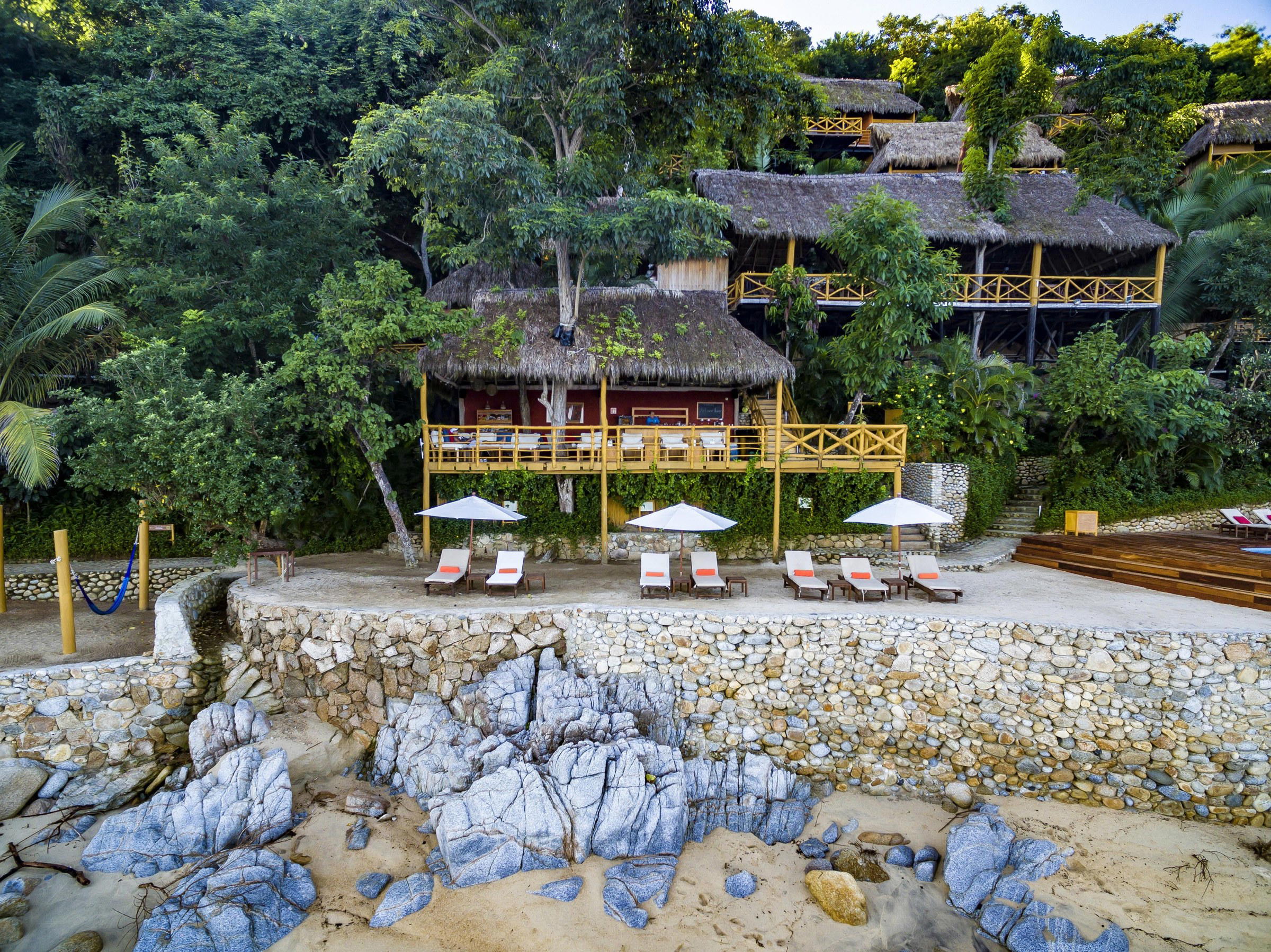
Where the Jungle Meets the Bay: Arriving at Xinalani
The boat ride is not an inconvenience, it is the point. Twelve miles south of Puerto Vallarta's hotel zone, the coast along Banderas Bay shifts from resort density to something close to its pre-development state: steep jungle ridgelines dropping directly to the water, small fishing communities with no road access, and an absence of the commercial infrastructure that defines the city proper. Xinalani sits at the end of that stretch, at Playa Xinalani in the village of Quimixto, and arriving by water rather than taxi immediately frames what the next few days will ask of you.
This structure of access, boat-only, no road, is not incidental to the resort's design philosophy. It is the design philosophy made physical. The decision to remain road-inaccessible keeps the property at a scale and pace that would collapse the moment a paved connection arrived. That choice also commits guests before they arrive: there is no popping out for supplies, no quick run back to town. The 33 rooms across Xinalani's hillside site are the consequence of that original decision.
Open-Air Architecture as a Structural Argument
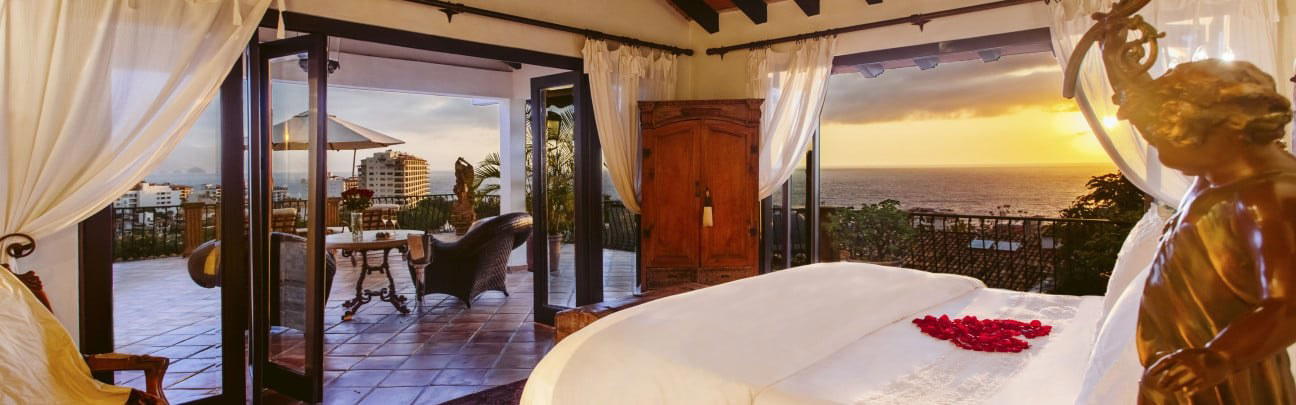
Mexico's Pacific coast has produced a recognisable design vernacular over the past three decades: palapa roofs, natural stone, indoor-outdoor transitions handled with large pivoting doors or retractable panels. What Xinalani does with that vocabulary is more committed than most. The standard guest rooms are not indoor-outdoor in the convention-centre sense of the phrase. They have three walls. The fourth side, typically the one facing the jungle canopy or the bay, opens without a door to close. A curtain is the only barrier, and the implication is that you will leave it open.
This is not a casual design decision. A three-walled room integrates the guest into the acoustic and atmospheric environment of the site: humidity, birdsong, the sound of the bay, the quality of air that changes between midday and three in the morning. Open-air showers in the standard rooms extend that logic. Artisan-made writing desks and private balconies with jungle-and-bay views situate the room at the intersection of craft and landscape rather than in the generic luxury tier of marble bathrooms and triple-glazed windows.
The casita suites push the concept further. Free-standing and private, they include details, pillow-leading beds, hammocks, silk mosquito netting, that acknowledge the environment without trying to seal the guest off from it. Silk netting against insects is a practical concession; it is also a material that belongs to the tropics in a way that synthetic alternatives do not. Hammocks on a private terrace facing Banderas Bay function differently than the same hammock beside a hotel pool. The bay in this context is not a backdrop. It is the primary view, and the architecture is arranged to maximise the hours you spend looking at it.
Michelin awarded Xinalani 3 Keys in 2024, placing it in company that includes properties operating at a different scale and price register. The Keys designation for hotels recognises a combination of accommodation quality, guest experience consistency, and setting, all three of which Xinalani addresses through its architectural choices rather than through amenity volume.
The Yoga Infrastructure and What It Actually Means for Non-Practitioners
Xinalani is understood primarily as a yoga retreat, and that categorisation is accurate enough to be useful for booking purposes. The property has four dedicated practice spaces: the Sand Terrace on the beach, a treehouse-like Jungle Studio refined into the canopy, a Meditation Cabin, and a Greenhouse. This is not a resort with a yoga mat in the corner of the fitness room. The programming infrastructure is genuine, and the design of each space reflects a specific relationship with the surrounding environment, the Jungle Studio's refined position, for instance, is not decoration but a functional decision about sound, air flow, and sightlines.
For guests with no interest in yoga, the infrastructure reads differently. Four purpose-built spaces for contemplative practice also mean four architectural set-pieces distributed across the property, each engaging with the site in a distinct way. The beach terrace orients toward the water; the treehouse studio orients toward the canopy. Exploring them as design objects rather than functional spaces is a reasonable use of an afternoon.
The spa offers massage treatments, and the property includes a shaman-led sweat lodge built into the rocky cliffs near the beach. The sweat lodge is a temazcal, a pre-Columbian tradition still practiced across Mexico; its integration into the cliff face rather than a purpose-built structure places it physically within the landscape in a way that a standalone building would not achieve. The beach club runs alongside these options for guests who want drinks, a swim, and nothing more structured than that.
Eating and the Rhythm of the Day
The waterfront restaurant serves a buffet breakfast described as bright and health-oriented, a natural fit for the guest profile and the open-air setting. Food and beverage details beyond breakfast are limited, but the resort's broader positioning in the low-impact, outdoor-immersive category is consistent with the Pacific coast tradition of fresh, local ingredients prepared with some restraint.
Absence of television, in-room tablets, and reliable wi-fi is part of the property's deliberate design. The property is telling you what it thinks your time is worth spending on, and it is making that argument with architecture rather than a welcome letter. A resort that installs a 65-inch screen and a high-speed fibre connection is making the opposite argument, and that argument is equally available at dozens of properties along this coastline and beyond it.
How Xinalani Sits Within Mexico's Pacific Coast Eco-Resort Category
Pacific coast of Mexico has developed a distinct sub-category of eco-resort that operates at low room counts, boat or four-wheel-drive access, and explicit environmental commitments. Playa Viva in Juluchuca and Las Alamandas in Costalegre occupy adjacent positions in this niche, each with low-key infrastructure and coastline settings that trade amenity density for landscape access. Xinalani's 33-room count places it within this cohort, though its yoga programming gives it a more defined audience profile than a general-use eco-lodge.
Against Mexico's broader luxury resort tier, One&Only; Mandarina in Riviera Nayarit, Four Seasons Resort Punta Mita, or Zadun, A Ritz-Carlton Reserve in Los Cabos, Xinalani is not competing on amenity breadth or fine-dining programming. It competes on specificity of experience and depth of environmental integration. Those are different value propositions, and guests who book one tier expecting the other will not be satisfied in either direction.
Comparable design-led eco-properties in other regions of Mexico include Cuixmala in La Huerta and Bruma Valle de Guadalupe in Ensenada, though the latter's wine-country positioning puts it in a different context. Among coastal wellness properties in the wider Mexican market, Palmaïa on the Riviera Maya and Etéreo, Auberge Resorts Collection target a similar wellness-oriented guest but with a higher amenity count and road access. Xinalani's boat-only model and open-air room architecture put it in a smaller, more committed niche.
Planning the Visit
Reaching Xinalani requires taking a water taxi from Puerto Vallarta's Boca de Tomatlán pier, the standard departure point for boat-accessible communities along the southern bay. The journey takes roughly 25 to 30 minutes depending on conditions. Guests should stock up on anything they need in Puerto Vallarta before departure, as the village of Quimixto has no commercial infrastructure to speak of. The property holds 33 rooms across its casita and cabin inventory; given the scale and the specificity of the experience, advance booking is advisable rather than optional. Michelin's 3 Keys recognition in 2024 provides formal external validation.
How It Stacks Up
Comparable venues nearby, for context on price, style, and recognition.
| Venue | Cuisine | Price | Awards | Notes |
|---|---|---|---|---|
| XinalaniThis venue — the venue you are viewing | Eco-chic wellness retreat perched on cliffs | $$$$ | Michelin 3 Key | Not listed |
| Four Seasons Resort Punta Mita | Traditional Mexican-style casitas with red-tiled roofs amid lush gardens against Pacific shores | $$$$ | Michelin 2 Key | Punta de Mita |
| Susurros del Corazón, Auberge Resorts Collection | Contemporary beachfront luxury resort with nature-inspired design integrating organic materials and Mexican artisan elements into a sophisticated coastal hideaway. | $$$$ | Michelin 2 Key | Punta de Mita |
| Las Alamandas | Secluded luxury beachfront estate with private beaches and expansive nature preserve | $$$$ | Michelin 2 Key | Costalegre |
| One&Only Palmilla, Los Cabos Resort | Historic luxury beachfront resort with casita-style accommodations | $$$$ | Michelin 2 Key | San José del Cabo |
| Zadun, A Ritz-Carlton Reserve | Mexican-inspired luxury beachfront resort | $$$$ | Michelin 2 Key | San José del Cabo |
Recognition history
Dated appearances from independent guides and award organizations, with the underlying list record or original source where available.
Michelin 3 Keys
Michelin
Michelin 3 Keys
Michelin
At a Glance
- Scenic
- Rustic
- Intimate
- Bohemian
- Wellness Retreat
- Romantic Getaway
- Honeymoon
- Beachfront
- Panoramic View
- Pool
- Spa
- Beach Access
- Restaurant
- Bar
- Massage
- Sauna
- Wi Fi
- Garden
- Waterfront
- Mountain
- Pool
- Spa
- Beach Access
- Restaurant
- Bar
- Massage
- Sauna
- Wi Fi
- Garden
Serene and natural with open-air spaces, ocean breezes, dramatic views, and a peaceful eco-friendly atmosphere.