

Titilaka occupies a solitary position on the grassy shoreline of Lake Titicaca, one of the world's highest and largest bodies of water. The 18-suite boutique property positions itself at the premium end of a route better known for backpacker lodges, with a design vocabulary rooted in earthy restraint and picture-window views across the deep blue lake. Arrival by private speedboat sets the tone for what follows.
Pearl is the En Primeur Club membership app — saves, bookings, and concierge access live there. Same editors, same standards.
- Address
- Tililaca, 37X7+5F Plateria s/n, Puno
- Phone
- +51 1 7005111
- Website
- titilaka.pe
- Directions
- Get directions
 Saves & bookings on Pearl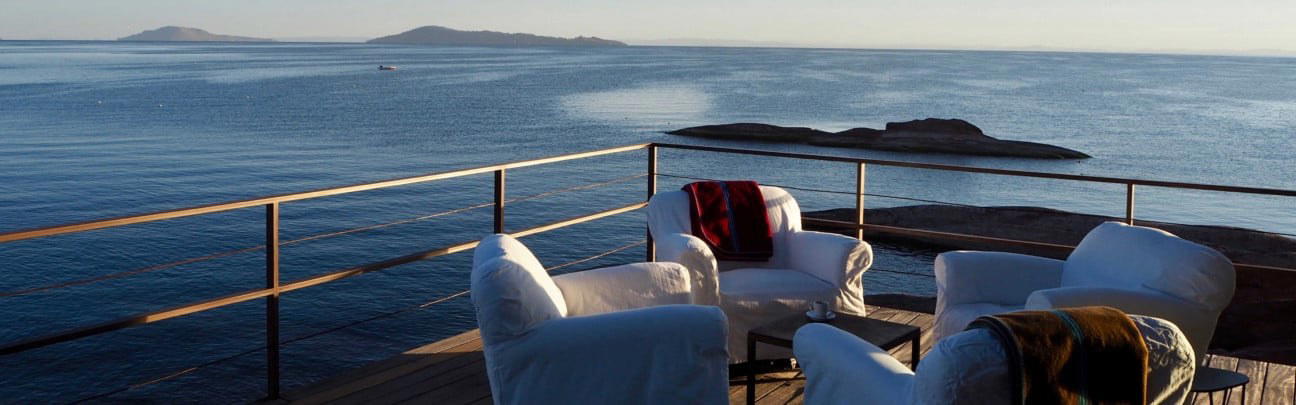
Where Sky, Water, and Stone Converge
Titilaka is a 5-star boutique hotel in Puno, Peru, with 2 Michelin Keys and 18 rooms, reached by private speedboat across Lake Titicaca, and the lodge appears as a solitary geometric form standing at the edge of a grassy peninsula, three storeys of clean lines set against a backdrop that shifts between deep blue water and the snow-edged silhouette of the Bolivian Cordillera Real. At 3,812 metres above sea level, the light behaves differently here: sharper in the afternoon, luminous at dawn, and at night so clear that the Milky Way reflects on the surface of the lake in a way that flattens the distinction between above and below. The architecture does not compete with any of this. It frames it.
That framing instinct defines the design logic throughout the property. Where properties at comparable altitude and remoteness in Peru, such as Palacio Nazarenas in Cusco, rely on colonial heritage and layered ornamentation to anchor a sense of place, Titilaka operates through restraint. The structure reads as a viewing instrument as much as a shelter, with picture windows in each of the 18 rooms oriented to capture the islands of Taquile and Amantani to the north and the full east-to-west sweep of the lake beyond. Earthy hues across the interiors, warm stone tones, muted textiles, echo the altiplano palette without pastiche.
The Architecture of Elevation
High-altitude boutique lodges occupy a specific design challenge: they must hold their own against geography that is, by any measure, overwhelming. The response at Titilaka is a three-storey structure that sits low against the horizon line rather than asserting height. Each room faces the water, a planning discipline that ensures the lake remains the primary visual experience regardless of which floor a guest occupies. Heated floors address the thermal reality of the altiplano without disrupting the spare interior aesthetic. Blackout curtains manage the high-altitude dawn, which arrives earlier and harder than at sea level.
The material choices read as locally inflected without being decoratively folkloric. Handcrafted bath products, oversized tubs, and high-end linens sit alongside an architecture whose simplicity resists the tendency toward Andean-themed decoration that affects many properties in the region. The lodge sits closer in spirit to properties like Amangiri in Canyon Point, where the design logic is built around geological context rather than cultural signifier, than it does to a heritage conversion. For lodges operating at altitude with small room counts and fully-inclusive formats, this restraint reads as a considered position in a competitive tier where design confidence often matters as much as amenity depth.
The boathouse at the northern tip of the peninsula extends the design thinking to the waterline: sailboats, kayaks, canoes, and paddleboards are held here, making the dock both a departure point and a physical declaration that the lake is the true centre of the property. For comparison, some of the region's other expedition-oriented properties, such as Delfin Amazon Cruises in Iquitos, build their spatial logic around movement through water rather than a fixed shore. Titilaka sits in both registers: it is a fixed place with a fixed address, but its meaningful axis is always outward toward the lake.
The Cuisine at Altitude
Peruvian cooking at altitude presents different ingredients, different textures, and different logic than the ceviche-led coastal canon that defines the country's international reputation. The Andean pantry runs to native potato varieties, quinoa, chuño (freeze-dried potato), and freshwater trout from the lake itself. Titilaka's kitchen, led by executive Chef María Fé Garcia, operates in this register, building a menu that draws on Andean ingredients while calibrating portion weight for guests acclimatising to altitude. This is a practical editorial point as much as an aesthetic one: heavy food at 3,812 metres is genuinely counterproductive, and the discipline of the kitchen approach reflects awareness of the physical context in which it operates.
All meals are included in the lodge's fully-inclusive model, which positions the dining experience as integral to the stay rather than as a separate commercial layer. Cocktail hour on the waterfront terrace is built into the daily rhythm of the lodge. The freshly caught trout that appears on the dinner menu arrives from water visible through the dining room windows, a provenance chain that requires no embellishment. For guests moving between properties on a Peruvian itinerary, the contrast with coastal kitchen logic at a property like Hotel Paracas, a Luxury Collection Resort, Paracas is instructive: two entirely different Peruvian ingredient vocabularies, separated by geography and altitude.
Lake Titicaca as the Programme
Lake Titicaca divides between Peru and Bolivia at an elevation that makes it the highest navigable lake on the planet, and one of the largest by surface area. The Inca regarded it as the point of human creation. The Aymara and Quechua communities that ring the shoreline still speak their languages as primary and maintain cosmologies centred on the lake, Spanish remains a second language in many of the surrounding villages. This is not scenic backdrop in the conventional resort sense. The cultural and historical density of the region is the primary attraction, and Titilaka's fully-inclusive programme of more than a dozen complimentary guided itineraries reflects a sober understanding of that fact.
The excursion range covers visits to Taquile and Amantani islands (including access to sections not open to general tourist traffic), birdwatching, mountain biking, archaeological site tours, millenarian hiking trails, market visits, weavers' homes, road trips, and excursions into Bolivia. All are led by bilingual local guides. For travellers comparing this model against other Peruvian luxury properties with integrated experience programmes, such as Inkaterra Machu Picchu Pueblo Hotel or Willka T'ika Essential Wellness in Urubamba, the distinction is that Titilaka's excursion access extends beyond Peruvian territory and includes private island access unavailable through standard tourist operators. The breadth of the programme also addresses the altitude acclimatisation curve: lower-intensity activities such as kayaking or a market visit are available for the first day, with more demanding hikes and altitude-exposed road trips suited to day two or beyond.
Planning Your Stay
Reaching Titilaka involves a deliberate sequence that begins, by design, before the lodge comes into view. From Juliaca airport or the Puno train station, a Land Rover meets arriving guests for the ninety-minute overland transfer to a private wharf, bypassing the density of Puno city entirely. From there, a thirty-minute speedboat crossing delivers guests directly to the lodge dock. The transfer is included in the stay and functions as an intentional decompression from the logistics of travel: by the time the boat tie-up at the northern dock, the property has already established its terms. Travellers arriving from Cusco can expect approximately five hours by road or rail. Those coming from Arequipa face around six hours by car. Arrival via Bolivia is also possible for guests building a cross-border itinerary.
For context within Peru's premium hotel tier, the lodge sits alongside properties at the intersection of expedition-oriented programming and boutique luxury, rather than in the urban five-star bracket that includes properties such as Crowne Plaza Lima by IHG in the capital. The fully-inclusive model simplifies budgeting: meals, guided excursions, use of all watercraft, and the Land Rover and speedboat transfers are built into the rate. Eighteen rooms and a single peninsula location mean availability is finite. Guests planning a broader Andean circuit should also consider Casa Andina Premium Arequipa as a staging point before or after the Puno leg, or connect to the Sacred Valley through properties such as Sumaq Machu Picchu Hotel in Aguas Calientes. Those building a wider Peru itinerary might also look at Refugio Amazonas Lodge in Puerto Maldonado for the jungle leg, or Hotel Kuelap in Utcubamba for the northern highlands. International routing connections are most relevant through properties like Aman New York or Cheval Blanc Paris for guests positioning Titilaka within a broader global itinerary at similar luxury tier.
Comparable Spots, Quickly
Comparable venues nearby, for context on price, style, and recognition.
| Venue | Cuisine | Price | Awards | Notes |
|---|---|---|---|---|
| TitilakaThis venue — the venue you are viewing | Contemporary luxury all-inclusive lakeside retreat | $$$$ | Michelin 2 Key | Not listed |
| Inkaterra La Casona | Restored 16th-century colonial manor with original architecture and Inca heritage. | $$$$ | Michelin 2 Key | Plaza de las Nazarenas |
| CIRQA | Historic former monastery revived as a luxury parador | $$$$ | Michelin 2 Key | Historical Center |
| Tambo del Inka, a Luxury Collection Resort & Spa | Contemporary luxury resort blending modern elegance with Andean heritage | $$$$ | Michelin 1 Key | Valle Sagrado |
| Inkaterra Hacienda Urubamba | Contemporary hacienda-style with colonial inspiration and local Peruvian craftsmanship | $$$$ | Michelin 2 Key | Urubamba |
| Palacio Nazarenas | 17th-century restored palace and convent with modern indulgence | $$$$ | World's 50 Best #87, 5-Star | near main square |
Recognition history
Dated appearances from independent guides and award organizations, with the underlying list record or original source where available.
Mr & Mrs Smith Smith Seal of Approval
Mr & Mrs Smith
Virtuoso Luxury Hotel Partner
Virtuoso
Michelin 2 Keys
Michelin
At a Glance
- Scenic
- Elegant
- Quiet
- Sophisticated
- Intimate
- Honeymoon
- Romantic Getaway
- Wellness Retreat
- Panoramic View
- Waterfront
- Spa
- Sauna
- Concierge
- Room Service
- Bar
- Restaurant
- Garden
- Waterfront
- Mountain
- Spa
- Sauna
- Concierge
- Room Service
- Bar
- Restaurant
- Garden
Serene and calming with real candles lit at night, relaxing music, panoramic lake views from every angle, and a peaceful tranquil atmosphere ideal for relaxation.