

Built in 1818 and awarded a Michelin Key in 2024 alongside 96 points from La Liste's Top Hotels ranking, Hotel de Russie occupies a quietly commanding position between the Spanish Steps and Piazza del Popolo. Its 0.7-acre garden, designed by Giuseppe Valadier, sets it apart from Rome's grander palazzo hotels. Rates from $1,864 per night across 122 rooms position it firmly in the city's top luxury tier.
A Garden Behind the Façade
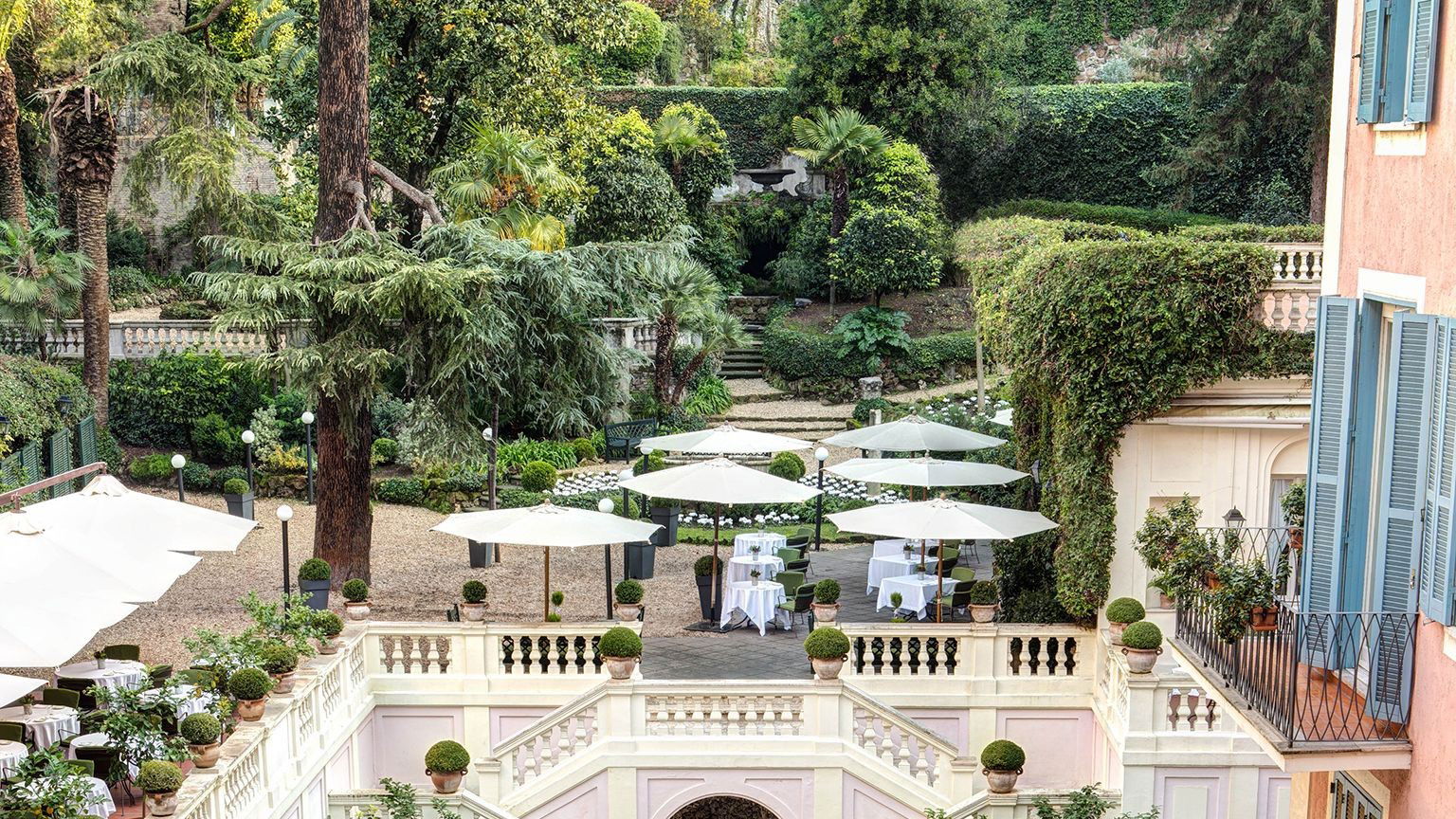
Rome's luxury hotel corridor along Via del Babuino runs from the Spanish Steps toward Piazza del Popolo, and the properties that line it range from grand international flagships to intimate design houses. Hotel de Russie sits inside this stretch with a deliberate restraint: its street-facing façade gives almost nothing away. That discretion is, in itself, a positioning statement. Where some properties in this tier announce themselves through imposing entrances and marble atria, the Russie's impact is displaced inward, concentrated entirely within its 0.7-acre garden.
That garden, designed by Giuseppe Valadier — the neoclassical architect responsible for the layout of Piazza del Popolo itself — is the hotel's primary architectural argument. Palm trees, citrus plants, and climbing roses occupy terraced levels that step up toward the Pincio hill, with views of Villa Borghese completing the frame. For a city as densely built as Rome, a garden of this scale in this location is a practical rarity. It functions as courtyard, dining terrace, and social space in one, and it defines the experience of staying here more than any interior detail. The hotel dates to 1818, though Rocco Forte Hotels took over the property in 2000 and repositioned it within their portfolio of European urban properties.
Where Hotel de Russie Sits in Rome's Luxury Tier
Rome's five-star market has expanded meaningfully over the past decade. Properties like Bulgari Hotel Roma, Hotel Vilòn, and JK Place Roma have introduced design-forward alternatives to the established institutional names. The Michelin Key program, launched in 2024, offers one useful cross-reference: Hotel de Russie holds a Michelin Key, placing it alongside properties including Hassler Roma and Hotel Eden in the city's formally recognised hotel tier. La Liste's 2026 Leading Hotels ranking awarded the property 96 points , a score that positions it at the upper end of the global list rather than merely the regional one.
Within the Rocco Forte portfolio, the Hotel de Russie occupies a different register from the group's more architectural newer properties. It is closer in character to an established grand hotel that has been edited rather than reinvented , rooms are modern and uncluttered without aggressively announcing a design concept. That approach suits Rome, where the city itself supplies sufficient visual material and where guests tend to use the hotel as a base and retreat rather than a destination in its own right. For properties in a more intimate mould, Hotel Locarno, Maalot Roma, and Portrait Roma occupy a smaller-footprint tier that draws a different kind of traveller.
The Garden as Editorial Lens: Local Setting, International Technique
The editorial angle that leading explains Hotel de Russie is not the building's history but the relationship between its specific Roman setting and the international hospitality grammar that Rocco Forte Hotels applies across their European properties. Valadier's garden is irreducibly local , its terracing follows the natural slope toward the Pincio, its planting uses species that have grown on this hillside for centuries, and its sightlines are calibrated to Rome's particular urban topography. The management layer placed over it is equally recognisable as a product of a British luxury group with properties from Florence to Edinburgh: consistent service standards, a particular attitude toward discretion, and interiors that read as cosmopolitan rather than specifically Italian.
This tension , between a site that is deeply embedded in Roman history and an operational approach that is deliberately international , is common to the better luxury hotels in European capitals. It works well here because the garden is strong enough to anchor the experience in place. Breakfast on the terrace with cornetti and espresso, or an evening aperitivo with views up to the Pincio, are experiences that could only happen in Rome. The delivery mechanism around them is Rocco Forte's , and it is a capable one. The hotel's 122 rooms and suites allow for a scale that supports full-service infrastructure without tipping into the anonymity that larger properties can produce.
Timing and Positioning in the City
The Via del Babuino address places Hotel de Russie within a short walk of two of Rome's most trafficked intersections: Piazza di Spagna to the south and Piazza del Popolo to the north. Both are demanding environments , crowded, loud, and hot for much of the year. The hotel's value proposition, at rates starting from $1,864 per night, is partly spatial: paying for the garden means paying for acoustic and visual separation from one of the city's noisiest corridors.
The practical argument for late spring through early autumn is direct: the garden is at its most functional during this period, breakfast outdoors is viable from April through October, and the evening light over the Pincio extends the terrace's utility well into dinner hours. Summer in Rome is intense , July and August bring heat that makes the shaded terraces actively useful rather than merely pleasant. Spring and September are the more balanced options, when temperatures sit in a range that makes the outdoor spaces comfortable throughout the day. Booking lead times for this period run longer, and the hotel's position near the Spanish Steps , a neighbourhood that attracts visitors year-round , means availability at prime dates should be treated as a planning constraint rather than an assumption.
Italy's Wider Luxury Hotel Context
Hotel de Russie belongs to a specific category of European urban grand hotel that balances historical credentials with contemporary operational standards. Comparable properties in Italy's premium tier include Four Seasons Hotel Firenze in Florence, which similarly uses a historic garden as a primary differentiator, and Aman Venice, where the relationship between a historic palazzo and a contemporary luxury operator defines the guest experience in a similar structural way. For travellers building a broader Italian itinerary, the contrast with rural properties , Castello di Reschio in Lisciano Niccone, Casa Maria Luigia in Modena, or Borgo Santandrea on the Amalfi Coast , is instructive. Urban properties in this tier trade the immersive range of a rural retreat for proximity and convenience, and Hotel de Russie represents that trade-off at a high level of execution.
Further afield in the Rocco Forte network, Portrait Milano offers an alternative urban format in a different Italian city. For travellers whose route extends beyond Italy, the same broad category of historically grounded urban luxury applies to properties like Aman New York and The Fifth Avenue Hotel, or at a very different scale and setting, Amangiri in Canyon Point. Other Italian options worth considering for Amalfi or southern itineraries include Il San Pietro di Positano and JK Place Capri. For Umbria, Corte della Maestà in Civita di Bagnoregio represents a very different register from the Rome urban tier.
For broader planning across the city, EP Club's full Rome hotels guide covers the range from boutique addresses to institutional names. Complementary resources include the Rome restaurants guide, the Rome bars guide, the Rome wineries guide, and the Rome experiences guide.
Practical Planning
Hotel de Russie operates 122 rooms and suites at Via del Babuino 9, between Piazza di Spagna and Piazza del Popolo in central Rome. Published rates start from $1,864 per night, placing the property in the upper bracket of Rome's luxury tier. The hotel holds a Michelin Key (awarded 2024) and a La Liste Leading Hotels score of 96 points (2026). Google reviewer ratings average 4.6 across 1,752 reviews, a signal of consistent execution at volume. The garden and outdoor terraces are the primary differentiator; stays from late April through October make the fullest use of them. The hotel is part of the Rocco Forte Hotels group.
Frequently Asked Questions
- Which room category should I book at Rocco Forte Hotel de Russie?
- The hotel's 122 rooms range from standard categories to suites, with rates beginning at $1,864 per night. The garden-facing rooms and suites provide direct connection to the Valadier-designed terraces, which are the property's primary spatial asset. Given the hotel's La Liste score of 96 points and its Michelin Key recognition, the upper room categories represent the clearest alignment between price and the experience the hotel is designed to deliver. If the garden terrace access and Pincio views are the reason you're choosing this address over other Michelin Key properties in Rome , such as Bulgari Hotel Roma or Hotel Eden , booking a room that faces the garden rather than the street makes the rate differential worth considering.
- What should I know about Rocco Forte Hotel de Russie before I go?
- The hotel's location on Via del Babuino, between the Spanish Steps and Piazza del Popolo, means it sits within one of Rome's most visited and most congested corridors. The surrounding neighbourhood is lively throughout the year. The property's ability to function as a calm base within that context depends significantly on the garden, which is the physical buffer between the street and the hotel's atmosphere. Rates from $1,864 per night reflect both location and the infrastructure required to maintain a 0.7-acre garden in central Rome. The Michelin Key and La Liste Leading Hotels recognition (96 points, 2026) confirm the property's standing in formal rankings, but the practical reason to choose it over smaller alternatives , such as Hotel Vilòn or Maalot Roma , is the garden scale, which those properties cannot replicate.
Cuisine and Recognition
A compact peer set to orient you in the local landscape.
| Venue | Cuisine | Awards | Notes |
|---|---|---|---|
| Rocco Forte Hotel de Russie | (2026) La Liste Top Hotels: 96pts; Price: $1,864 Rooms: 122 Rooms Built in 1818, the hotel is distinguished by its discreet façade, which conceals a magnificent 0.7-acre garden designed by Giuseppe Valadier — a lush oasis of palm trees, citrus plants, climbing roses, and glimpses of ancient ruins. In the distance, the view of the Pincio and Villa Borghese completes a cinematic tableau that makes every stay truly unforgettable. Once upon a time, on a sunny day, you might have spotted Pablo Picasso and Jean Cocteau plucking oranges from the garden and eating them on the spot. More than a century later, the Hotel de Russie remains a languid, enchanting retreat. You’re unlikely to find today’s Picassos and Cocteaus (more likely models or film stars) indulging with quite the same hedonism, but you may well catch them lounging in the library, leafing through the International Herald Tribune. Rome is famous for its energy — bumper to bumper traffic and hot, salty scents. Yet, though the Russie sits in the heart of the city — just across from the Spanish Steps and overlooking Piazza del Popolo — it remains a haven of calm. The screech of mopeds fades away, service is discreet, and the décor is understatedly elegant: modern, yet never ostentatious. The best time to stay is between late spring and early autumn, when you can enjoy breakfast on the patio — cornetti and milky espresso in the morning sun — and sip Prosecco on your terrace in the evening, listening to music drifting up softly from the piazza below.; (2024) Michelin 1 Key | This venue | |
| Bulgari Hotel Roma | Michelin 1 Key, World's 50 Best | Michelin 1 Key | |
| Rocco Forte Hotel De La Ville | Michelin 1 Key | Michelin 1 Key | |
| Singer Palace Hotel | Michelin 1 Key | Michelin 1 Key | |
| Six Senses Rome | Michelin 1 Key | Michelin 1 Key | |
| The St. Regis Rome | Michelin 1 Key | Michelin 1 Key |
Preferential Rates?
Our members enjoy concierge-led booking support and priority upgrades at the world's finest hotels.
Access the Concierge