




1 Michelin Key · La Liste Top Hotels · Mr & Mrs Smith Seal of Approval
Once the private residence of one of Bikaner's last Maharajas, Narendra Bhawan is now one of Rajasthan's most architecturally layered hotels — 82 rooms dressed in Art Deco lines, Portuguese tiles, English antiques, and locally crafted terrazzo, scoring 93.5 points in the La Liste Top Hotels 2026 ranking. At around $172 per night, it places the palace-hotel format within reach of a broader tier of heritage travel.

Pearl is the En Primeur Club membership app — saves, bookings, and concierge access live there. Same editors, same standards.
A Palace That Refuses to Be a Museum
Bikaner occupies an odd position in the Rajasthan circuit. It draws fewer visitors than Jaipur or Udaipur, yet it carries an equally layered history: a medieval city that once served as a critical node on the Silk Road, where merchant wealth and royal patronage produced architecture that has outlasted both. Several of its palaces have since been converted into hotels, a pattern common across Rajasthan, where the economics of heritage maintenance have made hospitality the most viable form of preservation. What differentiates those conversions is the degree to which the redesign allows the building to speak, rather than silencing it behind generic luxury finishes.
Narendra Bhawan sits at one end of that spectrum. The former residence of one of Bikaner's last Maharajas — who died without a male heir in 2003, effectively closing the city's royal lineage — was converted into an 82-room hotel under the MRS Hotels group. The design approach did not attempt to freeze the property in a single era. Instead, it assembled the interior the way a well-travelled collector might furnish a private house: Portuguese tiles alongside English antiques, velvet upholstery against locally crafted terrazzo floors, Art Deco structural logic layered with objects that suggest decades of acquisition rather than a single decorator's brief. The result reads less like a heritage hotel and more like a cabinet of curiosities that happens to have guestrooms.
The Architecture as Argument
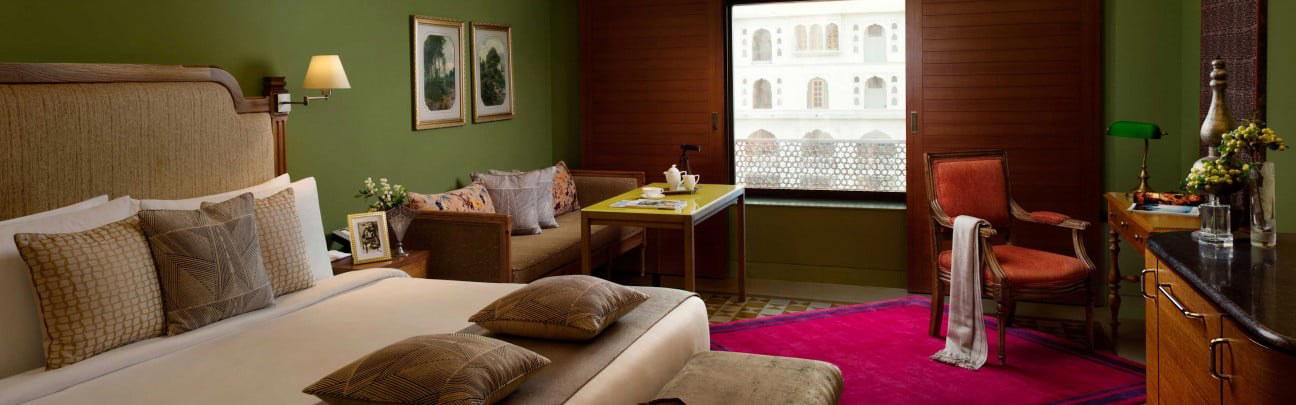
The palace-like facade sets expectations that the interior deliberately complicates. Where the exterior projects the formal geometry of an aristocratic residence, the rooms inside resist uniformity. Each of the 82 rooms is individually dressed, though all share a set of material commitments: king-sized beds, rare art objects, and what the property describes as lavishly appointed living arrangements. Many include soaking tubs and spacious living rooms furnished with vintage bar carts, a detail that signals the hotel's tonal register. This is not the white-glove solemnity of a grand colonial-era property like The Taj Mahal Palace, Mumbai or the structured serenity of The Oberoi Amarvilas in Agra. The atmosphere is closer to what La Liste described in its 2026 evaluation: eclectic, hedonistic, and easy-going.
That La Liste score, 93.5 points in the 2026 Leading Hotels ranking, places Narendra Bhawan in recognizable company without claiming a tier it does not occupy. La Liste's methodology weighs guest experience and culinary programming alongside design, which means the score reflects the full visit rather than architecture alone. For a property at roughly $172 per night, that positioning is notable: it suggests the hotel competes on editorial terms with larger-budget properties in the region, including design-led conversions like Alila Fort Bishangarh in Manoharpur, where the physical structure itself is the primary draw.
Ground Floor, Rooftop, and the Logic of the Day
The spatial sequence of the hotel follows a logic that encourages unhurried movement. The palace's ground-level parlors have been converted into a bar, a restaurant, and a pastry shop, three distinct food-and-drink anchors that distribute activity across the day without requiring guests to leave the property for anything. A foyer red piano with Edith Piaf lyrics painted across it functions as a kind of architectural joke: self-aware about the property's theatrical bent, but executed with enough confidence to land as charm rather than kitsch.
The rooftop carries different weight. An infinity pool positioned above the old city quarter offers a view of Bikaner that most visitors will not access from street level, the kind of vantage point that makes the city's medieval density legible in a way that walking through it does not. This matters in Bikaner particularly, where the old quarter's architecture repays aerial perspective. The rooftop also hosts massage treatments, with Bach Flower remedies incorporated into the program, a detail that places the wellness offer in a naturopathic rather than spa-industrial register.
In terms of how a day at Narendra Bhawan actually unfolds, La Liste's notes are more useful than a formal amenities list: lazy breakfasts extending into lazier lunches, dinners that end when guests retire rather than when the kitchen closes, carpet-shopping excursions into Bikaner with G&Ts; guaranteed on return. This describes a property calibrated for deceleration rather than activity scheduling, a different proposition from the structured excursion programs at properties like Aman-i-Khas in Ranthambore or Suján Jawai in Pali, where the surrounding landscape drives itinerary construction.
Bikaner in the Rajasthan Context
For travellers constructing a Rajasthan itinerary, Bikaner typically appears as an optional extension rather than a primary destination. That positioning is partly geographical, it sits northwest of the main circuit, further from Jaipur and Jodhpur than those cities are from each other, and partly a question of critical mass. Bikaner lacks the volume of fort-and-palace attractions that anchors Jaipur or the lake-based visual identity of Udaipur. What it has instead is a more concentrated character: a walled old city, a tradition of haveli architecture, a camel research station that draws specialists, and a reputation for distinct regional food, particularly its sweets and fried snacks.
For properties elsewhere in the region, the comparison set matters. The Leela Palace Jaipur and Amanbagh in Ajabgarh operate at higher price points and with more formal hospitality structures. Haveli Dharampura in Delhi offers a different model of heritage conversion, smaller, tighter, more explicitly focused on architectural preservation. Narendra Bhawan's 82 rooms place it at mid-scale for a heritage conversion, large enough to absorb group bookings but not so large that individual guests disappear into an institutional experience. The price point of around $172 per night is worth noting in that context: it sits comfortably below the upper tier of Rajasthan palace hotels while the La Liste score suggests the experience competes above that bracket.
For travellers extending beyond Rajasthan, the hotel connects naturally to a broader circuit of converted heritage properties across India. Chapslee in Shimla operates on a similar principle of intimate heritage conversion. Ananda in the Himalayas in Narendra Nagar takes a former maharaja's estate in a completely different programmatic direction. Both illustrate how widely the palace-conversion format varies in India once you move beyond the surface premise.
Planning a Stay
Narendra Bhawan is located at Samvit Shikshan Sansthan, Gandhi Colony, Samta Nagar, Bikaner, Rajasthan. Bikaner is served by its own airport, with connections from Delhi and Jaipur, and by rail on the main northwest Indian network, the overnight train from Delhi is the most practical option for travellers who prefer to arrive by land and use the journey time productively. Room rates start at around $172 per night, which for an 82-room property with this level of La Liste recognition represents a reasonable entry point for the tier. The hotel operates within the MRS Hotels group. Specific room availability, dining reservations, and booking terms should be confirmed directly with the property, as published rates and formats can change seasonally. Rajasthan's cooler months, October through February, represent the clearest window for visiting Bikaner, when the desert heat is manageable and the old city is at its most walkable. See our full Bikaner restaurants guide for dining context beyond the hotel's own food-and-drink program.
Comparable Spots, Quickly
Comparable venues nearby, for context on price, style, and recognition.
| Venue | Cuisine | Awards | Notes |
|---|---|---|---|
| Narendra Bhawan BikanerThis venue (the venue you are viewing) | Restored heritage palace with timeless royal elegance | 1 Michelin Key · La Liste Top Hotels | Not listed |
| Rajmahal Palace RAAS Jaipur | Heritage royal palace transformed into luxury boutique hotel | 1 Michelin Key · La Liste Top Hotels | Shivaji Nagar |
| Taj Mahal, New Delhi | Classic luxury heritage property with modern amenities | 1 Michelin Key · Virtuoso Luxury Hotel Partner | Lutyens' Delhi |
| The Oberoi Rajvilas | Traditional Rajasthani resort palace with landscaped gardens and reflection pools | 1 Michelin Key · La Liste Top Hotels | Goner Rd |
| The Johri, Jaipur | Restored 19th-century haveli blending Rajasthani heritage with contemporary luxury | 1 Michelin Key · World's 50 Best #94 | Johri Bazaar |
| Six Senses Vana | Wellness-oriented luxury resort harmoniously integrated with Himalayan nature | 1 Michelin Key · Mr & Mrs Smith Seal of Approval | Malsi |
Recognition history
Dated appearances from independent guides and award organizations, with the underlying list record or original source where available.
Michelin 1 Key
Michelin
La Liste Top Hotels
La Liste
Mr & Mrs Smith Seal of Approval
Mr & Mrs Smith
Conde Nast Gold List
Conde Nast
Small Luxury Hotels of the World Member
Small Luxury Hotels of the World
Full recognition history (6 entries)
Michelin 1 Key
Michelin
Details
- Elegant
- Sophisticated
- Ornate
- Romantic
- Scenic
- Honeymoon
- Romantic Getaway
- Anniversary
- Celebration
- Infinity Pool
- Historic Building
- Rooftop Pool
- Panoramic View
- Wi Fi
- Pool
- Spa
- Fitness Center
- Room Service
- Concierge
- Business Center
- Valet Parking
- Skyline
- Elevator
- Wheelchair Accessible
Luxurious and eclectic with rich velvet upholstery, antiques, Portuguese tiles, and a glamorous atmosphere enhanced by attentive service and curated dining.