Mount Falcon Country House Hotel

Michelin Selected
As Irish castles go, Mount Falcon is a relatively recent addition, dating back to the late nineteenth century. This means it’s not wedded to any specific historical details, though, which can be a strength. Imagine adding a range of detached self-catering lodges to a thousand-year-old castle, and the word “sacrilege” comes to mind. In Mount Falcon’s case it’s just a sensible expansion, and a new twist on the tradition of Irish country hospitality. The old house’s four original rooms and the two deluxe suites are classic in style and lack for no reasonable luxury, for decades Mount Falcon’s guests, a informed bunch, found them more than satisfactory to requirements. The expansion adds twenty-six superior rooms, which are stylistically quite continuous with those in the old house, and though newer, no less comfortable or attractive. On top of that, a number of one-, two- and three-bedroom lodges expand the offering beyond the traditional hotel paradigm. What they lose in old-castle romance they gain in privacy, residential atmosphere, and practical details (read: fireplaces). Of course the accommodations are only half the story. Once you’ve said everything there is to be said about the rooms, you still haven’t touched the grounds, the golf, the fishing, or the spa and it’s heated indoor pool, to say nothing of the kitchen, whose modern interpretations of traditional local ingredients show Irish cooking in its best possible light. How to get there: Mount Falcon is approximately a 30-minute drive from Ireland West Airport Knock (NOC), 3 hours from Dublin, and 1½ hours from Galway.

Pearl is the En Primeur Club membership app — saves, bookings, and concierge access live there. Same editors, same standards.
- Address
- Foxford Rd, Drumrevagh, Mount Falcon, Co. Mayo, F26 H744, Ireland
- Phone
- +353 96 74472
- Website
- mountfalcon.com
- Directions
- Get directions
A Victorian Estate on the Moy
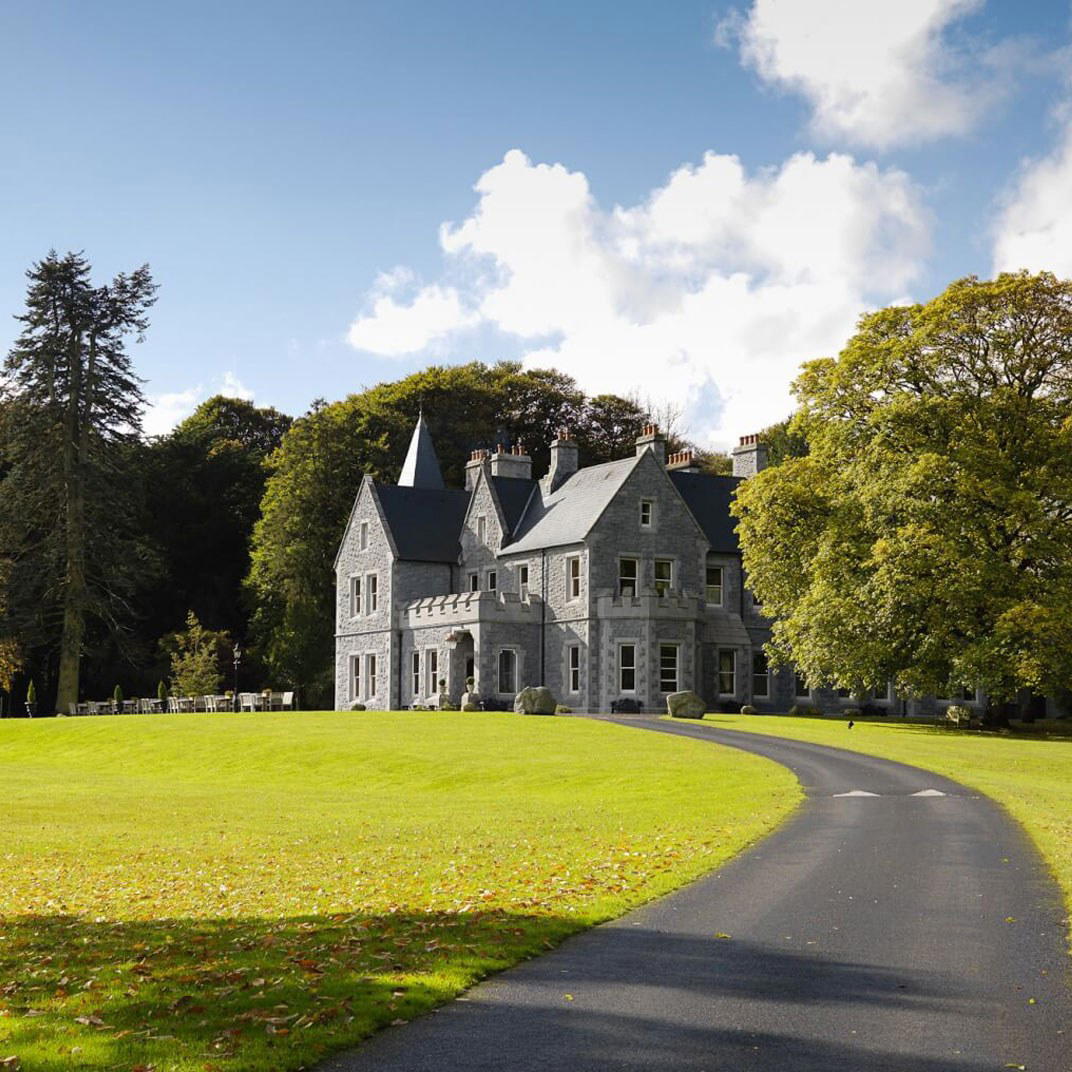
The approach to Mount Falcon along the Foxford Road sets a particular tone before you reach the door. A long avenue through mature woodland opens onto a grey-stone Victorian country house that sits with the self-assurance of a building that has never needed to announce itself. The architecture belongs to the castellated revival tradition that flourished in mid-nineteenth-century Ireland, when landowners commissioned houses designed to read as fortifications softened into domesticity: battlements above the roofline, deep-set windows, and stonework that weathers to a shade somewhere between graphite and cream depending on the light. It is a building type that Ireland produced in abundance, but Mount Falcon carries the form with particular conviction.
The house dates to the 1870s and its interior proportions reflect the ambitions of that era: high ceilings, broad corridors, fireplaces scaled for rooms that needed warming by solid fuel. Country house hotels across Ireland occupy a spectrum from full heritage-restoration projects to properties where the shell survives but the interiors have been updated to modern comfort standards. Mount Falcon sits at the more considered end of that spectrum, where period character and contemporary practicality are made to coexist rather than compete. The result is a property that reads as a house first and a hotel second, which is precisely what the Michelin Selected designation for 2025 suggests: a standard of quality and character that the guide applies to properties where the overall stay experience, not just the food operation, merits attention.
The Architecture as Argument
Irish country house architecture of the Victorian period drew heavily on the Gothic Revival and the Scots Baronial styles being codified by architects like William Burn and David Bryce. The battlements and corner towers that define Mount Falcon's silhouette are not defensive structures but architectural grammar, signals of a certain social aspiration rendered in local stone. Understanding that context matters when you arrive, because it reframes what might otherwise look like theatrical detail as something more grounded: a building that was always meant to sit in its landscape as though rooted there.
The grounds extend across a substantial estate, with the River Moy forming part of the boundary. The Moy is one of Ireland's principal salmon rivers, and fishing rights on this stretch have historically been among the more sought-after in the west. The relationship between the house and the river is not incidental: it shaped who came here, how long they stayed, and what the rhythm of the place felt like. That heritage gives Mount Falcon a functional identity that purely aesthetic country houses sometimes lack. The land is part of the architecture, and the architecture is part of the land in a way that requires some attention to read correctly.
Properties like Ballynahinch Castle in Recess and Glenlo Abbey Hotel and Estate in Galway operate on a similar model: substantial historic buildings, estate grounds, and a guest experience organized around the particularities of the west of Ireland. Dromoland Castle in Newmarket on Fergus and Kilkea Castle in Castledermot offer points of comparison in the castle-hotel format, though both operate at a different price register and with a more formal hospitality posture. Mount Falcon occupies a quieter position within this tier, which is part of what defines the experience.
Where It Sits in the County Mayo Picture
Ballina is the largest town in County Mayo and functions as a service hub for the northern part of the county. The Atlantic coast is within easy reach to the west, and the landscape around the Moy valley is lowland river country: wide skies, green fields cut by hedgerows, and the river itself running silver in most weather conditions. It is not the drama of Achill Island or the high moorland above Westport, but it has a particular calm that suits the country house format better than the more spectacular terrain to the south and west.
The western seaboard of Ireland has a concentrated number of properties in this category. Parknasilla Resort and Spa in Kerry and The Europe Hotel and Resort in Killarney draw on the Kerry landscape for their appeal; Gregans Castle Hotel in Ballyvaughan positions itself against the Burren. Mount Falcon's County Mayo setting is less marketed to international visitors than Kerry or Galway, which means the area operates at a lower ambient noise level in terms of tourism pressure. For travellers who have already covered the Ring of Kerry and the Connemara circuit, the Moy valley offers a different register. See our full County Mayo restaurants guide for context on eating and drinking in the wider area.
Among other Irish properties with Michelin recognition, design-led houses like Summerage in the Burren and Liss Ard Estate in Skibbereen demonstrate how the category has diversified: the country house model no longer defaults to period-room formality, but Mount Falcon's Victorian structure means it operates within a more traditional framework than either of those properties.
Planning Your Stay
Ballina sits roughly three hours by road from Dublin, making it a realistic two-night minimum destination rather than a weekend add-on to a city break. The town is on the Western Rail Corridor, though rail journey times from Dublin are longer than the drive. For guests combining Mount Falcon with a broader west-of-Ireland circuit, the property sits at a useful junction: Westport is forty minutes south, Sligo is an hour north, and the Wild Atlantic Way route is accessible in either direction.
For travellers building a longer Irish itinerary that takes in both the countryside and the cities, comparable Michelin Selected properties at different points of the compass include The Leinster in Dublin, Hotel Isaacs Cork, and No. 1 Pery Square in Limerick. Further afield in the Irish country house category, Ballymaloe House Hotel in Shanagarry and Marlfield House in Wexford represent the south and southeast. Cashel Palace in Cashel and Ballyvolane House in Castlelyons complete a reasonable survey of the category across the island. For those crossing into Connacht more broadly, The G Hotel Galway in Galway City represents the urban end of the western accommodation picture.
For international travellers calibrating Irish country house hotels against international benchmarks, the category occupies a different register than, say, Badrutt's Palace Hotel in St. Moritz or Hotel de Paris Monte-Carlo. The Irish model trades grand-hotel service architecture for house-scale intimacy: fewer staff ratios, more informal rhythms, and a physical environment that carries genuine history rather than period pastiche. Powerscourt Hotel, Autograph Collection in Enniskerry and The K Club in Straffan represent the resort end of Irish country hospitality, where facilities take precedence over atmosphere. Mount Falcon operates from the opposite premise.
At-a-Glance Comparison
Comparable venues nearby, for context on price, style, and recognition.
| Venue | Cuisine | Price | Awards | Notes |
|---|---|---|---|---|
| Mount Falcon Country House HotelThis venue — the venue you are viewing | Victorian Gothic country house estate with luxury lodges | Not listed | Michelin Selected | Not listed |
| Teach de Broc | Contemporary boutique hotel with elegant design and modern amenities, specifically curated for golf enthusiasts and leisure travelers. | $100–200 | Michelin Selected | Ballybunion |
| The Dean Galway | Design-led boutique hotel with Art Deco architecture and trendy curated decor | $100–200 | Michelin Selected | Galway City Centre |
| The Hawthorn By Galway Bay - A Virtuoso Preview Property | Contemporary luxury resort blending modern design with sustainable practices on golf course grounds | Not listed | Virtuoso Luxury Hotel Partner | Oranmore |
| Inchydoney Island Lodge and Spa | Contemporary luxury coastal retreat blending natural beauty with modern amenities. | Not listed | Michelin Selected | Inchydoney Island |
| Castle Dargan | Historic country estate blending 18th-century charm with modern comforts | $1–100 | Michelin Selected | Ballygawley |
Recognition history
Dated appearances from independent guides and award organizations, with the underlying list record or original source where available.
Michelin Selected
Michelin
Continue exploring
More in County Mayo
Hotels in County Mayo
Browse all →
Restaurants in County Mayo
Browse all →
Details
- Romantic
- Elegant
- Scenic
- Cozy
- Sophisticated
- Classic
- Romantic Getaway
- Family Vacation
- Weekend Escape
- Anniversary
- Historic Building
- Panoramic View
- Garden
- Pool
- Spa
- Wi Fi
- Room Service
- Concierge
- Restaurant
- Garden
- Mountain
Genuine old-style luxury with traditional charm, warm fireplaces, and relaxing atmosphere amid dramatic woodlands and river views.