



Forty-two courtyard houses threading through six centuries of hutong history, Mandarin Oriental Qianmen sits on the Beijing Central Axis — a UNESCO World Heritage corridor — and ranked No. 14 at The World's 50 Best Hotels 2025. The property holds a Forbes Travel Guide Five-Star rating for 2026 and won China's Best Hotel Spa at the 2025 World Spa Awards, placing it among Beijing's most credentialed small-scale luxury addresses.
 Discover on Pearl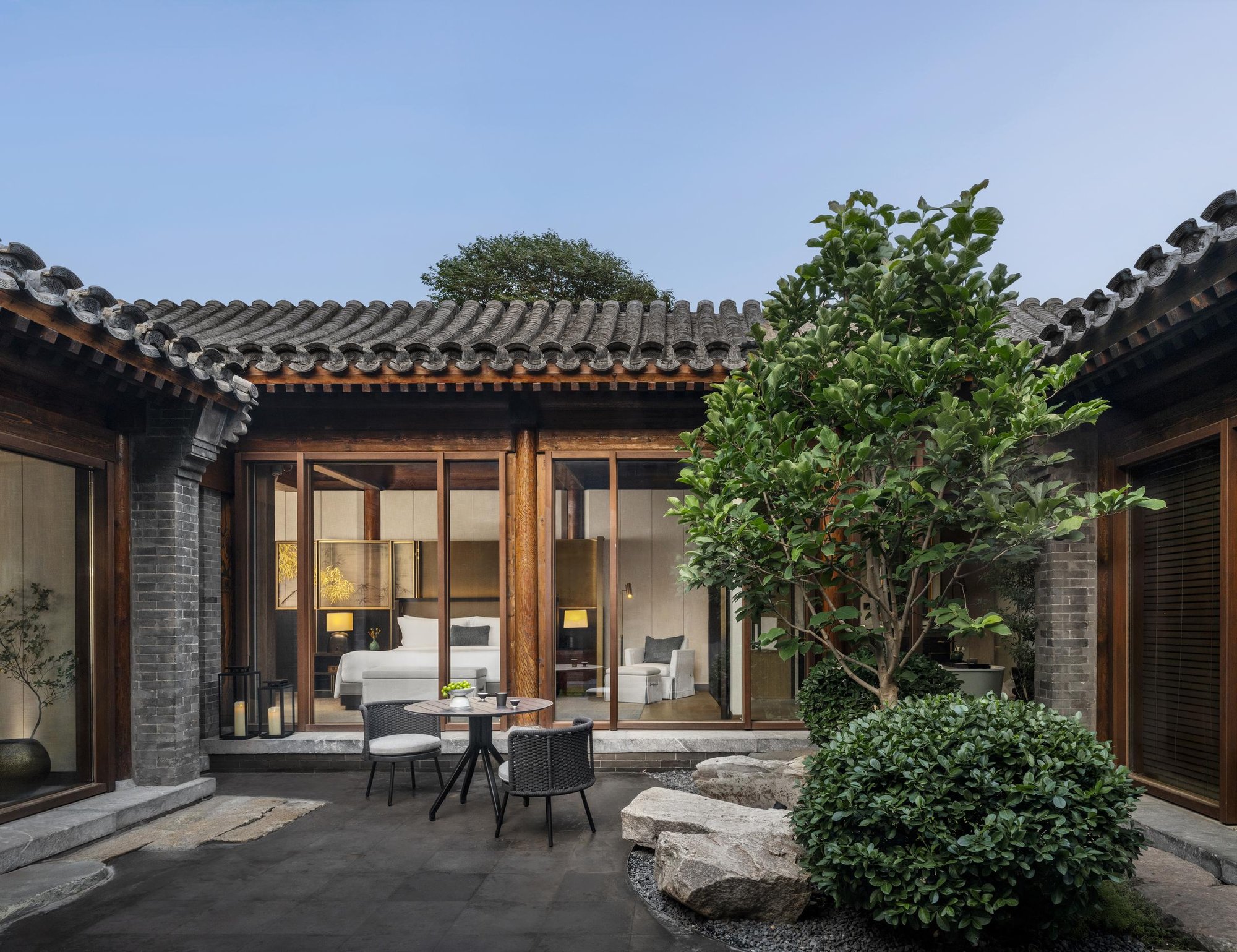
A Hotel That Lives Inside the City, Not Above It
The dominant model for luxury hotels in Beijing has long been the tower: glass-and-steel structures rising above the second ring road, offering skyline views in exchange for physical separation from street life. Mandarin Oriental Qianmen inverts that logic entirely. The property spreads horizontally across Caochang Hutong in Dongcheng District, occupying 42 discrete courtyard houses rather than a single unified building. You don't enter a lobby so much as step into a neighbourhood, then find your way to a gate, a courtyard, a room. The experience of arrival is closer to visiting a private residence in an old Beijing lane than checking into a hotel — which is, of course, the point.
That spatial logic places the property in a distinct competitive tier from Beijing's other flagship addresses. The Bvlgari Hotel Beijing, the Four Seasons Hotel Beijing, and the China World Summit Wing, Beijing all operate within the vertical, amenity-stacked format that defines international luxury in the city's central business districts. Mandarin Oriental Qianmen belongs to a smaller, architecturally differentiated cohort — properties where the structure itself is the primary experience rather than a container for it. For that comparison set, the closer references are Aman properties built into historic compounds, such as Aman Summer Palace in Beijing's northwest, or Amanfayun in Hangzhou, where the accommodation is distributed across a historic pilgrimage village.
The shortlist, unlocked.
Hard-to-book tables, cellar releases, and concierge-planned trips.
Get Exclusive Access →The Architecture of Caochang Hutong
The hutong surrounding the property dates back six centuries, and the courtyard houses within it retain the siheyuan model: four-sided enclosures built around a central open courtyard, originally designed for extended family life. At Mandarin Oriental Qianmen, these structures have been converted into guest suites while preserving the grey-brick facades, pitched rooflines, and spatial rhythm that define traditional Beijing residential architecture. The boundary between hotel and neighbourhood is deliberately blurred. Residences and small businesses occupy the same lanes; an increasing number of design boutiques and cafes have established themselves alongside the courtyards. Walking to your room may take you past a local resident's bicycle or a calligrapher working at an open window.
What this creates architecturally is a series of discrete micro-environments rather than a single designed interior. Each courtyard house has its own proportions, its own relationship to light at different times of day, and its own history. Several of the 42 structures were once the private residences of figures from Beijing's cultural and commercial history: Peking Opera artists including Li Hongchun, film director Guo Baochang, and the family behind the Tong Ren Tang traditional Chinese medicine brand. That provenance is woven into the physical fabric of the buildings rather than reduced to framed anecdotes in a corridor.
Scale, Density, and What 42 Rooms Means in Practice
Beijing's luxury hotel sector tends toward scale. Properties like the Fairmont Beijing Hotel and the Conrad Beijing operate across hundreds of rooms, with correspondingly dense programming and staffing. At 42 rooms spread across an entire hutong district, Mandarin Oriental Qianmen operates at a density closer to a private members' residence than a conventional hotel. That low key count directly shapes the guest experience: corridors don't fill with luggage trolleys; restaurants aren't competing with conference groups; the spa isn't booked out by corporate retreats.
Rated No. 14 at The World's 50 Best Hotels 2025 and awarded a Forbes Travel Guide Five-Star rating for 2026, the property has accumulated meaningful external validation in its early period of operation. It also appeared on the 2025 Hot List from both Condé Nast Traveler US and Condé Nast Traveller UK , a dual placement that reflects how the property has been received across different editorial markets. Rates begin at approximately $15,280 for a stay, positioning it at the upper end of Beijing's luxury accommodation market and pricing against peer properties where architectural singularity and restricted availability, rather than amenity volume, justify the rate.
Location on the Beijing Central Axis
The property's address on the Beijing Central Axis carries weight beyond its postcode. The Central Axis, a 7.8-kilometre north-south line running from Yongding Gate to the Drum Tower, was inscribed on UNESCO's World Heritage list as a defining element of imperial urban planning. The Qianmen area sits at the southern entry point of the Forbidden City zone, historically the transition between imperial precincts and the commercial city. That positioning means the property is within walking distance of Tiananmen Square, the Temple of Heaven, and the historic Qianmen shopping street, while also being embedded in one of the few hutong areas that has retained residential continuity rather than being converted wholesale into a tourist precinct.
For travellers comparing Beijing's premium options, location logic varies sharply by priority. The Eclat Beijing and the Four Seasons Hotel Beijing offer proximity to the city's central business district and embassy quarter. Mandarin Oriental Qianmen trades CBD convenience for direct access to the historic core. Guests whose primary interest is imperial Beijing , the axis sites, the hutong culture, the classical performing arts venues in Dongcheng , will find the location directly aligned with that agenda in a way that no tower hotel in the CBD can replicate.
Dining and Wellness Within the Compound
The food and beverage program follows the property's wider logic of contrast held in balance. High-end Cantonese and Italian restaurants operate alongside a hutong-style cocktail bar and the Maple Lounge, which focuses on tea service. That combination places the property in an interesting position relative to Beijing's dining scene: serious Chinese restaurant programming in a hutong setting is common enough, but the Italian offering and the cocktail bar suggest a property comfortable serving both local and international guests across different occasions. For a fuller picture of the city's dining options, see our full Beijing restaurants guide.
The wellness offering is more specifically positioned. The Spa at Mandarin Oriental Qianmen, Beijing won China's Leading Hotel Spa at the 2025 World Spa Awards. Alongside the spa and fitness center, the property operates a tea house and the Qiyuan Healing Space, which frames wellness through a traditional Chinese cosmological lens rather than the generic recovery-and-relaxation format of most hotel spas. This places the property's wellness programming in the same territory as properties like Amandayan in Lijiang, where the wellness offer is rooted in local tradition rather than imported from a global spa brand.
Planning a Stay
Given the property's profile , 42 rooms, early critical acclaim, and placement on multiple 2025 editorial hot lists , advance booking is advisable, particularly for travel between April and October when Beijing's climate and cultural calendar are at their most active. The Caochang Hutong address is in Dongcheng District, accessible by metro via the Qianmen station on Line 2. The property's distributed layout across multiple courtyard houses means that room selection matters more than at a conventional hotel; the character of each house differs, and communicating preferences at the time of booking will help secure a configuration suited to the length and purpose of the stay. For regional comparisons across China's premium hotel sector, the EP Club also covers properties including Xiamen Yunding Resort in Xiamen, 1 Hotel Haitang Bay, Sanya, and Altira Macau.
The shortlist, unlocked.
Hard-to-book tables, cellar releases, and concierge-planned trips.
Get Exclusive Access →Frequently Asked Questions
Side-by-Side Snapshot
A quick snapshot of similar venues for side-by-side context.
| Venue | Cuisine | Price | Awards | Notes |
|---|---|---|---|---|
| Mandarin Oriental Qianmen | World's 50 Best | This venue | ||
| Aman Summer Palace | ||||
| Bvlgari Hotel Beijing | ||||
| Conrad Beijing | ||||
| Fairmont Beijing Hotel | ||||
| Four Seasons Hotel Beijing |
Preferential Rates?
Our members enjoy concierge-led booking support and priority upgrades at the world's finest hotels.
Get Exclusive AccessThe shortlist, unlocked.
Hard-to-book tables, cellar releases, and concierge-planned trips.
Get Exclusive Access →