Khorfakkan Resort
Khorfakkan Resort belongs to a quieter UAE travel conversation: Sharjah’s east-coast corridor, where the Hajar Mountains meet the Gulf of Oman and scale matters as much as polish. With no public database details on rating, pricing, rooms, dining, or awards, it should be read through location first, then verified directly before travel.
Pearl is the En Primeur Club membership app — saves, bookings, and concierge access live there. Same editors, same standards.
- Address
- Khorfakkan, United Arab Emirates
 Saves & bookings on Pearl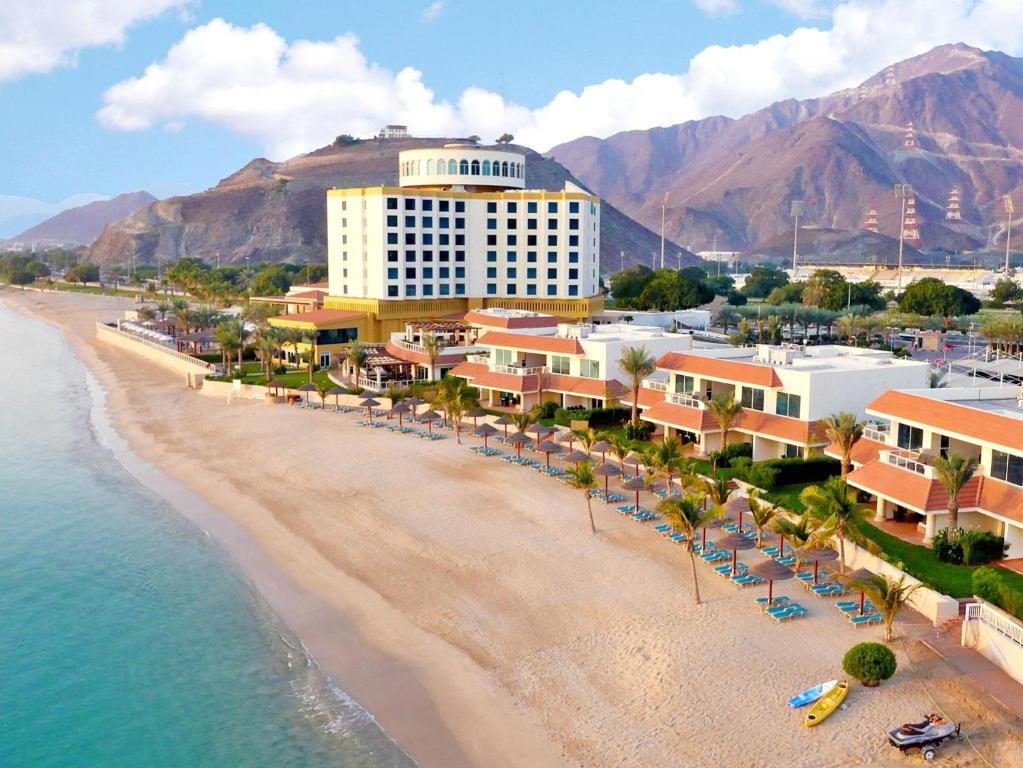
First read: coast, mountains, and a different UAE rhythm
Approaching Khorfakkan changes the usual UAE resort script. The visual language shifts from metropolitan skylines and engineered islands to a tighter composition of mountains, corniche, port activity, and the Gulf of Oman. The city sits on Sharjah’s east coast, separated from the country’s better-known western resort corridors by the Hajar Mountains, and that geography does much of the editorial work. Khorfakkan Resort is a 4-star hotel in Khorfakkan, United Arab Emirates, with 573 rooms and a recommended reservation policy. A stay here is not primarily about tower height, lobby theatre, or brand spectacle. It is about being in a coastal town where the mountains arrive close to the water and the pace is set by the road, the harbour, and the beach rather than a citywide hotel circuit.
That context matters because the available public record for Khorfakkan Resort is limited. No address, website, phone number, price range, restaurant information, chef, formal style category, or awards are listed. For an EP Club reader, that absence is not a minor footnote. It changes how the property should be assessed: as a location-led stay in Khorfakkan rather than a credential-led luxury hotel with a documented competitive profile. The editorial question is therefore not whether the resort can be ranked against Dubai’s polished urban palace hotels. The sharper question is whether Khorfakkan’s setting is the point of the trip.
In the UAE, coastal resort culture has split into several clear strands. Dubai and Abu Dhabi trade heavily on architecture, branded dining, beach clubs, and global hotel groups. Ras Al Khaimah and Fujairah draw more directly on mountain-and-sea geography. Sharjah’s east coast sits in a quieter lane, with Khorfakkan offering a town-scale alternative to the larger resort circuits. Khorfakkan Resort, by name and location, belongs to that second conversation: coastal UAE travel where the physical environment carries more weight than high-gloss urban programming.
Architecture and design: what can be said responsibly
That means no claim should be made about interiors, signature suites, lobby finishes, spa architecture, or beach-facing room layouts. Any page that describes marble, timber, private terraces, infinity pools, or named suites without verified source data would be filling gaps with fantasy.
What can be assessed is the architectural pressure created by the setting. In Khorfakkan, a resort has to answer a different brief from a city hotel in Dubai or a desert camp near Liwa. The site logic is coastal and vertical at once: sea on one side, mountain mass on the other, with the town and road network sitting between them. Good design in this corridor usually depends less on visual excess and more on orientation, shade, circulation, and how public and private spaces relate to the shore. In this part of the Emirates, a building that ignores the landscape quickly feels generic; one that frames it well can feel quietly convincing without needing theatrical interiors.
That is also where comparison helps. Atlantis The Royal in Dubai represents the city-resort model: architecture as skyline statement and hospitality as spectacle. Anantara Qasr al Sarab Desert Resort in Liwa Desert belongs to the desert-immersion model, where dunes dictate the guest experience. Fairmont Fujairah Beach Resort in Dibba sits closer in regional logic, using the UAE’s east-coast setting rather than western-city density. Khorfakkan Resort should be judged against that geography-led group, not against hotels whose main currency is metropolitan scale.
The Khorfakkan hotel context
Khorfakkan is not Dubai with fewer towers. It is a separate proposition: an east-coast port city within Sharjah, facing the Gulf of Oman and backed by the Hajar range. That gives the city a more contained travel rhythm, especially for guests using the stay as a base for coastal drives, mountain viewpoints, beaches, and Sharjah’s quieter side. The absence of supplied hotel-group information also matters. Without a listed operator, brand affiliation, or formal star rating, travellers should not assume the service structure associated with major international flags.
This is where the broader UAE comparison becomes useful. Mövenpick Resort Al Marjan Island in Ras al Khaimah belongs to an island-resort development pattern, with a clearly resort-driven destination context. Fairmont Ajman in Ajman sits in a city-beach lane on the western coast. Andaz by Hyatt – Palm Jumeirah in Palm Jumeirah reads through branded lifestyle hospitality and Dubai’s man-made island urbanism. Khorfakkan is different because the setting is less about built-up leisure infrastructure and more about a natural coastal frame.
Readers comparing destinations within the Emirates should use the local guide as the starting point, then widen the search to places where geography defines the stay. Al Badayer Retreat by Sharjah Collection in Sharjah points toward Sharjah’s desert side, while Khorfakkan points toward the emirate’s maritime edge. Telal Resort Al Ain in Al Ain shifts the reference again, toward inland heritage and desert space. The useful distinction is not luxury versus non-luxury; it is which landscape the hotel uses as its organising principle.
Dining, bars, and the limits of the record
That makes dining the section where restraint is especially necessary. It can only be placed within a city where meals are likely to be part of a broader coastal stay unless separate, verified restaurant details are confirmed.
For travellers who build trips around food, that distinction is practical. A resort without listed restaurant credentials may still serve guests well, but it should not be treated as a dining-led address without evidence. Khorfakkan’s appeal is better read through the day’s movement: beach time, mountain roads, a corniche walk, and local dining research. the city’s restaurants guide is the better place to compare meals, while the bars guide can clarify whether the drinking scene fits the kind of trip being planned.
The UAE comparison again sharpens the point. Dubai’s hotel restaurants often carry chef-name branding, global dining imports, and award-season visibility. Abu Dhabi and Ras Al Khaimah have their own resort-dining patterns, often tied to international hotel groups. Khorfakkan’s east-coast proposition is less obviously about culinary theatre. Until restaurant names, menus, chef details, prices, or awards are verified, the more credible editorial stance is to treat food and drink as research items rather than selling points. That is not a criticism. It is the difference between a destination chosen for its setting and one chosen for its restaurant roster.
Who should consider it
Khorfakkan Resort makes the clearest sense for travellers who want the UAE without defaulting to Dubai’s hotel grammar. If the trip is built around coast-and-mountain scenery, a quieter Sharjah base, and a less urban resort mood, the location has a strong case. If the priority is named restaurants, documented awards, suite categories, brand-managed service standards, or a clear price tier, the current record leaves too many blanks for a confident booking decision without direct verification.
That puts it in a useful middle space for trip planning. It may suit guests combining the east coast with other UAE settings: desert at Anantara Sir Bani Yas Island Al Yamm Villa Resort in Abu Dhabi, wildlife-oriented island stays at Anantara Sir Bani Yas Island Al Sahel Villa Resort in Sir Bani Yas Island, or a broader island-resort frame at Desert Islands Resort & Spa by Anantara in Al Dhafra. It also works as a contrast to a sharply branded coastal retreat such as Anantara Santorini Abu Dhabi Retreat in Ghantoot, where design identity is more explicit in the public positioning.
For travellers mapping the Emirates by terrain, the decision becomes clearer. Dubai gives density. Abu Dhabi gives cultural institutions, islands, and large-scale resort infrastructure. Liwa gives dunes. Al Ain gives inland heritage and oasis context. Khorfakkan gives an east-coast town between mountain and sea. That is the reason to place it on an itinerary.
Planning notes before confirming
Confirm the exact location, room categories, rate inclusions, cancellation terms, dining availability, family policies, beach or pool access, and transport arrangements before committing.
How far ahead to plan depends less on a published booking window, which is not provided, and more on the trip type. For a weekend or UAE public-holiday stay, start earlier because east-coast properties can become attractive alternatives when city hotels fill or prices move sharply. For midweek travel outside holiday periods, the planning pressure may be lower, but that should be checked against live availability. In Khorfakkan, timing also relates to season: the cooler months from late autumn through spring are generally more comfortable for outdoor coastal and mountain movement across the UAE, while summer heat changes the nature of daytime activity.
Transport deserves the same practical caution. No latitude, longitude, or address is supplied, so no exact distance or drive time should be stated here. Travellers should map the confirmed address from their arrival point rather than relying on general city references. Those building a wider itinerary can compare city categories through Our full Khorfakkan experiences guide and, for category completeness, Our full Khorfakkan wineries guide, though wine-focused travel in the UAE requires separate legal and venue-specific checking.
How it compares with design-led hotel travel elsewhere
Internationally, design-led hotels often declare themselves through architecture, heritage restoration, or a famous designer. The Fifth Avenue Hotel in New York City operates in a dense urban-historic register. Hôtel de Paris Monte-Carlo in Monte Carlo carries the weight of European grand-hotel tradition. Badrutt's Palace Hotel in St. Moritz is tied to Alpine resort history. Aman Venice in Venice and Cipriani, A Belmond Hotel, Venice in Venice sit inside a city where heritage, water, and arrival ritual shape the stay before service begins.
Those comparisons are not meant to place Khorfakkan in the same category; the record does not support that. They show how different hotels earn attention through different kinds of physical identity. Bvlgari Hotel Tokyo in Tokyo speaks through urban altitude and brand design. Mandarin Oriental Ritz, Madrid in Madrid speaks through historic capital-city hospitality. Khorfakkan’s potential strength is more elemental: the meeting of Gulf of Oman coastline and mountain edge. Until property-level details are verified, the setting remains the primary evidence.
Reputation & Price
Comparable venues nearby, for context on price, style, and recognition.
| Venue | Cuisine | Price | Awards | Notes |
|---|---|---|---|---|
| Khorfakkan ResortThis venue — the venue you are viewing | Not listed | $$$ | 4-Star | Not listed |
| LUX* Khorfakkan | Khorfakkan, Boutique-style luxury resort | $$$$ | 5-Star | Not listed |
| Jebel Hafeet | Not listed | $$$ | 4-Star | Jebel Hafeet, contemporary mountain resort |
| SUHA Hospitality | Not listed | $$$ | 4-Star | Al Mamzar, contemporary Arabic-style luxury serviced apartments |
| FORM Hotel Al Jaddaf, Dubai | Not listed | $$$ | 4-Star | Jaddaf, Contemporary urban hideaway with timeless feel |
| Jannah Executive Hotel Apartments | Not listed | $$$ | 4-Star | Al Zahiyah, Contemporary serviced apartments blending traditional charm with modern convenience |
Continue exploring
More in Khorfakkan
Hotels in Khorfakkan
Browse all →
At a Glance
- Scenic
- Elegant
- Modern
- Quiet
- Family Vacation
- Weekend Escape
- Group Retreat
- Romantic Getaway
- Beachfront
- Waterfront
- Destination Spa
- Panoramic View
- Wi Fi
- Pool
- Spa
- Fitness Center
- Room Service
- Concierge
- Business Center
- Beach Access
- Restaurant
- Airport Shuttle
- Waterfront
- Mountain
- Wi Fi
- Pool
- Spa
- Fitness Center
- Room Service
- Concierge
- Business Center
- Beach Access
- Restaurant
- Airport Shuttle
Bright, spacious, and resort-like, with a relaxed seaside atmosphere and scenic coastal views.