Anantara Sir Bani Yas Island Al Yamm Villa Resort


La Liste Top Hotels · World Travel Awards
Positioned among Abu Dhabi's island retreats rather than its city-centre towers, Anantara Sir Bani Yas Island Al Yamm Villa Resort earned 90 points in La Liste's 2026 Top Hotels ranking and won the 2025 World Travel Awards title for Abu Dhabi's Leading Hotel Villas. The address, on Sir Bani Yas Island in the Al Dhafra region, puts guests inside a wildlife reserve rather than on a hotel strip, making proximity to nature the primary proposition.

Pearl is the En Primeur Club membership app, where members save venues, book tables and use the concierge.
An Island Address That Changes the Premise
Most of Abu Dhabi's premium hotel market concentrates along the Corniche or on engineered islands close to the capital: the Four Seasons Hotel Abu Dhabi at Al Maryah Island, the Emirates Palace Mandarin Oriental, the Fairmont Bab Al Bahr, and the Conrad Abu Dhabi Etihad Towers all compete on skyline position, city access, and the scale of their facilities. Anantara Sir Bani Yas Island Al Yamm Villa Resort operates from a different set of premises entirely. Sir Bani Yas Island sits roughly 250 kilometres south-west of Abu Dhabi city in the Al Ruwais zone of the Al Dhafra region, and it is, first and foremost, a wildlife reserve. The hotel does not sit beside nature as a backdrop. It sits inside it.
That distinction matters more than it might sound. In a Gulf hospitality market that has spent two decades competing on architectural spectacle, imported marble, and F&B headcount, the Al Dhafra island model asks a different question: what does the address itself provide that no amount of interior design can replicate? At Sir Bani Yas, the answer is a former private reserve once developed under Sheikh Zayed bin Sultan Al Nahyan, converted into a conservation zone and opened incrementally to managed tourism. The wildlife here, including Arabian oryx, cheetah, hyena, and over 170 species of bird, is not a curated safari experience shipped in. It is the reason the island exists.
Where the Al Yamm Property Sits in the Island's Accommodation Tier
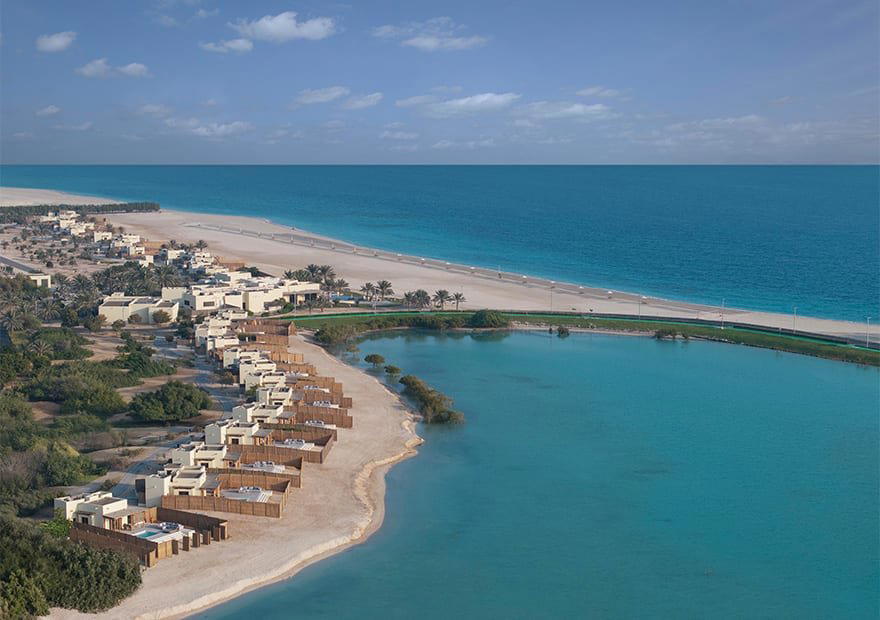
Sir Bani Yas hosts several Anantara properties, each calibrated to a different landscape and guest profile. The Al Yamm villas face the sea rather than the savannah interior, placing the resort in a coastal rather than a game-drive orientation. Villa formats have become the preferred delivery mechanism for premium island stays across the region, and Al Yamm fits that pattern: private pools, waterfront sightlines, and a degree of spatial separation that hotel-room formats cannot offer regardless of room size.
The 2025 World Travel Awards named Al Yamm as Abu Dhabi's Leading Hotel Villas, placing it ahead of city-side villa offerings in a market where villa product has expanded significantly in recent years. La Liste's 2026 Leading Hotels ranking, which assessed properties globally against a multi-source methodology, returned a score of 90 points. That score places the property inside a recognised international peer tier without requiring any Abu Dhabi hospitality context to understand. For comparison, La Liste's methodology draws on critic reviews, guest feedback, and culinary positioning simultaneously, so a 90-point return for a resort that is not primarily defined by its restaurant programme is notable.
Guests considering comparable nature-immersive formats elsewhere in the UAE might look at the Desert Islands Resort & Spa by Anantara, also on Sir Bani Yas, or at Al Wathba, a Luxury Collection Desert Resort & Spa for a desert-facing alternative closer to the capital. For deeper wilderness orientation, Anantara Qasr al Sarab Desert Resort in the Liwa Desert represents a different register of remoteness. Those seeking cultural immersion over wildlife access might consider Arabian Nights Village or ERTH Abu Dhabi Hotel.
The Logic of Remote Luxury in the UAE
The Abu Dhabi government's investment in Sir Bani Yas as a conservation and tourism asset reflects a broader pattern visible across Gulf hospitality: the move away from purely urban or beach-resort formats toward what the industry sometimes calls experiential remoteness. Properties like Amangiri in Canyon Point built that model in the American Southwest; Castello di Reschio in Lisciano Niccone applies it to European heritage landscapes. In the UAE, Sir Bani Yas is the most developed version of this proposition, with conservation credentials that precede its tourism development rather than being constructed around it.
What the Al Yamm address specifically provides, beyond the island's wildlife context, is coastal access in a setting where the Gulf's shallow blue-green water is visible from villa level without any built environment interrupting the sightline. This is not a view that most Abu Dhabi hotel addresses can offer. Properties in the capital face either the city's own skyline or the Corniche's managed waterfront. The difference in spatial experience between that setting and open water with no urban context is significant for guests whose primary purpose is decompression rather than city programming.
Other Anantara properties in the region offer their own geographic arguments: Anantara Mina Ras Al Khaimah Resort pairs beachfront position with mountain proximity; Anantara Santorini Abu Dhabi Retreat in Ghantoot imports an Aegean architectural vocabulary to the UAE coastline. The group's UAE portfolio covers several distinct terrain types, and Al Yamm's wildlife-island position is among the more differentiated within that set.
Planning the Stay
Sir Bani Yas Island is accessible by ferry from Jebel Dhanna on the mainland, or by light aircraft via a short scheduled service. The island's relative remove from Abu Dhabi city, roughly a two-hour drive to the ferry terminal before the crossing, makes it a stay of substance rather than a night stop. The keyword search data for this property shows consistent year-round interest without pronounced seasonal peaks, though Gulf travel broadly concentrates in the October to April window when temperatures are compatible with outdoor wildlife activity. Arriving in that cooler period opens access to guided game drives, kayaking, and the island's walking and cycling tracks at a level that the summer months do not permit.
Booking is handled through Anantara's central reservations infrastructure. Guests comparing regional villa-format stays might also review Andaz Capital Gate Abu Dhabi for a city-side alternative, or look at the Fairmont Ajman for beachfront format across the emirate boundary. For broader Abu Dhabi context, EP Club's full Abu Dhabi restaurants and hotels guide maps the city's hospitality across neighbourhoods and price tiers.
Those whose interest in remote luxury extends beyond the UAE might consider Al Badayer Retreat by Sharjah Collection for a dune-desert format, or look further afield to Jebel Hafeet in Al Ain for mountain-edge positioning. International references in the low-intervention, nature-immersive tier include Aman Venice and Badrutt's Palace Hotel in St. Moritz, both of which demonstrate how address specificity can substitute for conventional hotel-scale amenities at the premium end of the market.
The Essentials
Comparable venues nearby, for context on price, style, and recognition.
| Venue | Price | Awards | Notes |
|---|---|---|---|
| Anantara Sir Bani Yas Island Al Yamm Villa ResortThis venue (the venue you are viewing) | Not listed | La Liste Top Hotels · World Travel Awards | Not listed |
| Shangri-La, Qaryat Al Beri, Abu Dhabi | $100–200 | Michelin Selected · Forbes 4-Star | Al Maqtaa, Luxury beachfront resort in Venetian-inspired complex |
| Andaz Capital Gate Abu Dhabi | $100–200 | Michelin Selected · World Luxury Hotel Awards WLHA Continent Winner | Al Safarat, luxury lifestyle hotel in architectural marvel Capital Gate |
| The St. Regis Abu Dhabi | $750–1,000 | La Liste Top Hotels · Forbes 5-Star | Al Khubeirah, Contemporary luxury resort blending authentic Arabian hospitality with over a century of St. Regis bespoke service tradition. |
| W Abu Dhabi - Yas Island | Not listed | Michelin Selected | Yas Island, Futuristic luxury hotel inspired by Arabian traditions and desert landscapes |
| The Ritz-Carlton Abu Dhabi, Grand Canal | $300–500 | Michelin Selected · Forbes Recommended | Al Rawdah, Luxury waterfront resort inspired by Renaissance architecture with Arabian influences |
Recognition history
Dated appearances from independent guides and award organizations, with the underlying list record or original source where available.
La Liste Top Hotels
La Liste
World Travel Awards
World Travel Awards
Continue exploring
More in Abu Dhabi
Hotels in Abu Dhabi
All hotels in Abu Dhabi →
Restaurants in Abu Dhabi
All restaurants in Abu Dhabi →
Details
- Quiet
- Elegant
- Scenic
- Intimate
- Sophisticated
- Ornate
- Honeymoon
- Romantic Getaway
- Wellness Retreat
- Anniversary
- Weekend Escape
- Beachfront
- Private Villa
- Infinity Pool
- Destination Spa
- Panoramic View
- Pool
- Spa
- Fitness Center
- Room Service
- Concierge
- Wi Fi
- Private Beach
- Tennis Court
- Bicycle Rental
- Waterfront
- Wheelchair Accessible
- Step Free Entrance
Tranquil and serene beachfront atmosphere with rustic elegance, natural earth tones, and sophisticated modern amenities evoking peaceful luxury.