
A 17th-century Maqfia harem-palace in Fès's Andalous Quarter, Karawan Riad operates across seven suites at approximately $350 per night. A decade of considered renovation has brought underfloor heating, Italian rain showers, and a French-Fassi dining programme into a property defined by carved plaster, zellije tilework, and private terrace access — without erasing the palatial gravity that makes the address meaningful.
 Discover on Pearl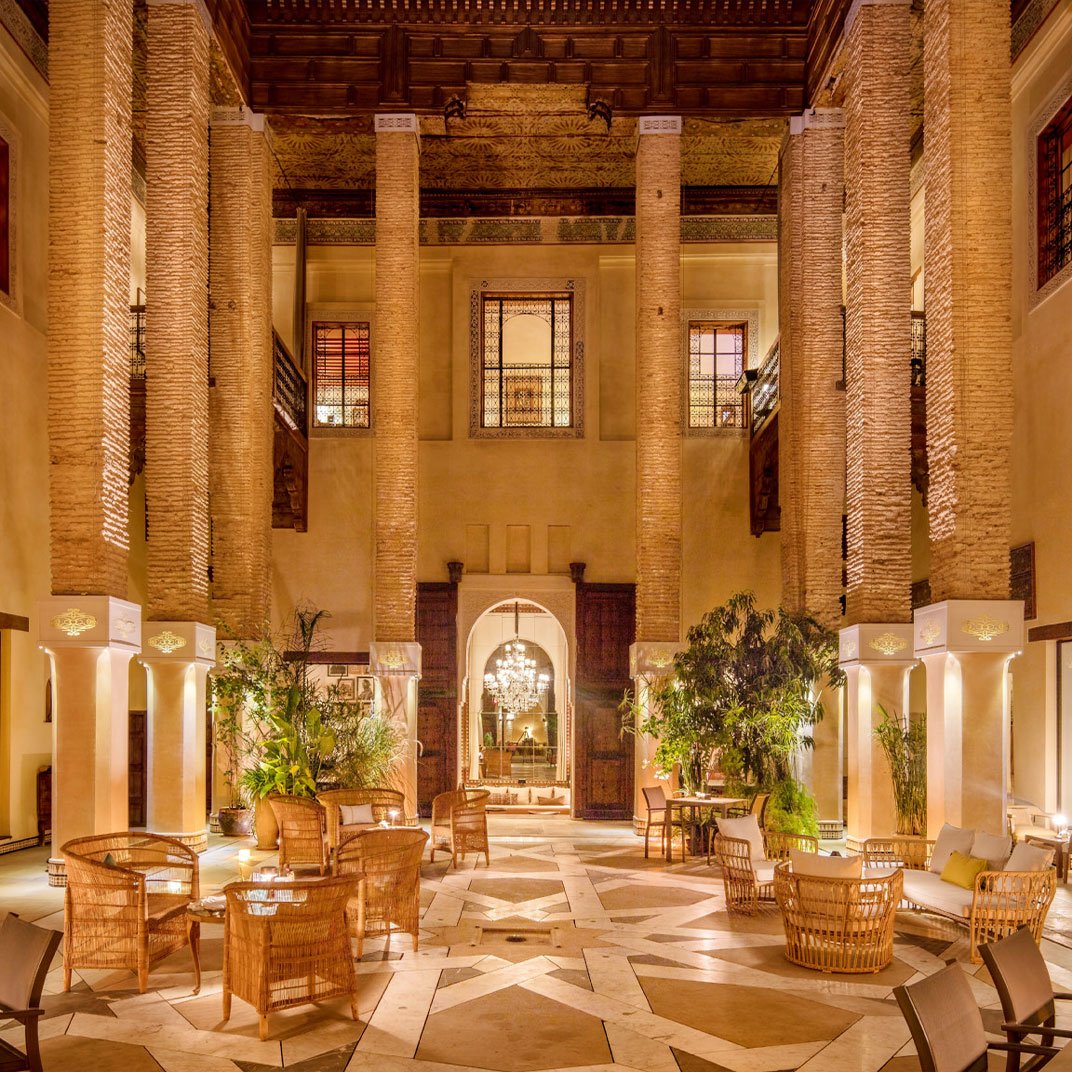
A Palace Tradition, Reconsidered
Fès holds a particular authority among Morocco's medina cities: it invented the riad formula, refined it over centuries, and now hosts a competitive field of properties ranging from entry-level guesthouses to serious heritage restorations. At the premium end of that field, the distinction between a well-appointed renovation and a genuinely considered one becomes apparent quickly. Karawan Riad, occupying a 17th-century Maqfia harem-palace in the Andalous Quarter, sits in the latter category — a property where the original architecture is neither museumified nor overwhelmed by contemporary intervention, but used as the load-bearing structure for something that reads as both historical and operational.
The Andalous Quarter location is not incidental. Fès el-Bali's tourist density concentrates around the tanneries and the main souks of the Quaraouiyine side; this quarter offers a degree of separation that changes how the medina reads at street level. Arrivals who have run the gauntlet of Bab Boujloud find a different pace here — narrower derbs, fewer guided groups, and the kind of ambient silence that lets the architecture register properly. For context on Fès's wider accommodation range, see our full Fès restaurants and hotels guide.
The shortlist, unlocked.
Hard-to-book tables, cellar releases, and concierge-planned trips.
Get Exclusive Access →The Rooms: Seven Suites, Graduated by Privacy
Seven suites is a deliberate constraint. At that count, the property functions closer to a private residence than a hotel , occupancy is visible, service ratios are workable, and the communal spaces never feel contested. The open-plan layouts move through their volumes at a pace that larger rooms rarely afford, typically resolving into private terraces rather than shared balconies. Materials throughout , carved plaster wall treatments, zellije tilework flooring, silk brocade, damask cushions, hand-painted calligraphy , are applied with an eye for placement rather than density. Mirrors are positioned to pull in North African light without transmitting heat, which is a practical consideration that doubles as a design discipline.
Infrastructure has been brought into the 21st century without announcement: underfloor heating, Italian rain showers, black marble bathrooms with stone vessel sinks, Les Sens de Marrakech bath products, complimentary wi-fi, and sound-system docking stations occupy the same rooms as wrought-iron filigree window frames and cedar writing nooks. That coexistence is the result of a decade of renovations , not a single makeover, but an iterative process that suggests proprietors willing to keep returning to the problem. The rooftop suite resolves the hierarchy: a rose-bedecked terrace, a vertical garden, and an embedded bathtub give it a privacy and elevation that the other suites, excellent as they are, do not replicate.
At approximately $350 per night, Karawan Riad prices above entry-level medina riads and in line with the serious heritage tier in Fès , a bracket that includes Riad Fès and Riad Laaroussa. The Fes Marriott Jnan Palace operates on a different model entirely , larger keys, full international-brand infrastructure, a different competitive set. Karawan Riad's peer group is the design-led, low-key-count restoration category, where the room itself is the primary argument.
The Dining Programme: French-Fassi Cooking in a Stone Courtyard
The editorial angle at Karawan Riad, given its physical setting, is the dining programme and how it extends the property's spatial logic into the kitchen. Morocco's medina cities have a culinary identity rooted in long-cooked braises, preserved lemons, argan oil, and the kind of spice layering that takes years to calibrate. Fès, specifically, has a culinary tradition , Fassi cuisine , regarded within Morocco as the country's most refined, with a particular emphasis on seafood preparations that arrive from the Atlantic coast via established trade routes.
The restaurant here works in that tradition while drawing on French culinary technique, a combination that characterises a strand of Moroccan fine dining that has been operating in medina properties for several decades. French-Fassi cooking, at its most considered, uses classical French structure , sauce construction, protein timing, plating discipline , as a frame for Moroccan spice profiles and local sourcing priorities. The result is a register that reads legibly to European palates without flattening the distinctiveness of the source cuisine. The seafood preparations at Karawan Riad are foregrounded in the kitchen's identity, which aligns with Fassi culinary tradition rather than working against it.
Physical setting for dining is the stone courtyard , a commanding space criss-crossed with minuscule water conduits, with a step-down lounge and tea rooms stocked with Mariage Frères products. Eating here, the architecture does the atmospheric work without requiring theatrical supplementation. The hammam and treatment salons sit within the same circuit of keyhole arches and vaulted passageways, making it possible to move from dinner through to a proper hammam without re-entering the medina streets.
Morocco's Premium Riad Tier in Context
Karawan Riad's closest comparison points are not the large Moroccan resort hotels , La Mamounia in Marrakesh, for instance, operates at a different scale and international profile , but the smaller, design-focused heritage properties that have emerged across Morocco's historic cities over the past two decades. Properties like Jnane Tamsna in Marrakech, Dar Ahlam in Ouarzazate, or Dar Maya in Essaouira represent the same design-led, low-capacity restoration approach across different Moroccan cities and typologies. Hotel Sahrai in Fès takes a more contemporary architectural position on the hillside above the medina; its sibling listing confirms the property's SLH affiliation and the broader appetite for design-conscious Fès accommodation. Karawan Riad sits within the medina itself, which changes the nature of the proposition: guests are inside the fabric of the city, not positioned above or adjacent to it.
Internationally, the appetite for small-count heritage properties has produced comparable formats , Aman Venice represents the European extreme of the palazzo-as-private-residence model , but the economics and guest experience differ significantly from a seven-suite riad in North Africa. The comparison is useful for understanding what the format promises rather than what it delivers in identical terms.
Planning Your Stay
Reaching Karawan Riad means arriving at Fès-Saïss Airport, approximately 15 kilometres from the medina, then making the transfer into Fès el-Bali by taxi or pre-arranged transfer. Luggage handling in the medina requires porters or donkeys on the narrower derbs; the property address at 21 Derb Ourbia Makhfiya is navigable with advance coordination. Booking should be made directly or through a reputable travel agent given that no website or phone number is listed in current records , email contact through aggregator platforms is the most reliable current route. Seven rooms means availability narrows quickly in peak medina season, which runs through spring and autumn; summer heat in the medina is a practical consideration that the property's underfloor heating and rain showers address for the colder months. Guests exploring Morocco's wider hotel range can compare against Banyan Tree Tamouda Bay, Fairmont Tazi Palace Tangier, Michlifen Resort & Golf in Ifrane, Hyatt Regency Casablanca, Fairmont La Marina Rabat Salé, Kasbah Tamadot in Asni, La Fiermontina Ocean in Larache, La Sultana Oualidia, Rabat Marriott Hotel, Hilton Taghazout Bay, Dar al Hossoun in Taroudant, and Château Roslane across the country's varied accommodation tiers.
The shortlist, unlocked.
Hard-to-book tables, cellar releases, and concierge-planned trips.
Get Exclusive Access →Frequently Asked Questions
Budget and Context
These are the closest comparables we have in our database for quick context.
| Venue | Price | Awards | Notes |
|---|---|---|---|
| Karawan Riad | This venue | ||
| Riad Fès | |||
| Fes Marriott Jnan Palace | |||
| Riad Laaroussa |
Preferential Rates?
Our members enjoy concierge-led booking support and priority upgrades at the world's finest hotels.
Get Exclusive AccessThe shortlist, unlocked.
Hard-to-book tables, cellar releases, and concierge-planned trips.
Get Exclusive Access →