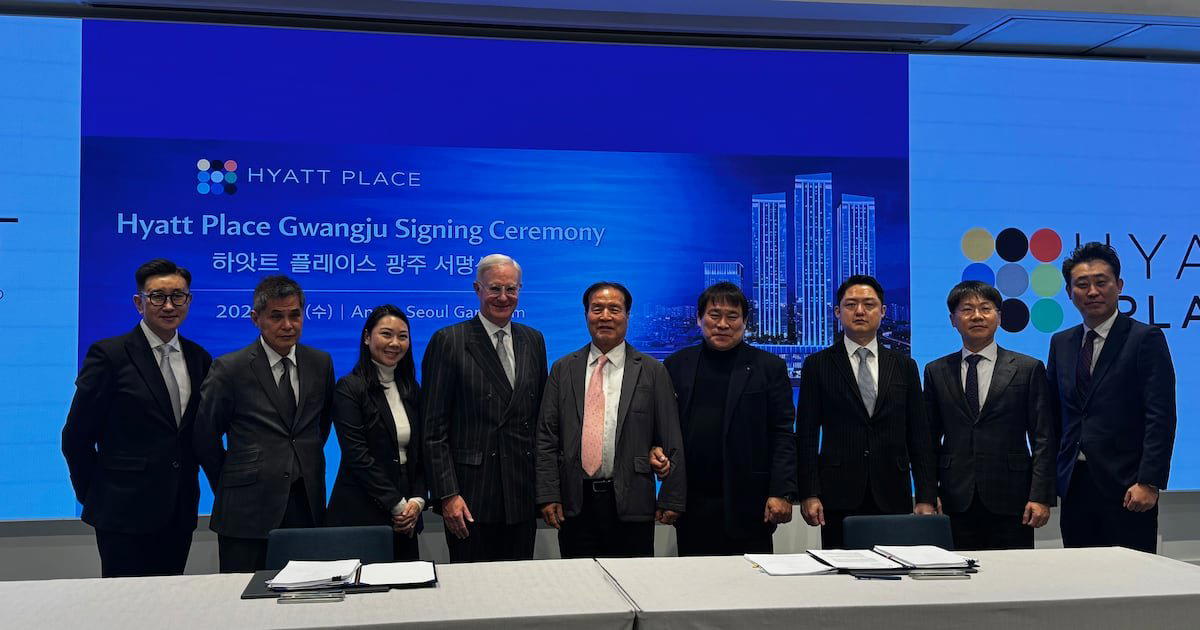
Hyatt Place Gwangju
Hyatt Place Gwangju brings the brand's reliable select-service format to South Korea's cultural capital, a city better known for its May 18th democratic movement history and thriving contemporary art scene than for international hotel density. For travelers using Gwangju as a base for the Jeolla region or the Asia Culture Center, the property sits within a market where mid-tier international flags remain less common than in Seoul or Busan.

Pearl is the En Primeur Club membership app — saves, bookings, and concierge access live there. Same editors, same standards.
Where Gwangju's Hotel Market Places a Hyatt Flag
South Korea's hotel geography has long been weighted toward Seoul, Busan, and Jeju. International brand penetration in secondary cities follows a different curve, and Gwangju illustrates that pattern clearly. The city is the administrative and cultural center of South Jeolla Province, home to the Asia Culture Center and the annual Gwangju Biennale, yet its international hotel inventory remains thin compared to the capital. Hyatt Place, as a select-service tier within the Hyatt portfolio, represents a pragmatic fit for a market where full-service luxury flags have limited commercial justification outside the peak festival season. For context, properties like the Grand Hyatt Jeju or JW Marriott Jeju Resort & Spa operate in leisure-heavy resort markets that justify full-service infrastructure. Gwangju's demand profile is different: business travel, domestic tourism, and a growing cultural-tourism segment drawn by the Biennale circuit.
The Physical Register of a Select-Service Format
Hyatt Place as a global format operates in a specific design register: consistent brand language, open-lobby social spaces, and a layout that prioritizes functional efficiency over theatrical arrival sequences. This stands in contrast to the destination-resort aesthetic you find at properties like Haevichi Hotel & Resort Jeju or the curated design statements of Art Paradiso Hotel in Incheon. The Hyatt Place format globally leans toward open-plan lobbies that consolidate check-in, casual dining, and lounge functions into a single flow. In a Korean context, where full-service hotels often maintain strict spatial hierarchies between lobby, restaurant, and guest floor access, the more permeable Hyatt Place layout reads as notably informal. That informality is the product of deliberate brand positioning, not an absence of design intent.
The guest room configuration in the Hyatt Place system typically separates a sofa-sleeper living area from the primary sleeping zone, a format designed to absorb both overnight business travelers and families without requiring a suite category. For travelers accustomed to the denser, more formal room layouts of Seoul's flagship properties, including the Casino Hotel Seoul or the Dormy Inn Seoul Gangnam, the Hyatt Place spatial approach will feel distinctly different in proportion and atmosphere.
Gwangju as a Context for the Stay
Understanding why someone books Hyatt Place Gwangju requires understanding what Gwangju offers as a destination. The city's May 18th Democratic Uprising Memorial is one of modern Korea's most significant historical sites, drawing both domestic and international visitors on a year-round basis. The Gwangju Biennale, held in even-numbered years, concentrates a globally mobile art audience into the city for a compressed window, creating the kind of peak-demand spike that international hotel brands can anchor to. The Asia Culture Center, a large-scale cultural complex built on the site of the former provincial government building, functions as a year-round draw for architecture-interested visitors: its design, by Woo Kyung-kuk, partially embeds below grade to preserve the historical site's sightlines, a spatial decision that has made it a reference point in Korean cultural architecture discussions.
For travelers moving through the broader southwest Korea circuit, Gwangju connects easily to the Suncheon Bay wetlands and the tea gardens of Boseong, making it a logical overnight stop rather than just a transit point. Properties like South Cape Owners Club in Namhae serve the leisure-resort end of Jeolla travel; Hyatt Place Gwangju serves the city-base end of the same regional journey.
Positioning Within Korea's Wider Hotel Tier
Korea's mid-tier international hotel market has filled in significantly over the past decade, but the geographic distribution remains uneven. Seoul concentrates the premium inventory, with full-service properties competing directly in the Gangnam and CBD corridors. Gwangju's select-service tier is where a Hyatt Place flag makes commercial sense, occupying a band between domestic business hotels and the full-service international properties that cluster in major gateway cities. For a direct comparison at the upper end of the Korean market, properties like Ananti at Busan Cove or Kensington Hotel Seorak demonstrate what design-led or resort-anchored properties look like at the premium tier. Hyatt Place Gwangju operates in an entirely different competitive set, one defined more by consistency, brand loyalty program integration, and predictable service delivery than by architectural distinction or F&B programming depth.
The Hyatt Place tier sits below Park Hyatt and Andaz in the portfolio hierarchy but above the budget-tier Hyatt House format, occupying a middle band that suits the Gwangju market's demand profile.
Planning the Stay
Gwangju is accessible by KTX high-speed rail from Seoul, with journey times running approximately two hours from Yongsan or Suseo stations. The Gwangju Biennale runs in September and October of even-numbered years, and hotel availability across the city tightens significantly during that window. Booking in advance for Biennale periods is advisable. Outside the Biennale cycle, Gwangju sees more moderate international visitation, and availability is generally less constrained.
Comparable Venues
Comparable venues nearby, for context on price, style, and recognition.
| Venue | Cuisine | Price | Notes |
|---|---|---|---|
| Hyatt Place GwangjuThis venue — the venue you are viewing | Contemporary mixed-use hotel tower | $$ | Not listed |
| Lexington Busan | Hotel | Not listed | Busan |
| Oakwood Lagoon Town Gangneung | resort-led development | $$$ | Cultural |
| Gangwon-do | family resort with golf focus | $$ | Seo-myeon |
| Camptong Forest | rustic forest pension | $$ | Gapyeong-gun |
| KOSMOS ULLEUNGDO | Cliffside healing resort with villa accommodations | $$$ | Buk-myeon |
At a Glance
- Modern
- Business Trip
Modern upscale atmosphere expected from Hyatt brand in a new luxury development.