
Selected by the Michelin Guide Hotels 2025, Hotel El Manantial del Silencio sits along Ruta Nacional 52 at the edge of Jujuy's high-altitude quebrada country. The property belongs to a tier of Argentine retreats defined by landscape immersion and deliberate restraint rather than resort scale. For travellers routing through northwestern Argentina, it represents one of the more considered lodging options in the region.
Pearl is the En Primeur Club membership app — saves, bookings, and concierge access live there. Same editors, same standards.
- Address
- Ruta Nacional N52 Km 3,5, Y4618 Purmamarca, Jujuy, Argentina
- Phone
- +54 388 490-8080
- Directions
- Get directions
 Saves & bookings on Pearl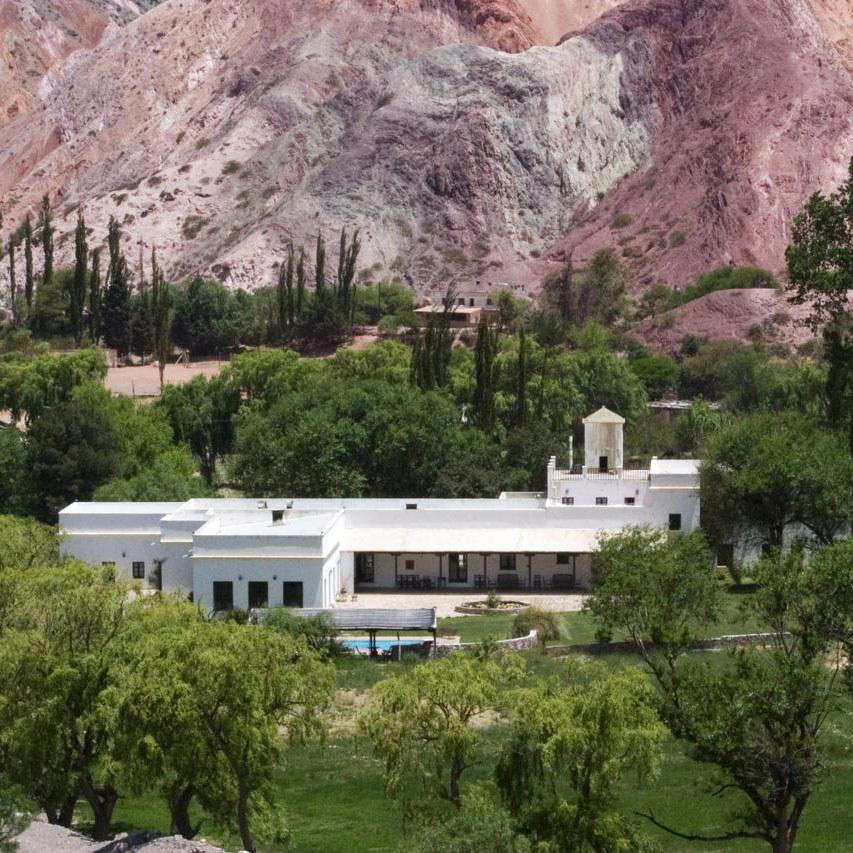
Where the Quebrada Sets the Design Brief
The road into Jujuy's high northwest is itself an argument for slowing down. Ruta Nacional 52 climbs through the Quebrada de Humahuaca, a UNESCO World Heritage valley where ochre, violet, and rust-coloured rock formations have been eroding into their current shapes for roughly ten million years. At kilometre 3.5 of that route, Hotel El Manantial del Silencio is a 20-room hotel in Purmamarca, Jujuy, Argentina, at the threshold of the Quebrada de Humahuaca. Hotel El Manantial del Silencio positions itself not as a counterpoint to the landscape but as a direct response to it. In a region where the physical environment dominates every design decision, properties that resist the temptation to impose imported aesthetics tend to hold up better over time, and Manantial del Silencio's address alone signals its intentions.
Argentina's premium lodging market has split along a familiar axis: large international-flag properties concentrated in Buenos Aires, Mendoza, and Bariloche, and a smaller cohort of independently operated, place-specific retreats that treat the surrounding geography as their primary asset. The Awasi Iguazu in Puerto Iguazu and Estancia Cristina in El Calafate occupy that second tier in their respective regions. Manantial del Silencio does the same for the Puna and quebrada country of Jujuy, where the altitude, the light, and the pre-Columbian built environment create a context that urban-resort templates simply cannot replicate.
The Architecture of Silence
The property's name, which translates roughly as the spring of silence, is also an architectural position. In the high quebrada, particularly powerful design gesture is often the one that creates a frame rather than a feature. Adobe construction, thick walls, and narrow apertures have been the dominant building language of this valley for centuries, used by the Tilcara and Omaguaca peoples long before Spanish colonisation, and refined through the colonial period into the churrigueresque churches that still anchor towns like Humahuaca and Tilcara. Properties that reference this material tradition, rather than graft on imported finishes, tend to read as belonging. The use of earth tones, natural materials, and low horizontal profiles is not merely aesthetic in this context; it is a practical acknowledgment that at 2,600 metres above sea level, with ultraviolet radiation and temperature swings of 20 degrees between day and night, the building envelope needs to work hard.
That design lineage places Manantial del Silencio in a different competitive conversation than, say, the Alvear Palace Hotel in Buenos Aires, which operates within the entirely different register of European Beaux-Arts grandeur, or the Entre Cielos Wine and Wellness Hotel in Mendoza, where vineyard integration is the organising principle. In Jujuy, the organising principle is the quebrada itself: its colour palette, its silence, its altitude, and its pre-Columbian weight.
Michelin Selection and What It Signals
The Michelin Guide's 2025 hotel selection for Argentina covers properties across a range of price points and formats. Inclusion in the 2025 list places Manantial del Silencio in a curated national set.
Within the broader Michelin Argentina hotel selection, properties like La Bamba de Areco in San Antonio de Areco and Colomé Winery in Molinos represent the estancia and wine-country format. Manantial del Silencio sits in a different sub-category: the high-altitude, culture-immersive retreat, where proximity to indigenous heritage sites and the physical drama of the quebrada are the core product rather than gastronomy or sport. That distinction matters when setting expectations.
The Region as Context
Jujuy sits in Argentina's far northwest, bordering Bolivia and Chile, and the province functions as one of the country's most culturally intact corners. The Quebrada de Humahuaca, which received UNESCO World Heritage status in 2003, is a 155-kilometre valley that serves as both a trade and migration corridor going back at least ten thousand years. The pre-Inca, Inca, and colonial layers are still visible in the architecture, the religious calendar, and the markets that run through towns like Tilcara, Purmamarca, and Humahuaca. The Carnival period, typically running through February, draws significant domestic tourism and transforms the normally quiet valley towns. Travellers who prefer a less crowded experience often time visits for the shoulder months of April through June or September through November.
For those building a wider northwestern Argentina circuit, the region connects logically to Cafayate in Salta province to the south, where Grace Cafayate anchors the wine tourism offer, and to the Valles Calchaquíes, where House of Jasmines in La Merced Chica provides another style of historically grounded lodging. The overall arc from Jujuy south through Salta to Cafayate is among the more coherent cultural routes in South America, and a property positioned at its northern anchor plays a different role than a standalone destination resort.
Planning Your Stay
The hotel sits at kilometre 3.5 on Ruta Nacional 52, in Purmamarca, Jujuy, at the threshold of the quebrada proper. Jujuy's Gobernador Horacio Guzmán International Airport receives flights from Buenos Aires, and the drive from the airport to the property takes under thirty minutes. For travellers coming from Purmamarca or further north, the property is accessible by the same national route that connects the valley's main towns. Reservation is recommended, especially during Carnival season. For comparison, Correntoso Lake and River Hotel in Villa La Angostura faces similar seasonal compression during its peak summer window, which suggests that Michelin-selected Argentine properties outside the capital tend to operate with tighter availability than their room counts might imply.
For travellers exploring Argentina's full premium lodging range, our full Jujuy restaurants and experiences guide covers the wider regional context. Those building a multi-stop Argentine itinerary will also find relevant comparators in Los Cauquenes Resort and Spa in Ushuaia and Estancia La Paz Hotel in Ascochinga, both of which operate within the same place-specific, Michelin-recognised tier that Manantial del Silencio represents at the northern end of the country.
Quick Comparison
Comparable venues nearby, for context on price, style, and recognition.
| Venue | Cuisine | Price | Awards | Notes |
|---|---|---|---|---|
| Hotel El Manantial del SilencioThis venue — the venue you are viewing | Spanish neo-colonial boutique hotel with adobe architecture and regional materials | $$$ | Not listed | Not listed |
| Colomé Winery | Boutique colonial-style estancia set in high-altitude vineyards. | $$$$ | Not listed | Molinos |
| San Isidro Plaza | Modern boutique hotel on tree-lined street near cathedral | $$$ | 4-Star | San Isidro |
| Estancia La Paz Hotel | Historic countryside estate with resort amenities | $$$ | 4-Star | Ascochinga |
| La Urumpta Hotel, AKEN Mind | contemporary design hotel surrounded by lush vegetation | $$$ | 4-Star | Río Cuarto |
| Mine Hotel Boutique | Owner-driven intimate retreat blending aesthetics, design, and personalized service. | $$$ | 4-Star | Palermo Soho |
Recognition history
Dated appearances from independent guides and award organizations, with the underlying list record or original source where available.
Michelin Selected
Michelin
At a Glance
- Quiet
- Scenic
- Rustic
- Elegant
- Cozy
- Romantic Getaway
- Wellness Retreat
- Weekend Escape
- Panoramic View
- Garden
- Terrace
- Wi Fi
- Pool
- Spa
- Restaurant
- Garden
- Mountain
- Garden
- Wi Fi
- Pool
- Spa
- Restaurant
- Garden
Elegant colonial ambiance with whitewashed adobe walls, stone floors, high ceilings, and natural light flooding through large windows, creating a peaceful and fresh atmosphere.