
World Luxury Hotel Awards WLHA Continent Winner
A double award-winner for Luxury Service and Luxury Historical Hotel recognition, Hotel Casa 1800 Sevilla occupies a converted palace in the Casco Antiguo, within walking distance of the Cathedral and Real Alcázar. The property operates at the quieter, more intimate end of Sevilla's boutique hotel tier, with a format built around historic architecture and attentive personal service rather than scale.

Pearl is the En Primeur Club membership app, where members save venues, book tables and use the concierge.
Boutique Palaces and the Sevilla Hotel Scene
Sevilla's premium hotel tier has organised itself around two distinct models. The first is the converted grand hotel: large, internationally affiliated properties that use their scale and brand recognition to anchor the upper end of the market. The second, smaller cohort is the historic mansion or palace repurposed as a boutique property, where the architecture itself is the primary credential. Hotel Casa 1800 Sevilla belongs firmly to the latter. Located on Calle Rodrigo Caro in the Casco Antiguo, the property sits within walking distance of the Cathedral, the Real Alcázar, and the Barrio Santa Cruz, placing it at the geographic and cultural centre of the city's most historically significant district. That address is not incidental: in Sevilla's boutique tier, proximity to the old city's core is a meaningful differentiator from properties that trade on amenity scale rather than location intensity.
The hotel has received recognition from the World Luxury Hotel Awards at the highest level of its peer category, holding both the Global Winner designation for Luxury Service in the Boutique Hotel category and the Continent Winner designation for Luxury Historical Hotel. That combination of awards is worth reading carefully. The service recognition operates globally against all boutique luxury entrants; the historical hotel recognition operates at a continental level across Europe. For a property without an international chain affiliation, both signals carry genuine weight in placing Casa 1800 within a specific competitive tier.
For context on how boutique historical hotels in Spain position themselves more broadly, properties such as Atrio Restaurante Hotel in Cáceres and Abadía Retuerta LeDomaine in Teruel illustrate how the category draws on architectural heritage to compete with larger branded rivals. Closer to home within Andalucía, the boutique palace format recurs frequently: the challenge is always to maintain service standards at low key counts without the operational infrastructure of a full resort.
The Architecture of the Stay
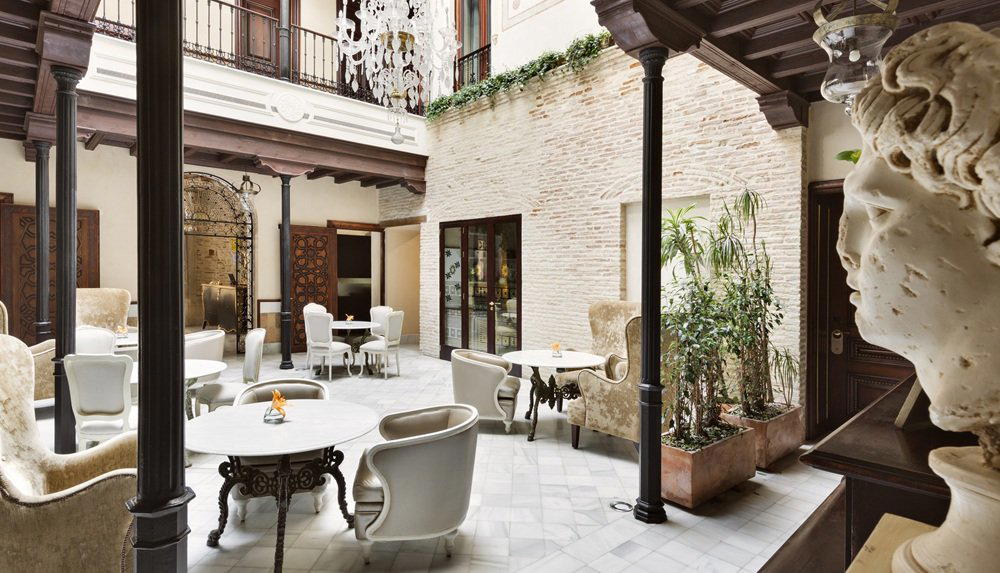
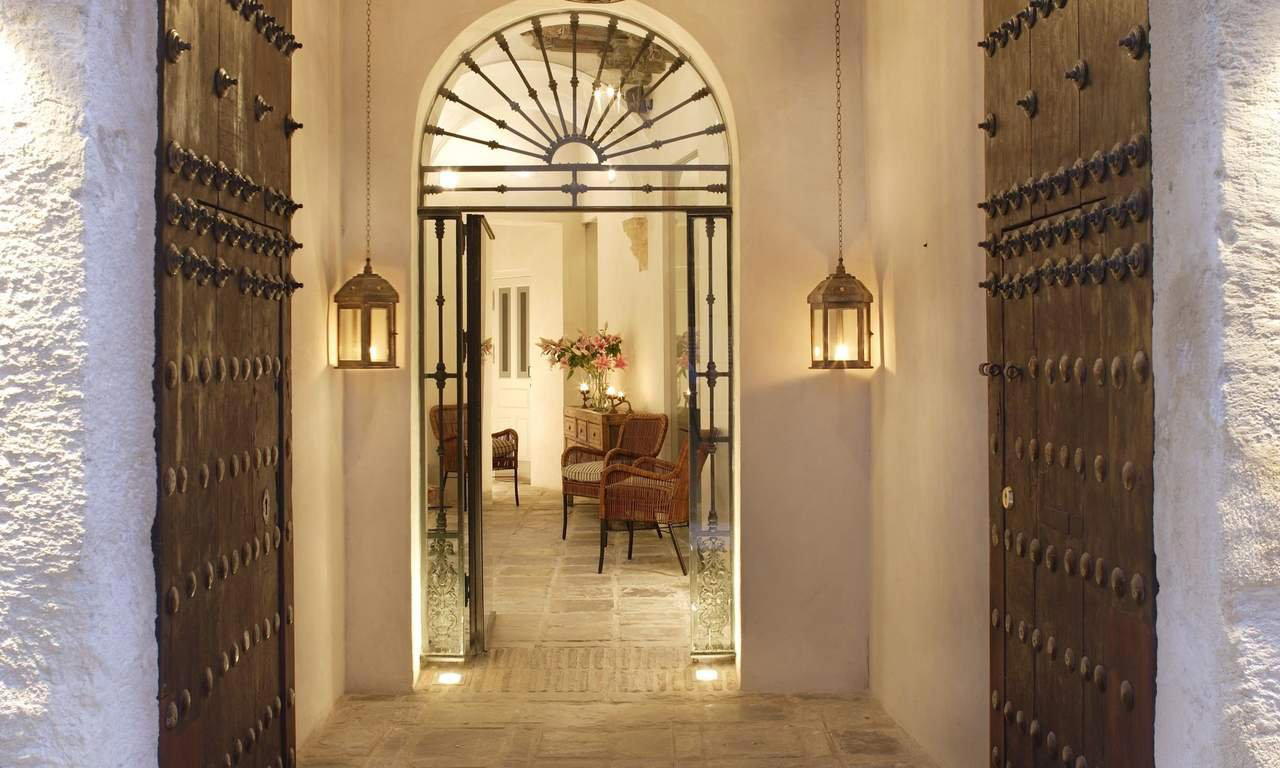
Sevilla's Casco Antiguo contains some of the most layered built fabric in Iberia: Moorish foundations, Renaissance courtyard structures, and Baroque overlays that accumulated across five centuries of continuous urban development. Properties in this district cannot simply be designed; they must be interpreted. The hotel format that works here is one in which the existing architecture sets the terms and the contemporary intervention is restrained, used to introduce comfort without erasing the spatial logic of the original building.
Casa 1800's position on Calle Rodrigo Caro, a narrow street in the oldest residential quarter of the city, signals a deliberate departure from the large-footprint hospitality model. The Casco Antiguo does not accommodate hotel blocks; it accommodates houses, and a property that reads convincingly here must do so on the neighbourhood's own terms. This is a common characteristic across the most credible Andalusian boutique properties, and it applies with equal force to urban palaces in Sevilla as it does to rural estates elsewhere in the region.
For travellers comparing the boutique palace format across Spain's Mediterranean coast and islands, Hotel Can Cera in Palma and Can Alberti 1740 Hotel Boutique in Mahón represent the same typology applied to Mallorcan and Menorcan civic architecture. The structural similarities are instructive: all operate on low key counts, all foreground historic fabric, and all position service quality as the primary competitive lever against larger properties.
Service as the Central Proposition
The Global Winner for Luxury Service designation tells you something specific about how this property is meant to function. At the boutique end of the market, service quality is almost always the variable that distinguishes a well-restored building from a hotel that operates as a premium product. Large luxury properties can absorb inconsistencies through volume and amenity breadth; small properties cannot. The award recognition here suggests that the operation has been structured to deliver consistency at a level that reads against international peers rather than merely against local alternatives.
In practical terms, this means the ratio of staff attention to guests is likely high relative to room count, and the format is calibrated for guests who want proximity to the city's historic centre rather than resort-style self-containment. Sevilla in high season, roughly April through June and September through October, brings enough visitor density to the Casco Antiguo that small properties with attentive service models are often the more functional choice over larger hotels that process higher volumes. Booking ahead for those windows is advisable; the combination of limited inventory and a known awards profile tends to tighten availability early in the planning cycle.
Other boutique properties in Spain that have built their guest proposition around service depth at low capacity include Cavalta Boutique Hotel, also in Sevilla, and Mas de Torrent Hotel & Spa in Torrent, where Catalan farmhouse architecture serves a similar function to the Andalusian palace format.
Dining and Food in the Casco Antiguo
The editorial angle for a property like this is honest on one point: boutique hotels in historic urban quarters in Spain rarely anchor their identity in destination dining programmes the way that resort properties or chef-led hotel concepts do. The Casco Antiguo's density of tapas bars, traditional ventas, and serious restaurants within walking distance creates a different dynamic. Guests at a property like Casa 1800 are likely to eat across the neighbourhood rather than within the hotel's own spaces, and the Sevilla dining scene is good enough to make that the obvious choice.
Sevilla's food identity is Andalusian in its fundamentals: fried fish, jamón from the sierra, salt cod preparations, and a sherry culture rooted in the proximity of Jerez. The city sits at the intersection of influences from Extremadura to the north, the Atlantic coast to the southwest, and the older Moorish culinary tradition that shaped its use of spice and citrus. For a more complete map of where to eat across the city's different quarters and price points, our full Sevilla restaurants guide covers the territory by neighbourhood.
Travellers building a broader Iberian itinerary around properties with serious in-house culinary programmes might also consider Akelarre in San Sebastián, where the hotel identity is inseparable from the restaurant, or Pepe Vieira Restaurant & Hotel in Poio, which operates as a chef-led destination in Galicia. Mandarin Oriental Ritz, Madrid represents the large-format alternative for travellers whose dining programme is the primary driver of the hotel decision.
Planning Your Stay
The hotel is located at Calle Rodrigo Caro 6, in the Casco Antiguo district (postcode 41004). The Real Alcázar entrance and the Cathedral are within a few minutes on foot, which makes this address one of the most practical in the city for visitors whose priority is time in the historic quarter rather than transit convenience. Sevilla's old city is not well-served by vehicle access, so the walkability of the location is a genuine operational advantage rather than simply a marketing point.
High season runs from Semana Santa and the Feria de Abril in spring through to late June, and again from mid-September through October. Both windows see significant price and availability pressure across all Sevilla accommodation. Travellers with flexibility should consider the shoulder months of March and November, when the Casco Antiguo is less congested and the city's temperature is more amenable to sustained walking.
For travellers comparing properties across Spain's broader boutique and resort spectrum, EP Club covers the full range: from urban palaces like Mandarin Oriental Barcelona and Marbella Club Hotel to island estates such as La Residencia, A Belmond Hotel, Mallorca, Hotel Can Ferrereta in Santanyí, Cap Rocat in Cala Blava, and BLESS Hotel Ibiza. Beyond Spain, the boutique historical format extends to properties such as Aman Venice and, for those comparing small-format luxury at the very best of the market, Aman New York and The Fifth Avenue Hotel in New York City.
Cost and Credentials
Comparable venues nearby, for context on price, style, and recognition.
| Venue | Price | Awards | Notes |
|---|---|---|---|
| Hotel Casa 1800 SevillaThis venue (the venue you are viewing) | $200–300 | World Luxury Hotel Awards WLHA Continent Winner | Not listed |
| Vincci Selección Unuk | $300–500 | 1 Michelin Key | Soho (Seville Old Town), Grand Luxury boutique hotel blending traditional Sevillian architecture with contemporary design; intimate 34-room property positioned as a design destination with Michelin Key recognition. |
| Tayko Sevilla | $100–200 | Michelin Selected · Mr & Mrs Smith Seal of Approval | Santa Cruz, Historic regionalist exterior with contemporary restoration |
| Casa Palacio Don Ramón | $500–750 | Michelin Selected | Encarnacion-Regina, Historic palace with modern luxury renovations |
| Vincci Molviedro | $100–200 | Michelin Selected | Centro, Contemporary Andalusian fusion in historic buildings |
| Gravina 51 | $100–200 | Michelin Selected · Mr & Mrs Smith Seal of Approval | Casco Antiguo, Restored historic palacio with contemporary classic interiors |
Recognition history
Dated appearances from independent guides and award organizations, with the underlying list record or original source where available.
World Luxury Hotel Awards WLHA Continent Winner
World Luxury Hotel Awards
Full recognition history (2 entries)
World Luxury Hotel Awards WLHA Global Winner
World Luxury Hotel Awards
Continue exploring
More in Seville
Hotels in Seville
All hotels in Seville →
Bars in Seville
All bars in Seville →
Details
- Romantic
- Elegant
- Intimate
- Classic
- Cozy
- Romantic Getaway
- Anniversary
- Weekend Escape
- Rooftop Pool
- Historic Building
- Panoramic View
- Terrace
- Wi Fi
- Pool
- Spa
- Room Service
- Concierge
- Skyline
- Garden
- Wheelchair Accessible
- Elevator
Elegant and peaceful atmosphere with ornate chandeliers, neutral tones, coffered ceilings, and original wooden details, providing a quiet oasis despite central location.