Garner Kutch Gujarat sits in one of India's most architecturally and culturally layered regions, where the vast salt flats of the Rann meet a tradition of craft, mud-work architecture, and nomadic design that has no close parallel on the subcontinent. For travellers arriving from the polished circuits of Rajasthan or Gujarat's urban centres, Kutch operates on a different register entirely, raw, unhurried, and deeply material in its aesthetic logic.

Pearl is the En Primeur Club membership app — saves, bookings, and concierge access live there. Same editors, same standards.
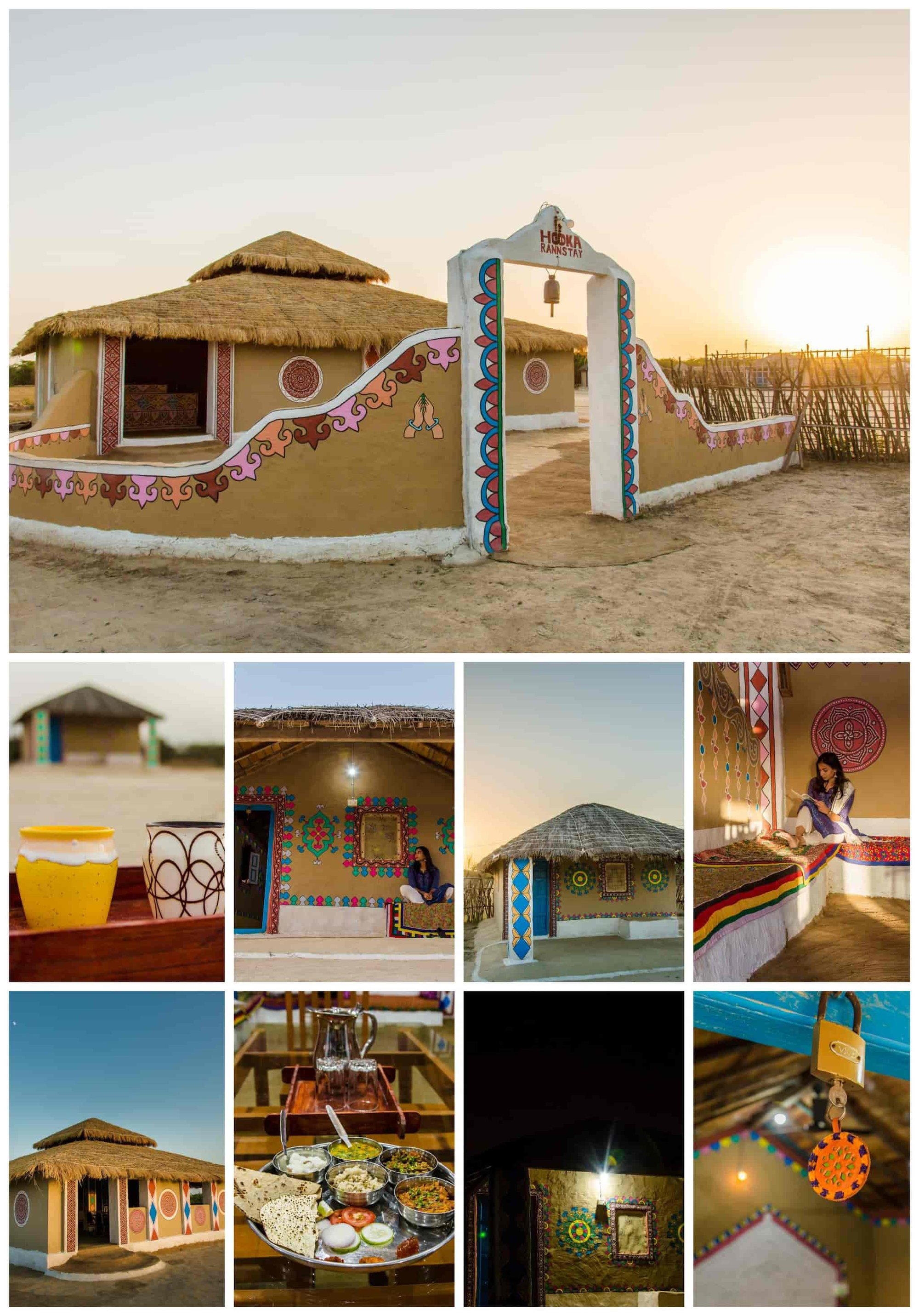
Where the Rann Shapes the Room
There is a particular quality of light in Kutch that architects and designers have been trying to work with, or against, for centuries. The district sits at the edge of the Great Rann, a seasonal salt marsh that turns white and mirror-flat for months at a time, reflecting a sky that oscillates between violet at dusk and bleached white at noon. Buildings here have always had to reckon with that environment. The vernacular response, developed across generations of Koli, Rabari, and Ahir communities, is the bhunga: a circular mud dwelling with thick rammed-earth walls, a conical thatched roof, and interior surfaces covered in intricate mirror-work and clay relief. That formal tradition, born from functional necessity in a seismically active, climatically extreme region, is now the single most defining architectural reference point in Kutch hospitality.
Garner Kutch Gujarat operates within this broader context. The region it draws from is not a backdrop; it is a design source. For travellers accustomed to the curated grandeur of The Leela Palace Jaipur or the marble-and-inlay vocabulary of The Oberoi Amarvilas in Agra, Kutch presents something structurally different: an aesthetic built from earth, mirror, and textile rather than from hewn stone and Mughal geometry.
The Architecture of Kutch Hospitality
Kutch has become, over the past two decades, a case study in how vernacular building traditions can be reinterpreted for contemporary hospitality without dissolving into pastiche. The pressure to do so comes from the region's own history: the 2001 Bhuj earthquake destroyed a significant portion of the district's built fabric, and the reconstruction period accelerated both the documentation and the selective revival of traditional building methods. Properties that opened in Kutch after 2005 largely faced a choice between international resort conventions and a more grounded engagement with local craft and spatial logic.
The better properties chose the latter. The signature moves are consistent across the category: low-profile structures that don't compete with the flat horizon, interior surfaces that carry the mark of artisan hands rather than machine finish, and a spatial rhythm that opens toward landscape rather than enclosing against it. This positions Kutch hospitality within a broader Indian design movement that includes properties like Suján Jawai in Pali and Amanbagh in Ajabgarh, where the physical setting is treated as the primary design material.
What distinguishes the Kutch version of this approach is the craft density. Kutch is home to more distinct embroidery traditions than any comparable district in India, with Rabari, Mutwa, Ahir, Suf, and Banjara needlework each representing a separate visual grammar. Interiors that draw on this material genuinely read differently from those that import craft as decoration: the objects carry locational weight.
Setting and Spatial Logic
In a region where the flat geography can make scale feel arbitrary, considered properties in Kutch work with smallness deliberately. The bhunga tradition is inherently intimate; the circular form, typically no more than four to five metres in diameter, creates an interior experience that is contained and enveloping rather than expansive. Contemporary interpretations scale this up without necessarily abandoning the formal logic, using curved walls, low ceilings, and continuous surface treatment to maintain the sensory register of the original.
The result, in the better examples, is a kind of architectural honesty that larger or more category-conventional properties cannot replicate. This is a different competitive tier from the palace hotels of Rajasthan or the coastal luxury of properties like Baale Resort Goa. It is also a different register from the Himalayan retreat model represented by Ananda in the Himalayas. Kutch sits in a category of its own: desert-edge, craft-anchored, and defined more by what surrounds the property than by what is built inside it.
Food and the Kutchi Table
Kutchi cuisine occupies a narrow band in India's broader food conversation, largely because the region's cooking is deeply shaped by pastoral and nomadic traditions that don't translate easily into restaurant formats. Dairy is central: chaas (spiced buttermilk), dahi (yoghurt), and ghee appear at every meal point. Lentil preparations tend toward simplicity, cooked with few aromatics, reflecting both the availability of ingredients on the salt plains and a culinary culture that prizes clarity over complexity. Breads, including rotlo made from bajra or jowar flour, are cooked on open flames and carry a char that no gas-range reproduction matches.
The regional vegetarian tradition is strict in many communities, which has produced a cuisine that achieves depth through technique and fermentation rather than protein variety. Travellers arriving expecting the spice-forward intensity of, say, the restaurant offer at The Taj Mahal Palace, Mumbai will find Kutchi food quieter and more austere, but no less considered for that. It rewards patience and context.
Quick Comparison
Comparable venues nearby, for context on price, style, and recognition.
| Venue | Cuisine | Price | Notes |
|---|---|---|---|
| Garner Kutch GujaratThis venue — the venue you are viewing | Midscale conversion hotel with flexible spaces | $$ | Not listed |
| Gateway Dehradun | Contemporary comfort reflecting local heritage | $$$ | Niranjanpur |
| Shakti Prana | Remote, all-inclusive Himalayan mountain retreat combining guided walking journeys with village stays and a small luxury lodge as the centerpiece. | $$$$ | Kumaon, Uttarakhand |
| Kumbh Village | Traditional Kumbh Mela village-style cottages and tents | $$ | Naini |
| Hotel Irada, Pune Wine Country | Contemporary reimagining of storied winery manor with midcentury modern interiors | $$$$ | Daund |
| Pebble Street | Hotel | $$ | New Friends Colony |
At a Glance
- Relaxed
- Cozy
- Business Trip
- Weekend Escape
- Pool
- Fitness Center
- Spa
- Room Service
- Concierge
- Pool
- Fitness Center
- Spa
- Room Service
- Concierge
Relaxed and locally inspired vibe with flexible communal spaces for comfort and convenience.