


Four Seasons Hotel Guangzhou occupies the top 30 floors of the 103-story Guangzhou International Finance Centre, with 344 rooms positioned between the 74th and 98th floors overlooking the Pearl River. The hotel earned 90.5 points in the 2026 La Liste Top Hotels ranking and holds five restaurants and bars across multiple sky-high levels, including Catch on the 100th floor. Google reviewers rate it 4.6 from 370 reviews.
 Discover on Pearl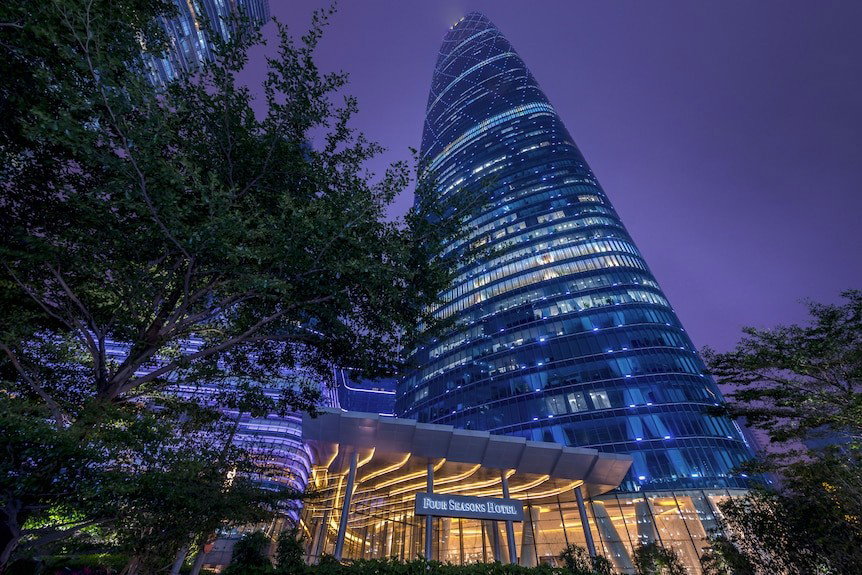
A Hotel in the Sky, Over a City That Never Stopped Building
Step onto any of the guest room floors between the 74th and 98th levels of the Guangzhou International Finance Centre, and the city below becomes a diagram of itself: the Pearl River cutting a grey-green line through Tianhe District, the Canton Tower's latticed silhouette on the opposite bank, and the Guangzhou Opera House anchoring a neighbourhood that has gone from reclaimed land to one of southern China's most concentrated clusters of contemporary architecture in under two decades. Four Seasons Hotel Guangzhou does not merely occupy a tall building; it occupies a particular moment in Guangzhou's civic ambition, and the view from every floor-to-ceiling window makes that argument without any assistance from the hotel's marketing team.
Among Guangzhou's luxury tier, which includes properties such as Rosewood Guangzhou, Mandarin Oriental, Guangzhou, and Park Hyatt Guangzhou, the Four Seasons sits in the vertical-spectacle tier: fewer than a handful of hotels in mainland China place their entire room inventory above the 70th floor of a single supertall tower. That positioning shapes everything, from the engineering of the spa and pool to the multi-restaurant programme stacked across the building's uppermost floors. The 2026 La Liste Leading Hotels ranking placed the property at 90.5 points, which positions it within the upper band of that list's global hotel dataset and confirms the competitive set it belongs to when read against peers like The Ritz-Carlton, Guangzhou and Conrad Guangzhou.
Rooms That Frame the Pearl River
The 344 guest rooms are arranged so that floor-to-ceiling windows face either the Pearl River or the broader cityscape, and the interior palette has been calibrated not to compete with what lies outside. Grey, ivory, and taupe form the base, with teal or plum upholstery providing punctuation in the seating areas, and a layered blue carpet that reads like a reference to traditional Chinese ink-wash painting without being literal about it. Grey leather headboards anchor ivory cotton bedding; glass writing desks and swivel chairs occupy the workspace. A black lacquered console conceals the minibar. The oversized marble bathrooms include deep soaking tubs, and given the altitude, the act of soaking while looking out over Guangzhou carries a particular quality that the ground-floor equivalents at other properties cannot replicate.
Entertainment infrastructure in the rooms includes a 42-inch LCD television, an iPod dock, and an MP3 connection, which reflects a fit-out era that has since been superseded in some peer properties; guests with streaming-first habits should factor this in. The total room count of 344 across 30 floors maintains a density that allows the property to function at scale while delivering the service ratios the Four Seasons brand is associated with across its global portfolio, from Aman New York in New York City to Aman Venice in Venice.
Five Venues, One Vertical Stack
Guangzhou's dining scene is anchored in Cantonese tradition, one of the four major schools of Chinese cuisine and the one most deeply associated with this city's identity. The hotel's food and beverage programme engages that context directly at Yu Yue Heen, a Cantonese restaurant finished in black and red lacquer, where the dim sum warrants specific attention. Dim sum in Guangzhou is a serious civic ritual, conducted daily across thousands of teahouses and hotel dining rooms, and Yu Yue Heen's version belongs to the hotel-tier bracket of that tradition. For the full Guangzhou restaurants guide, the city's broader dim sum geography goes well beyond hotel dining rooms, but for guests who want to benchmark what in-house Cantonese cooking can do at this price tier, Yu Yue Heen is the reference point within the building.
Kumoi operates on a different culinary register. Chef Masannobu Hoshina leads a Japanese programme built around sushi, grilled items, and tempura in a setting described as modern rather than rustic, which reflects the direction that premium Japanese dining in mainland Chinese cities has taken over the past decade: less nostalgia for cedar and paper screens, more clean material contrast and controlled light. At the all-day Caffe Mondo, the kitchen works a primarily western register with Italian emphasis alongside some Chinese dishes, making it the most family-accessible venue in the stack and the one calibrated for guests who want a low-friction meal rather than a destination dining experience.
Catch, on the 100th floor, holds a specific position in the hotel's identity as Guangzhou's highest restaurant at time of writing. The format centres on seafood sourced globally, served in a dining room finished in gold, grey, and purple, with the kind of views that orient diners toward the window regardless of what arrives at the table. The Atrium Lounge on the 70th floor handles drinks, coffee, and afternoon tea at mid-tower, while Tian Bar on the 99th floor offers a tighter, more atmospheric perch for cocktails and cold and warm tapas. Most guests at Tian Bar are there as much for altitude as for the drinks list, which is a candid way of saying the bar competes less on programme depth and more on its position in the sky. For a wider picture of what the city offers at ground level, our full Guangzhou bars guide maps the scene across all neighbourhoods.
The Wider Pearl River New City Context
Pearl River New City, the district where the hotel sits, represents Guangzhou's most deliberate experiment in planned density. The Guangzhou Opera House, designed by Zaha Hadid and completed in 2010, sits within walking distance, as does the Guangdong Museum, and the area's skyline continues to evolve with successive tower completions. For visitors arriving from elsewhere in China or internationally, this neighbourhood functions as a legible entry point into contemporary Guangzhou rather than a gateway to the older city, which is roughly 10 minutes away by taxi. Guangzhou Baiyun International Airport is a 30-to-45-minute drive, depending on traffic, and Guangzhou East Railway Station is approximately 10 minutes from the property, making high-speed rail connections to Shenzhen, Hong Kong, and further afield direct to manage. The hotel also connects to the Metro subway system, which covers the city's major nodes.
Seasonality matters considerably in Guangzhou. Late autumn, typically October through November, brings the city's most consistently comfortable conditions: humidity drops, temperatures sit in a range that supports walking and outdoor exploration, and the light over the Pearl River has a quality that the summer months, with their heat and typhoon exposure, cannot provide. The hotel's inspectors note that late spring and early summer bring the heaviest rainfall, and typhoons originating over the South China Sea occasionally affect the city between June and October. Lunar New Year generates peak travel pressure at Baiyun International Airport; guests with schedule flexibility should build that into their planning. For hotels across the city at different price points and neighbourhoods, our full Guangzhou hotels guide provides comparative context, including properties like Langham Place, Guangzhou, Hotel, Guangzhou, and LN Hotel Five.
Sustainability Within a Supertall Format
Responsible luxury in a property of this scale involves a different set of considerations than in a low-rise resort. Operating 344 rooms across 30 floors of a supertall tower means energy consumption occurs in a concentrated vertical column, and the Four Seasons Hotels and Resorts group has published group-wide environmental commitments that cover water reduction, waste diversion, and supply chain sourcing. Assessing how those commitments translate at property level in Guangzhou specifically requires data the hotel has not made publicly granular, but the group's overall direction is toward Science Based Targets and emissions reduction across its managed portfolio. For guests who weight sustainability credentials in their selection process, the peer comparison among Guangzhou's luxury tier is worth examining; properties like Rosewood Guangzhou and Mandarin Oriental, Guangzhou operate under parent companies with their own published frameworks. Across China more broadly, the hospitality industry's sustainability reporting remains less standardised than in European markets, which affects how directly properties can be compared. For reference points elsewhere in the country, 1 Hotel Haitang Bay, Sanya in Sanya represents the most explicitly sustainability-positioned hotel brand operating at luxury tier in China, while Aman properties such as Amanfayun in Hangzhou and Amanyangyun in Shanghai take a heritage-conservation approach that positions sustainability through architectural preservation rather than operational metrics. For experiences tied to Guangzhou's cultural and natural assets, our full Guangzhou experiences guide covers options beyond the hotel. Visitors curious about the city's wine and drinks culture will find our full Guangzhou wineries guide a useful companion. Beyond China, luxury hospitality in the Four Seasons tier elsewhere in the region, such as Altira Macau in Macau or Andaz Shenzhen Bay in Shenzhen, provides a calibration for travellers moving across the Pearl River Delta.
Planning Your Stay
The hotel's address is 5 Zhujiang West Road, Pearl River New City, Tianhe District, Guangzhou, 510623. Room availability and current pricing should be confirmed directly with the property or through the Four Seasons central reservations system, as rates fluctuate with Canton Fair periods, Lunar New Year, and peak autumn travel season. The spa, pool, and fitness centre are part of the in-house amenity set, though specific treatment menus and pool access policies should be verified at booking. Guests travelling with children will find Caffe Mondo the most appropriate venue for family meals, while Kumoi and Yu Yue Heen function better as adult dining settings in terms of format and pacing. Google reviewers rate the property 4.6 across 370 reviews, which for a luxury hotel at this scale reflects a consistently high satisfaction baseline rather than the polarised scoring that characterises more idiosyncratic properties. For a broader view of similarly positioned Four Seasons-tier luxury in Beijing, Aman Summer Palace in Beijing, Mandarin Oriental Qianmen in Dongcheng, and Amandayan in Lijiang offer instructive contrasts in how China's luxury hotel tier operates across different city types and Banyan Tree Chongqing Beibei in Chongqing represents the resort-adjacent approach within a major mainland Chinese city.
Frequently Asked Questions
Price and Recognition
A small comparison set for context, based on the venues we track.
| Venue | Price | Awards | Notes |
|---|---|---|---|
| Four Seasons Hotel Guangzhou | La Liste Top Hotels: 90.5pts | This venue | |
| Conrad Guangzhou | |||
| Mandarin Oriental, Guangzhou | |||
| Park Hyatt Guangzhou | |||
| Rosewood Guangzhou | |||
| Shangri-La Hotel, Guangzhou |
Preferential Rates?
Our members enjoy concierge-led booking support and priority upgrades at the world's finest hotels.
Get Exclusive Access