
Finch Hattons sits inside Tsavo West National Park across 17 rooms, placing it among Kenya's smaller, more deliberate tented camps where scale is a design choice rather than a limitation. The property operates within one of East Africa's largest and least-trafficked wilderness areas, positioning it at a considerable remove from the Mara circuit's higher-footfall alternatives.
Pearl is the En Primeur Club membership app — saves, bookings, and concierge access live there. Same editors, same standards.
- Address
- Tsavo West National Park, Kenya
- Website
- virginlimitededition.com
- Directions
- Get directions
 Saves & bookings on Pearl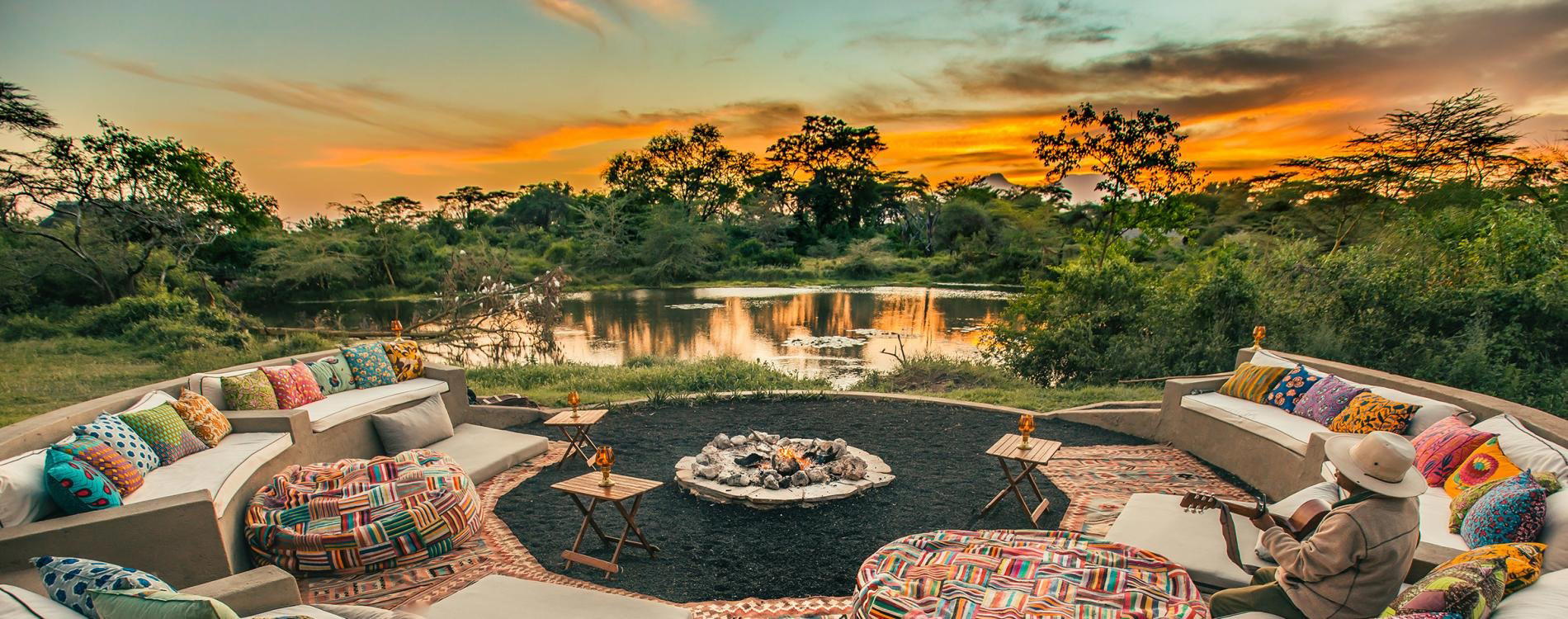
Canvas, Canvas, and the Weight of Tsavo
Tsavo West is not the Maasai Mara. That distinction matters before anything else is said about the camps inside it. Where the Mara draws dense concentrations of vehicles during the great migration window and supports a layered tier of lodges from mid-market tented camps to branded full-service lodges and established international names, Tsavo operates at a different register entirely. The two Tsavo parks together constitute one of the largest protected areas in the world, and their relative quietness compared to the Mara is not a deficiency. It is the point. Camps here function inside a landscape where the absence of traffic is itself a form of luxury.
Finch Hattons Luxury Safari Camp arrives in this context with 17 rooms. At that scale, it belongs to the tier of East African properties where intimate capacity is a deliberate constraint, not a development phase. The camp shares that structural logic with others in Kenya's specialist spectrum, such as Borana Lodge in Laikipia and Solio Lodge in Nyeri, where guest numbers are kept low enough that the experience of the place does not compete with itself.
The Architecture of Restraint
Safari camp design in East Africa has divided into two recognisable approaches over the past two decades. The first moves toward permanence: stone-and-timber structures, heated pools, chef-driven dining rooms, and an interior language borrowed from international boutique hotels. The second holds to a softer materiality, canvas, wood, open air, where the physical boundaries between interior and exterior remain genuinely porous. Finch Hattons sits within the Tsavo West National Park environment, where that porosity is not decorative. The bush is not a backdrop seen through picture glass. It arrives on its own terms, with the sounds and temperatures of the surrounding ecosystem shaping the experience from inside the accommodation.
Across Kenya's premium safari circuit, this distinction has become a meaningful differentiator. Properties like Elewana Elsa's Kopje in Meru National Park or Saruni Samburu are defined as much by their relationship to the terrain they occupy as by any interior specification. In Tsavo West specifically, the volcanic rock formations, the Chyulu Hills visible to the northwest, and the Mzima Springs within the park create a physical setting that places significant demands on how a camp integrates itself. A property that reads as dropped into the landscape rather than grown from it loses credibility quickly against the environment it is supposed to be offering access to.
With 17 rooms, Finch Hattons operates at a scale that allows site responsiveness. Larger camps, even well-run ones, generate a gravitational pull toward central facilities, scheduled mealtimes, and group rhythms that compress the sense of individual access to the bush. Smaller footprints allow the rhythm of the park itself to set the pace.
Tsavo West Inside the Broader Kenya Safari Circuit
Kenya's premium safari properties now distribute across several distinct wilderness zones, each with its own character and competitive dynamics. The Mara circuit concentrates the highest density of high-end operators, from andBeyond Bateleur Camp and andBeyond Kichwa Tembo to Mahali Mzuri in the Olare Motorogi Conservancy and Enaidura Camp. Laikipia represents a different conservancy model, anchored by properties like andBeyond Suyian Lodge and Elewana Loisaba Tented Camp. The Chyulu Hills and Amboseli corridor adds a further tier, represented by ol Donyo Lodge.
Tsavo West sits somewhat outside these established circuits in terms of visitor volume, which is precisely what gives it appeal for travellers who have already covered the higher-footfall zones. It also provides logical geographic positioning for itineraries that combine a Nairobi base, at a property like Villa Rosa Kempinski, with onward movement toward the coast, where options range from Sarova Whitesands in Mombasa to Chale Island and Sirai Beach in Kilifi. Tsavo West can anchor the middle section of that arc.
Cottar's Safaris in Narok and Sarova Lion Hill in Nakuru represent further comparison points within Kenya's premium camp spectrum, useful for calibrating where any single property sits within the broader continuum of price, scale, and experience format.
Planning and Practical Considerations
Tsavo West receives the fewest visitors of any major Kenyan park relative to its size, but that figure varies meaningfully by season. The dry months from June through October concentrate wildlife around water sources, including the Mzima Springs inside the park, producing conditions that rival the Mara in terms of game density if not volume of species. The short rains in November and the long rains between April and May change the park's character considerably.
Access to Tsavo West runs through Mtito Andei Gate or Tsavo Gate, both reachable from Nairobi by road (approximately four to five hours) or by light aircraft to the camp's nearest airstrip, the latter being the standard approach for premium bookings.
What the 17-Room Scale Delivers
In the concentrated end of Kenya's camp market, 17 rooms functions as a signal. It implies that the property is not organised around conference capacity or high-throughput safari groups. Larger-format operations, even good ones, introduce a scheduling logic that competes with spontaneity. Smaller camps can move around the park's daily rhythms, adjust game drive timing to conditions, and keep staff-to-guest ratios at levels that allow genuine responsiveness rather than structured programming.
The comparison set for a 17-room Tsavo West camp is not the Mara's large operators. It sits closer to the conservancy-model properties of Laikipia or the specialist bush camps of northern Kenya, where low capacity is part of a deliberate positioning. That positioning carries its own expectations: guests arriving at this scale of property are generally not first-time safari visitors seeking a comprehensive introduction, but repeat travellers who know what they are looking for and have chosen the quieter park deliberately.
Connections Across the Kenya Circuit
- Borana Lodge, Laikipia, conservancy-model low-capacity camp for comparison
- ol Donyo Lodge, Chyulu Hills, nearest geographic peer within southern Kenya
- Elewana Elsa's Kopje, Meru, comparable park-embedded intimate camp format
- Kinondu Kwetu, Diani Beach, coastal extension option after Tsavo
- Saruni Samburu, northern Kenya specialist camp for extended circuit planning
Comparable Venues
Comparable venues nearby, for context on price, style, and recognition.
| Venue | Cuisine | Price | Awards | Notes |
|---|---|---|---|---|
| Finch Hattons Luxury Safari CampThis venue — the venue you are viewing | Luxury tented camp evoking 1920s safari glamour with modern comforts. | $$$$ | 5-Star | Not listed |
| The Charming Lonno Lodge Watamu | Swahili-inspired boutique lodge with Italian warmth and ancient-style architecture | $$$$ | 5-Star | Watamu |
| Swahili Beach Resort | Luxury resort blending rich Swahili heritage with contemporary elegance, designed with minimum ecological impact while delivering unusual comfort. | $$$$ | 5-Star | Diani Beach |
| Kwetu Nairobi, Curio Collection by Hilton | Historic fusion of nature, city, and 1800s heritage with cozy local charm. | $$$$ | 5-Star | Westlands |
| andBeyond Kichwa Tembo Tented Camp | Luxury safari camp combining timeless canvas tents with modern amenities, grounded in Maasai-inspired design and natural materials set within a private concession. | $$$$ | 5-Star | Kawai |
| Angama Mara | luxury tented safari camp | $$$$ | 5-Star | Oloololo Escarpment |
Recognition history
Dated appearances from independent guides and award organizations, with the underlying list record or original source where available.
Preferred Hotels Member
Preferred Hotels
At a Glance
- Romantic
- Elegant
- Scenic
- Sophisticated
- Ornate
- Honeymoon
- Romantic Getaway
- Family Vacation
- Wellness Retreat
- Panoramic View
- Private Dining
- Infinity Pool
- Wi Fi
- Pool
- Spa
- Fitness Center
- Room Service
- Concierge
- Laundry Service
- Garden
- Mountain
- Wi Fi
- Pool
- Spa
- Fitness Center
- Room Service
- Concierge
- Laundry Service
Serene and sophisticated atmosphere with natural sounds of wildlife, relaxed lighting on private decks, and views of hippo pools and Chyulu Hills.