


A 16th-century monastery turned 11-room luxury hotel, CIRQA occupies one of Arequipa's oldest sillar stone estates, steps from Plaza de Armas. Its glass-walled dining salon serves contemporary interpretations of Arequipenean cuisine, while the modernist interiors draw comparisons to design-led Italian properties. Rates from US$478 per night, with a 4.7 Google rating across 267 reviews.
 Discover on Pearl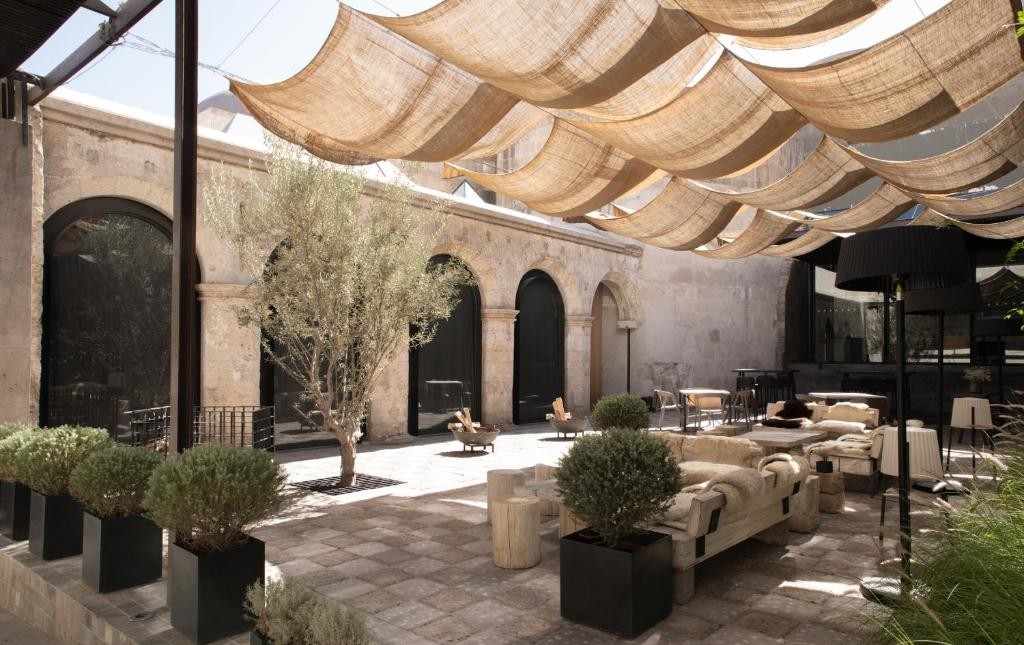
A Monastery Transformed: How Arequipa's Historic Core Houses One of Peru's Most Considered Small Hotels
The approach to CIRQA prepares you for what follows. Calle Sucre runs close enough to Arequipa's Plaza de Armas that you can hear the square's ambient city noise, yet once the tall double doors close behind you, that sound drops away almost entirely. What remains is the quiet particular to very old stone: the sillar volcanic rock that forms the estate's walls has been absorbing Arequipa's light and sound since 1540, making this one of the earliest European-built structures in the Americas still in active use. That context matters more than any single design decision inside.
Peru's hotel conversation tends to cluster around Lima's Miraflores district and the Cusco corridor, where converted colonial palaces and Inca-adjacent properties have spent decades competing for the same international traveler. Arequipa sits outside that circuit, which is partly why CIRQA operates in a less crowded competitive tier. The city's own identity, built on sillar architecture, a distinct regional cuisine, and proximity to both the Colca Canyon and the Chilina Valley, supports a different kind of stay, one less anchored to checklist tourism and more oriented toward the city itself. Nearby, Las Casitas, A Belmond Hotel, Colca Canyon takes the opposite approach, positioning itself within the canyon rather than the urban center, and Casa Andina Premium Arequipa offers a larger-footprint alternative for travelers who prioritize brand infrastructure over intimacy.
The shortlist, unlocked.
Hard-to-book tables, cellar releases, and concierge-planned trips.
Get Exclusive Access →Eleven Rooms, Four Centuries of Walls
The property runs eleven rooms across an estate that has moved through several lives since its 16th-century origins as a monastery. That institutional past, with its emphasis on contemplation and spatial economy, inflects the current configuration. Small key counts in historic Latin American properties are rarely accidental: the building's structure, with its thick stone walls and cellular room layout derived from monastic lodging, imposes a natural ceiling on capacity. CIRQA works within those constraints rather than against them, which keeps the property in the specialist tier that small design-led hotels occupy globally, closer in sensibility to Castello di Reschio in Lisciano Niccone or Hotel Esencia in Tulum than to any branded chain conversion.
The interior design strategy is worth noting for what it chooses not to do. Rather than leaning into colonial reproduction, the rooms take a modernist-inflected approach, sparse, somewhat eclectic, and described by those familiar with the property as reminiscent of well-executed Italian design hotels. Technology is present where it adds function: rain showers, flat screens, bedside reading lamps. But the dominant atmosphere remains one of quiet and material honesty, letting the stone do the interpretive work that over-designed heritage hotels often delegate to furniture. For comparable approaches to historic-property conversion, Palacio Nazarenas in Cusco offers an instructive parallel within Peru, where Belmond's intervention in a former convent produced a similarly restrained luxury register.
The Dining Programme: Glass Walls, Regional Depth
Arequipenean cuisine is one of Peru's most internally coherent regional traditions. While Lima's restaurant scene has absorbed international technique and global recognition, Arequipa's food culture has retained a distinct grammar: dishes built around local chili varieties like the rocoto and aji panca, slow-cooked preparations rooted in pre-colonial and Spanish colonial exchange, and an emphasis on high-altitude proteins and grains. The city considers itself, with some justification, the capital of Peruvian home cooking, and that identity creates both an opportunity and a constraint for any hotel kitchen that tries to engage with it seriously.
CIRQA's kitchen addresses this through contemporary interpretation rather than direct reproduction. The dining space itself, a glass-walled salon that opens onto a shaded terrace, positions the meal against the estate's historic stonework. That architectural framing is a deliberate editorial choice: the visual contrast between the glass enclosure and the 16th-century walls is what gives the dining experience its particular tone, the sense that something regional and time-rooted is being reconsidered rather than simply served. This approach sits in a broader trend across Peru's premium hotel dining, where properties increasingly treat local culinary traditions as living material for refinement rather than as set dressing. Elsewhere in the country, properties like Inkaterra Machu Picchu Pueblo Hotel and Sumaq Machu Picchu Hotel take comparable stances toward Andean ingredients and culinary heritage.
The terrace option extends the dining experience beyond the salon's interior. In a city with Arequipa's climate, outdoor dining is a legitimate year-round consideration rather than a seasonal amenity, and the estate's courtyard configuration provides the kind of protected outdoor space that larger urban hotels rarely achieve.
Beyond the Estate: What the Location Makes Possible
CIRQA's address on Calle Sucre places it within walking distance of the Plaza de Armas and Arequipa's historic center, a UNESCO World Heritage Site since 2000. The proximity to the square matters logistically: the city's primary market, church circuit, and restaurant concentration are all accessible without a vehicle. For travelers who want to engage with Arequipa's urban fabric directly, the location removes the friction that outlying properties introduce.
The hotel's staff can arrange excursions beyond the city, and the geography supports several distinct trip types. The Colca Canyon, one of the world's deepest, lies roughly three hours by road and is a different order of experience from the city itself. The Chilina Valley, considerably closer, offers a lower-effort alternative for those who want agricultural and landscape context without a full-day commitment. These excursion options place CIRQA in a practical conversation with dedicated canyon properties like Las Casitas, A Belmond Hotel, Colca Canyon, though the two properties serve different primary purposes: one is built around the canyon experience, the other around the city.
For a broader read on where CIRQA sits within Arequipa's accommodation and dining options, see our full Arequipa restaurants guide. Travelers building a longer Peru itinerary might also consider how CIRQA connects to the wider circuit: Titilaka in Puno anchors the Lake Titicaca end, while Willka T'ika Essential Wellness in Urubamba and Refugio Amazonas Lodge in Puerto Maldonado extend the range into the Sacred Valley and Amazon basin respectively.
Planning a Stay
Rates start from US$478 per night, with a higher price point of approximately US$614 also referenced in booking data. The property holds a 4.7 rating across 267 Google reviews, a signal of consistent delivery at a small scale where individual experiences carry more weight on aggregate scores. Arequipa's Rodríguez Ballón International Airport sits approximately 9 kilometers from the property, accessible by taxi or private transfer. The city's train station is around 2 kilometers away for those arriving overland. GPS coordinates for navigation are -16.3995, -71.5433. Given the eleven-room capacity, availability at the property moves faster than at larger hotels in the region, and reservations made well in advance are advisable, particularly during Peru's high-travel months of June through August and around major regional festivals.
The shortlist, unlocked.
Hard-to-book tables, cellar releases, and concierge-planned trips.
Get Exclusive Access →Frequently Asked Questions
Budget and Context
A fast peer set for context, pulled from similar venues in our database.
Preferential Rates?
Our members enjoy concierge-led booking support and priority upgrades at the world's finest hotels.
Get Exclusive AccessThe shortlist, unlocked.
Hard-to-book tables, cellar releases, and concierge-planned trips.
Get Exclusive Access →