Smalls Jazz Club
Since 1994, Smalls Jazz Club at 183 W 10th St in Greenwich Village has operated as one of New York's most committed small-room jazz venues, running late-night sessions that draw serious players and listeners alike. The basement format and low-barrier entry keep the focus squarely on the music, placing it in a different register from the city's larger, more theatrical jazz rooms.
Pearl is the En Primeur Club membership app — saves, bookings, and concierge access live there. Same editors, same standards.
- Address
- 183 W 10th St, New York, NY 10014
- Website
- smallslive.com
- Directions
- Get directions
 Saves & bookings on Pearl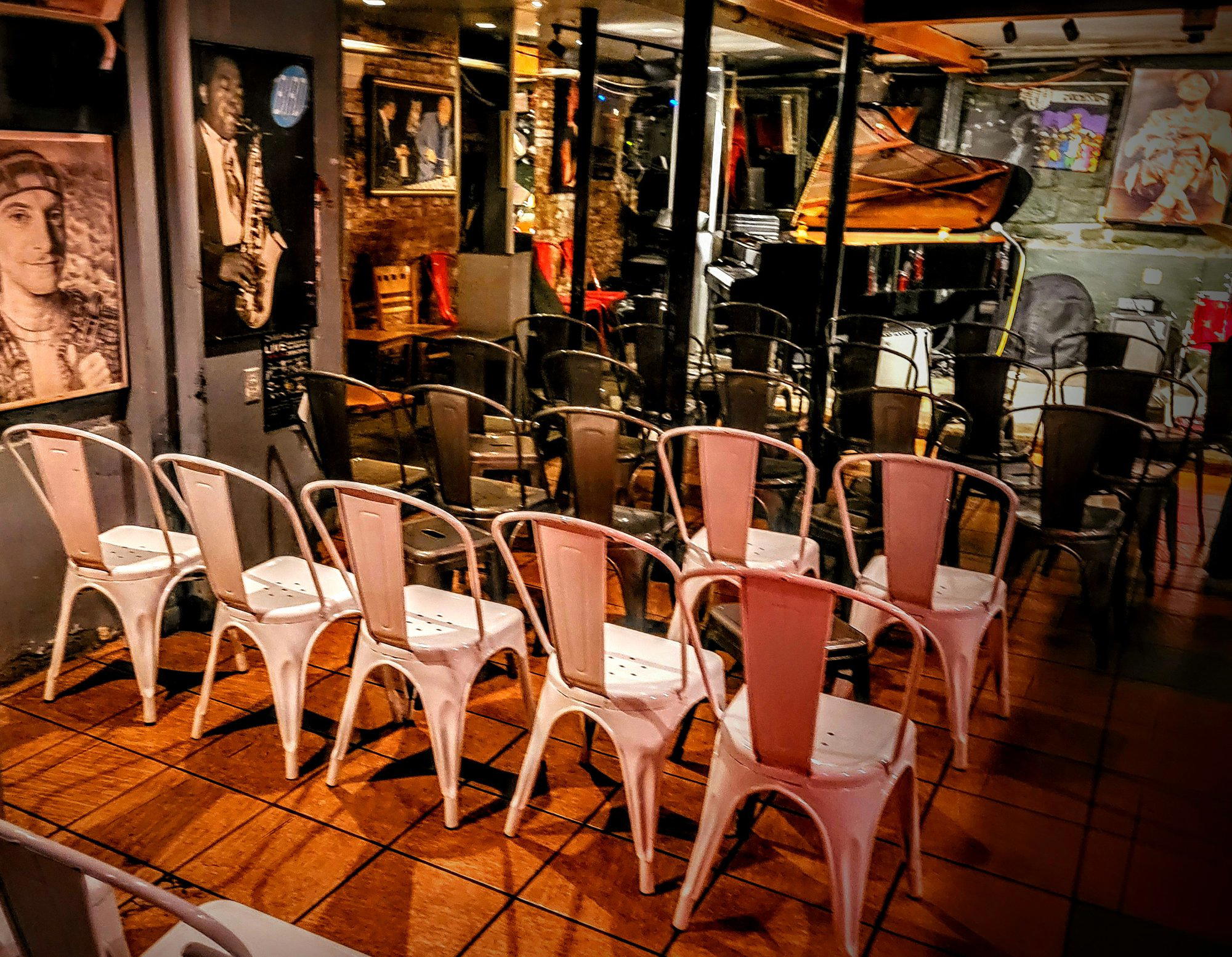
Thirty Years Underground: What Smalls Gets Right About Jazz
Greenwich Village's relationship with jazz is longer and more complicated than any single club can represent. The neighbourhood gave the world the Village Vanguard, the Blue Note, and a dozen rooms that have since closed, each one a chapter in the city's argument with itself about what live jazz should look and sound like. Smalls Jazz Club, which opened on West 10th Street in 1994, arrived as that argument was shifting: the era of the grand supper-club jazz room was receding, and a smaller, more democratic format was taking hold. Thirty years on, Smalls sits at the centre of that format's legacy in New York.
The small-room jazz model that Smalls helped define operates on a specific set of principles. Low capacity forces acoustic intimacy. No food service keeps the room quiet and attentive. Extended late-night sessions, sometimes running past 4am, allow musicians to move through material at a pace that shorter sets can't accommodate. These aren't aesthetic choices so much as structural ones, and they produce a listening environment that the city's larger venues, with their table minimums and truncated sets, cannot replicate. For anyone tracking the difference between jazz as entertainment and jazz as practice, the distinction matters enormously.
West 10th Street places Smalls in the densest concentration of serious jazz rooms in the United States. The Village Vanguard, a few blocks north, represents the institutional tier: it has been operating since 1935, holds around 123 seats, and has produced a documented catalogue of live recordings that functions almost as a parallel archive to the music itself. The Blue Note operates at a different scale entirely, with a tourist-facing programming model and table service that positions it closer to the supper-club tradition. Smalls occupies a third position: post-institutional, pre-commercial, built for the working musician and the committed listener rather than for either the heritage audience or the casual visitor.
That positioning places it in a peer group that includes rooms like Mezzrow, which shares ownership and operates on the same block, offering a similar late-night, low-capacity format. Taken together, these two rooms function as something close to a jazz incubator for the Village, where younger players work through material alongside established names, often in the same evening. The format rewards return visits: the same room sounds different depending on who is playing and how far into the night the session has run.
The Music as the Product: What the Format Delivers
In most premium bar and music venues, the experience is assembled from multiple components: the drink program, the interior design, the service choreography, the curation. At Smalls, the assembly is deliberately sparse. The music carries almost the entire weight of the experience, which means the quality of the programming is the primary variable a visitor is assessing. This is a meaningful distinction from the approach taken at, say, Superbueno or Attaboy NYC, where the drink program itself is the editorial statement and the room design amplifies it. At Smalls, the room recedes and the bandstand advances.
That model demands a higher degree of confidence from the visitor. You are not arriving at a curated cocktail experience where the structure guides you through the evening. You are arriving at a room where musicians set the agenda, and the quality of your experience depends partly on your willingness to follow where they go. For listeners who want that kind of engagement, no supplementary program — not the cocktail list at Amor y Amargo, not the architectural drama of Angel's Share — substitutes for it.
Late-Night New York: The Case for the Extended Session
New York's late-night bar and music culture has contracted significantly since 2020. Venues that once ran programming until 4am now close at 2am or earlier, and the loss has reshaped the city's nighttime geography in ways that are still being mapped. Smalls' commitment to extended sessions, which has been a structural feature of the club since its earliest years, positions it as one of the remaining anchors of the city's late-night music infrastructure. The sessions that begin after midnight operate differently from the early sets: the audience is smaller, the musicians are more likely to take risks, and the line between performance and rehearsal blurs in productive ways.
For visitors building a serious evening around live music in New York, this creates a sequencing opportunity. Early dinner in the Village, cocktails at one of the neighbourhood's more considered drink programs, then a late entry at Smalls to catch the session as it deepens. The club's accessibility, no reservation required for most sessions, entry by cover charge, makes it a realistic last stop rather than a logistical commitment that needs to be planned weeks in advance. Compare this to the booking discipline required at destination cocktail rooms like Kumiko in Chicago or Bar Leather Apron in Honolulu, where the reservation is a significant part of the planning structure.
How Smalls Compares to Small-Room Jazz Nationally and Globally
The small-room jazz model that Smalls represents has parallels in other cities, though few venues have sustained it for as long or with the same consistency. In New Orleans, rooms like Jewel of the South blend cocktail craft with live music programming in a format that is more hybridised. In Houston, Julep builds its identity around a specific drinks tradition rather than live performance. In San Francisco, ABV sits firmly in the cocktail-bar category. In Washington, D.C. Allegory operates as a design-led bar program within a hotel context. None of these rooms are attempting what Smalls does, which is to make the live music session the sole organising principle of the experience.
Internationally, the closest analogues tend to be in cities with strong jazz infrastructures: Paris has a cluster of small rooms in the Latin Quarter that operate on similar principles, and Tokyo's jazz bar culture, centred on listening rooms rather than performance venues, reflects a related but distinct tradition. What distinguishes Smalls within this global context is the density of talent that New York's position as the centre of contemporary jazz makes available on any given night. A room in Paris can programme consistently, but it cannot draw from the same pool. Even The Parlour in Frankfurt on the Main, operating in a city with a serious jazz scene, works within different structural constraints.
Planning Your Visit
Smalls Jazz Club is located at 183 W 10th Street in Greenwich Village, within walking distance of the A, C, E, B, D, F, and M lines at West 4th Street. Sessions typically run across multiple sets beginning in the early evening, with late-night programming continuing well past midnight. Entry is by cover charge, and the venue does not require advance reservations for most sessions, making it one of the more accessible serious jazz rooms in the city. For a broader picture of where Smalls fits within New York's drinking and nightlife map, see our full New York City restaurants guide.
Quick reference: 183 W 10th St, Greenwich Village, New York, NY 10014. Walk-in entry by cover charge. Late-night sessions most nights.
Cuisine Lens
A quick peer reference to anchor this venue in its category.
| Venue | Awards |
|---|---|
| Smalls Jazz ClubThis venue — the venue you are viewing | Not listed |
| The Long Island Bar | World's 50 Best |
| Superbueno | World's 50 Best |
| Amor y Amargo | World's 50 Best |
| Angel's Share | World's 50 Best |
Continue exploring
More in New York City
Bars in New York City
Browse all →
Restaurants in New York City
Browse all →
Hotels in New York City
Browse all →






At a Glance
- Intimate
- Classic
- Well Known
- Lively
- Late Night
- Special Occasion
- Live Music
- Historic Building
- Seated Bar
- Lounge Seating
- Classic Cocktails
Current opening hours
- Monday
- 7 PM–3:30 AM
- Tuesday
- 7 PM–3:30 AM
- Wednesday
- 7 PM–3:30 AM
- Thursday
- 7 PM–3:30 AM
- Friday
- 2 PM–3:30 AM
- Saturday
- 2 PM–3:30 AM
- Sunday
- 2 PM–3:30 AM
Hours can change for holidays and private events. Last verified .
Dimly lit underground space with high-energy live jazz performances creating an intimate, musician-focused atmosphere.
Know Before You Go
- Getting there
- 183 W 10th St, New York, NY 10014