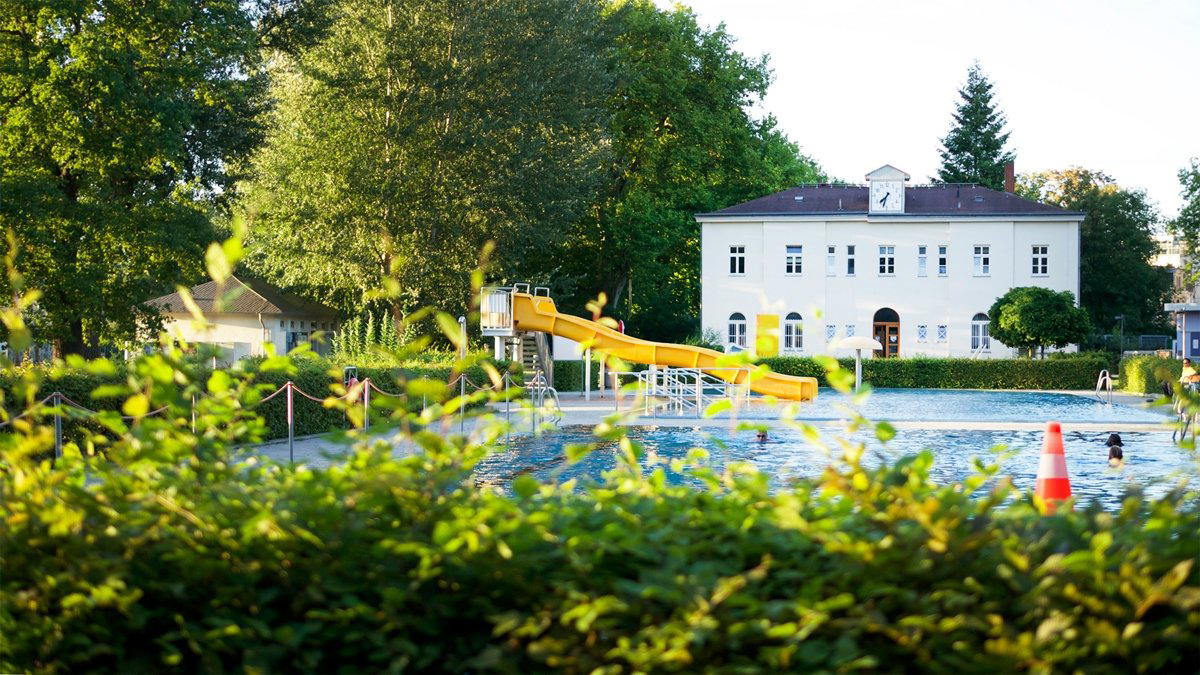
A former public bath complex on Schreberstraße, Schreberbad occupies a slice of Leipzig's early-20th-century municipal heritage and now draws a crowd that understands the city's shift from post-industrial grit to considered drinking culture. The address puts it within reach of the city centre without sitting inside it, which tells you something about who this place is for and what kind of evening it encourages.

Pearl is the En Primeur Club membership app — saves, bookings, and concierge access live there. Same editors, same standards.
- Address
- Schreberstraße 15, 04109 Leipzig, Germany
- Phone
- +49 341 23493380
- Website
- l.de
- Directions
- Get directions
Water, Tile, and the Architecture of Anticipation
There is a particular kind of pleasure in drinking somewhere that was built for a completely different purpose. Former industrial halls, converted printing works, repurposed ecclesiastical spaces: Germany has a long tradition of layering new social functions onto old civic ones. In Leipzig, that tradition finds one of its more literal expressions at Schreberbad, where the bones of a public bathing facility on Schreberstraße 15 set the physical terms for everything that follows. The tile work, the proportions, the residual institutional geometry of a space designed for municipal hygiene rather than leisure drinking: all of it creates a register that no purpose-built bar can replicate, because no purpose-built bar would dare.
Leipzig's bar culture has matured considerably since the city's post-reunification period, when cheapness and volume defined most of what was on offer. The current scene is more stratified. There are neighbourhood regulars, serious cocktail programs, late-format spots, and a growing cluster of venues that treat sourcing and production as editorial statements rather than marketing copy. Schreberbad sits in that broader conversation, drawing on Leipzig's continued identity as a city that generates cultural momentum without the cost pressures that flatten experimentation in Frankfurt or Munich.
Where the Food Comes From and Why That Question Matters
The ingredient sourcing question is rarely neutral in a venue like this. When a bar or restaurant occupies a historically loaded space, it faces a choice: perform a version of the past, or take the setting as a foundation for something with its own point of view. Saxony's producer network, from small-batch distillers in the Erzgebirge to market gardeners supplying the city's eastern neighbourhoods, gives bars in this city material to work with that their counterparts in more expensive cities cannot always access at equivalent price points.
In practical terms, this means a drink menu that can credibly point to provenance rather than simply listing ingredients by name. It also means the food component, where it exists, carries more weight than a conventional snack offering. A bar in a former bathhouse with access to regional supply chains occupies a more interesting position than one simply pouring well-known spirits in a stripped-back room. Whether Schreberbad has fully committed to that model or operates closer to a more conventional format is a question that the visit itself answers better than any description can.
Leipzig's Bar Geography: Where Schreberbad Fits
The Schreberstraße address places Schreberbad in close proximity to Leipzig's city centre, which means it benefits from foot traffic patterns that more peripheral venues have to work harder to attract. The distinction matters when you consider how Leipzig's bar scene distributes itself. Some of the city's most interesting programs have migrated toward Connewitz and Schleußig, following cheaper rents and a younger residential base. Venues closer to the centre, by contrast, operate in a zone where the audience is broader and the pressure to hold multiple formats simultaneously, casual early evening, more considered late-night, is higher.
For visitors building a bar itinerary in Leipzig, Espresso Zack Zack and Industriestraße 18 represent different points on the same city's spectrum. The former leans into the coffee-to-cocktail continuity that several European cities have made central to their daytime-to-night narrative; the latter works a more industrial-aesthetic register. Schreberbad's former-bathhouse setting gives it a distinct physical identity within that peer group, which is not nothing in a city where differentiation increasingly requires either serious program depth or a space that does some of the work on its own.
Benchmarking Against the German Bar Scene
Leipzig occupies a different tier from Germany's bar capitals. Buck and Breck in Berlin and Le Lion Bar de Paris in Hamburg have established international reference points for what German cocktail culture can produce at its ceiling. Goldene Bar in Munich operates in a heritage-space register not entirely unlike Schreberbad's, though Munich's cost base and tourist density create a very different economic environment. Further afield, The Parlour in Frankfurt on the Main, Bar Trattoria Celentano in Cologne, and Uerige in Dusseldorf each define their city's bar identity in ways that reflect local culture rather than chasing a generic cocktail-bar template.
Leipzig's contribution to that national conversation is less about technical competition at the elite level and more about what happens when a city with genuine creative density and manageable overheads develops a bar culture on its own terms. The result tends toward venues that are specific in character, affordable by German urban standards, and less anxious about performing sophistication than their counterparts in larger cities. Schreberbad, in its converted civic shell, is an expression of exactly that dynamic.
For international reference, bars like Bar Leather Apron in Honolulu demonstrate that serious drinking culture can emerge in cities not typically associated with cocktail programs, which is a useful frame for understanding Leipzig's current moment. The city is not an afterthought on the European bar map; it is simply running on a different timeline and at a different price point than the markets that attract most of the critical attention.
Planning a Visit
Schreberbad is located at Schreberstraße 15, 04109 Leipzig, placing it within walking distance of the city centre and accessible by tram from Leipzig Hauptbahnhof without requiring additional planning. For a fuller picture of what the city's bar and restaurant scene offers across different neighbourhoods and formats, the EP Club Leipzig guide maps the relevant venues by area and style.
Continue exploring
More in Leipzig
Bars in Leipzig
Browse all →
Restaurants in Leipzig
Browse all →

Hotels in Leipzig
Browse all →
Wineries in Leipzig
Browse all →
Details
- Lively
- Casual Hangout
- Beer Garden
- Outdoor Terrace