Berber & Q
Berber & Q occupies a converted railway arch on Acton Mews in Hackney, where open-fire cooking and Middle Eastern-inflected menus meet a drinks program that takes its cues from the same region's botanical traditions. The space is loud, smoke-edged, and deliberately informal, a sharp contrast to the technical precision in the glass.
Pearl is the En Primeur Club membership app — saves, bookings, and concierge access live there. Same editors, same standards.
- Address
- 338 Acton Mews, London E8 4EA, United Kingdom
- Phone
- +44 20 7923 0829
- Website
- berberandq.com
- Directions
- Get directions
 Saves & bookings on Pearl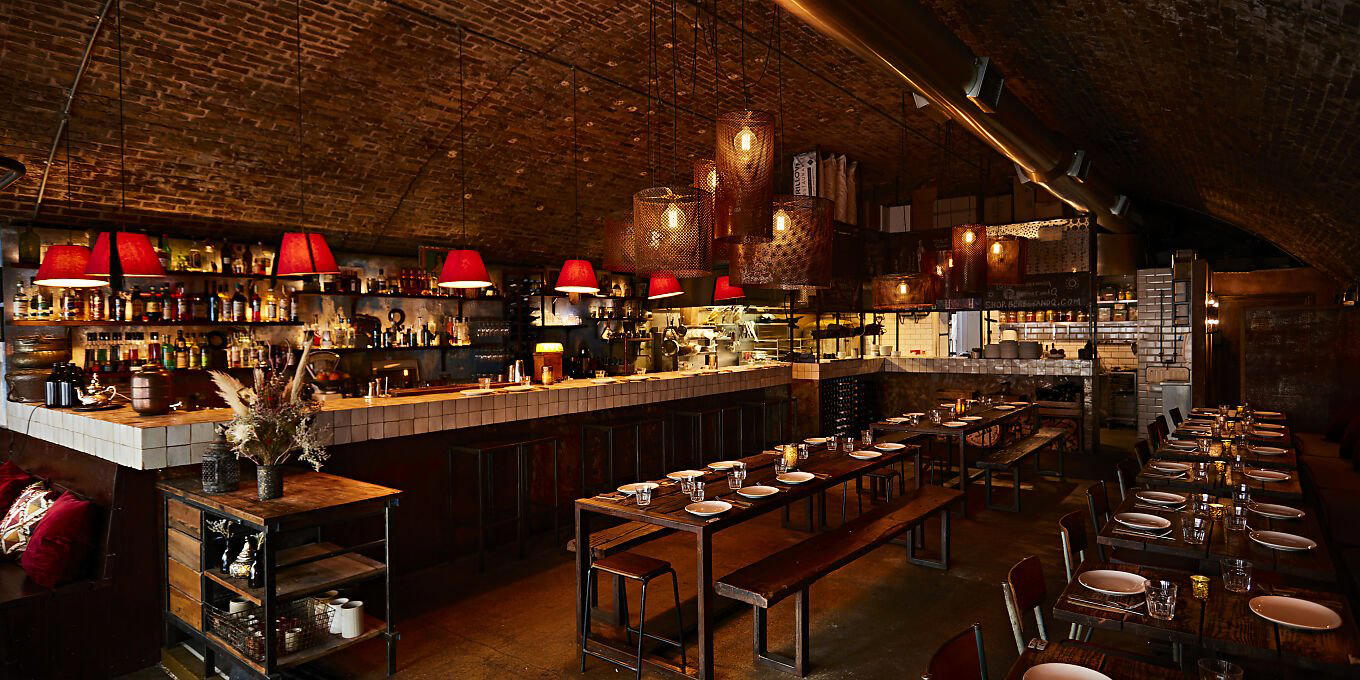
Hackney's railway arches have hosted enough transient bar concepts over the past decade to earn a degree of scepticism, but Berber & Q has settled into a durable presence at 338 Acton Mews. Berber & Q at 338 Acton Mews sits inside that longer-running cohort, a space defined by its physical fabric as much as its menu. Arrive at the arch and the cues are immediate: smoke drifts from the grill, the ceiling is low and brick-vaulted, and the noise level suggests a room that fills early and stays full.
Fire, Smoke, and the Architecture of the Room
The arch format matters to how the restaurant and bar feel together. In venues of this type, the kitchen is rarely hidden, the grill is part of the atmosphere, and the drinks counter sits in natural proximity to it. London has moved steadily toward this kind of open, integrated room format over the past decade, stepping away from the strict delineation between bar and dining floor that characterised an earlier generation of mid-market openings. Berber & Q belongs to the post-separation model: the drinks program is not an afterthought to the food, and the food is not merely a reason to extend drinking time. Both sides carry weight.
For logistics: the address is 338 Acton Mews, London E8 4EA, United Kingdom. The railway arch setting means the space has a fixed physical envelope, it does not expand to absorb a queue, so arriving without a reservation during peak hours is a risk worth calculating before you go.
The Drinks Program Through a Botanical Lens
The editorial angle on Berber & Q's bar is not simply what it stocks but what it chooses to emphasise. Middle Eastern and North African botanical traditions offer a distinct reference point for spirits curation, think anise-heavy arak and its regional relatives, flower-forward syrups derived from rose and orange blossom, and the drier, herb-led profiles that appear across the Maghreb's drinking culture. London bars that engage seriously with these traditions occupy a niche relative to the gin-and-vermouth-centred programs that dominate the city's more technically decorated rooms.
Across London's bar scene, the past several years have seen an increasing number of programs organise their back bars around a coherent regional or botanical logic rather than simply stocking a range of premium international spirits. 69 Colebrooke Row works from a precision-science frame. A Bar with Shapes For a Name pushes into formal conceptualism. Amaro builds its identity around a single spirit category. Berber & Q's drinks logic is grounded instead in geography and culinary tradition, the cocktail list reflects the same part of the world that the kitchen draws from, which gives the overall experience a coherence that menus assembled from trend-led spirits often lack.
Arak-based builds, fermented-fruit shrubs, and drinks that use rose water or pomegranate as genuine structural elements rather than garnish flourishes represent a different technical vocabulary from the clarified and stirred programs that have dominated London's award-listed bars in recent years. The bar at Berber & Q operates closer to the food side of the menu than to the cocktail-as-standalone-art model, drinks are built to work alongside the grill.
The Back Bar as Regional Statement
Curation in a drinks program is most legible when the selection commits to something. A back bar that holds forty premium bottles from twelve different spirit categories signals breadth; one that holds twenty bottles organised around a single regional logic signals conviction. The better bars in this second model use their selection as an argument: this is what this cuisine drinks, and here is why it works. Academy makes a comparable argument from a different cultural reference point. Berber & Q's curation, at its most coherent, positions the drinks counter as an extension of the kitchen's sourcing logic rather than a parallel retail operation.
Beyond London, the principle of drinks programs organised around culinary geography rather than spirit-category prestige has produced some of the more interesting bar programs in the UK. Bramble in Edinburgh, Schofield's in Manchester, and Merchant Hotel in Belfast each demonstrate that strong point-of-view curation holds up across different city scales and formats. Horseshoe Bar Glasgow, Mojo Leeds, and L'Atelier Du Vin in Brighton represent further points on that spectrum. Internationally, Bar Leather Apron in Honolulu is another venue where curation logic defines the experience more than bottle count does. Berber & Q's geographic focus gives it a comparative advantage in differentiation, the Middle Eastern and North African drinks tradition is less frequently mined at the London bar level than, say, Japanese whisky or Mesoamerican agave spirits.
What the Food Does to the Drinks
The charcoal grill shapes everything else in the room, including the drinks. Smoke, spice, and char as dominant flavours on the plate set a high-contrast baseline against which lighter, flower-forward cocktails register differently than they would alongside a cold kitchen. Drinks programs that work in proximity to open-fire cooking often skew toward acidity, sweetness, or aromatic weight to hold their ground, thin, technically precise sours can disappear next to heavily spiced lamb. The botanical and anise-led profiles in the Berber & Q drink repertoire are structurally well-suited to this dynamic.
This is the practical argument for pairing regional drinks with regional food: the flavour relationships have been developed over centuries of shared table culture, not reverse-engineered by a cocktail developer working from a menu specification. The Middle Eastern tradition of serving arak with mezze, the anise-forward spirit cutting through fats and amplifying herbs, is the template. Berber & Q applies a version of that logic in a London railway arch, which is both an obvious and an underexplored move in the city's bar-restaurant sector.
Planning Your Visit
Hackney operates on a different hospitality rhythm than the West End or the City. The area around Acton Mews and London Fields draws a crowd that eats later and stays longer, which means the room at Berber & Q tends to find its full atmosphere after 8pm on weekend evenings. Earlier sittings are less pressured and better suited to extended time at the bar before or after the table. For those building a wider London bar itinerary, the venue sits at one end of a coherent East London circuit;
City Peers
Comparable venues nearby, for context on price, style, and recognition.
| Venue | Cuisine | Price | Notes |
|---|---|---|---|
| Berber & QThis venue — the venue you are viewing | cocktail_bar | $$ | Not listed |
| Alchemy Bar | cocktail_bar | $$ | City of London |
| The Drapers Arms | pub | $$ | Barnsbury |
| The Wickham Arms | pub | $$ | Brockley |
| Yeni Umut 2000 Dalston | Bar | $$ | Dalston |
| Skehans | pub | $$ | New Cross Gate |
Continue exploring
More in London
Bars in London
Browse all →
Restaurants in London
Browse all →
Hotels in London
Browse all →

At a Glance
- Lively
- Trendy
- Industrial
- Group Outing
- Casual Hangout
- Standalone
- Communal Tables
- Seated Bar
- Craft Cocktails
Current opening hours
- Monday
- Closed
- Tuesday
- Closed
- Wednesday
- 6–10:30 PM
- Thursday
- 6–10:30 PM
- Friday
- 6–11 PM
- Saturday
- 6–11 PM
- Sunday
- Closed
Hours can change for holidays and private events. Last verified .