Wynand Fockink

One of Amsterdam's oldest jenever tasting houses, Wynand Fockink operates from a narrow alley off the Damrak, pouring traditional Dutch spirits in the proeflokaal format that once defined the city's drinking culture. The address on Pijlsteeg has held this role since 1679, and the space has changed little in character since. EP Club awarded it Pearl 2 Star Prestige recognition in 2025.
 Discover on Pearl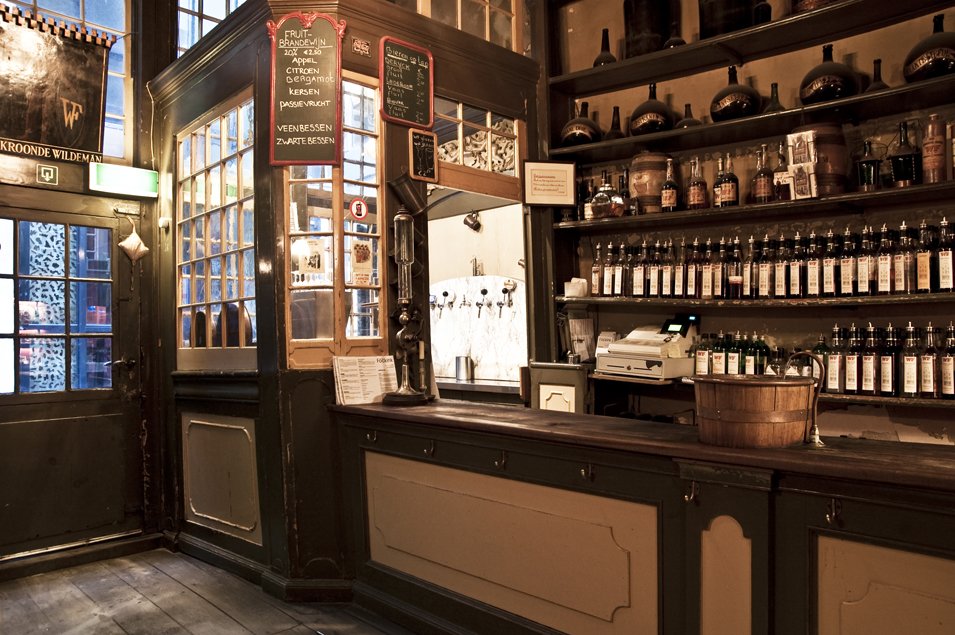
A Narrow Alley, Three Centuries of Proof
In Amsterdam's older city centre, the alley known as Pijlsteeg connects the Damrak to the Nieuwendijk without much ceremony. It is easy to miss, which is partly the point. The proeflokaal tradition, in which a distillery opened a small tasting room directly attached to or near its production site, was never designed for foot traffic. It was designed for regulars who already knew where to go. Wynand Fockink, at Pijlsteeg 31, is one of the few places in the Netherlands where that format has survived intact, operating from premises associated with the distillery since 1679.
The physical space communicates its age before you have ordered anything. Low ceilings, wooden shelving stacked with hand-labelled bottles, and a counter that allows for standing rather than sitting: these are not design choices imported from a contemporary bar program. They are what the proeflokaal always looked like, and Wynand Fockink has not felt the need to update the template. EP Club awarded it Pearl 2 Star Prestige recognition in 2025, placing it among the Netherlands' most significant spirits destinations.
The Proeflokaal Format and Where It Sits in Dutch Drinking History
The Dutch relationship with distilled spirits is older and more specific than most visitors realise. Jenever, the juniper-forward grain spirit that preceded and influenced what became gin, was produced commercially in the Netherlands from the late sixteenth century. By the seventeenth and eighteenth centuries, Amsterdam's canal district supported dozens of distilleries, many running their own tasting rooms where buyers, merchants, and ordinary drinkers could sample before purchasing. The proeflokaal was a commercial and social institution simultaneously.
Most of those rooms have closed. Some survive as bars that have borrowed the aesthetic without the substance. A smaller group, including Wynand Fockink, maintains an unbroken connection to the production tradition that gave the format meaning. That lineage matters when you are drinking spirits whose character is defined by recipe continuity and aging in wooden casks rather than by innovation cycles. The Dutch spirit market has seen renewed international interest since the gin boom created appetite for botanical spirits with documented provenance, and Wynand Fockink occupies an authoritative position in that context. For comparable distillery heritage elsewhere in the Netherlands, Nolet Distillery in Schiedam and Van Kleef in The Hague represent the other principal surviving nodes of traditional Dutch distilling.
What You Are Actually Drinking
Jenever divides into two broad categories. Jonge jenever (young) uses a higher proportion of neutral grain spirit, resulting in a lighter, more approachable pour that dominated Dutch consumption after post-war production regulations reshaped the industry. Oude jenever (old) refers not to age but to the traditional recipe style, which uses a higher malt wine content and often sees time in oak, producing a rounder, more complex spirit with faint whisky-like undertones. At a house with Wynand Fockink's production history, the range extends well beyond those two categories into fruit-infused jenevers, herbal liqueurs, and aged expressions that have been part of the catalogue for generations.
The traditional serving practice here is worth understanding before you arrive. A tulip-shaped glass is filled to the brim, requiring the first sip to be taken while the glass remains on the counter, leaning forward rather than lifting. This is not theatre invented for tourists. It is the original practice, emerging from the practical reality of a brimming pour in a standing room. The combination of an aged jenever and a glass of Dutch lager served alongside it is known as a kopstoot, a pairing that has its own documented place in Amsterdam's social history. Bols, whose distilling history in Amsterdam also stretches back centuries, represents the other major reference point for understanding how Dutch spirits production evolved from the same seventeenth-century origins.
Pijlsteeg in the Context of Amsterdam's Old Centre
The address sits in the dense, tourist-heavy corridor between Centraal Station and Dam Square, a part of the city that has absorbed enormous visitor pressure without much of the character that once defined it. Wynand Fockink's survival in this location is partly a function of the alley's obscurity, which has kept it from the fate of neighbouring streets. The immediate area rewards walking at a pace slow enough to notice what is not signposted. For a fuller picture of Amsterdam's drinking scene beyond the tourist axis, see our full Amsterdam bars guide. For restaurants and hotels in the city, our Amsterdam restaurants guide and our Amsterdam hotels guide provide the broader context. The full range of Amsterdam's drink-focused producers is mapped in our Amsterdam wineries guide, and for activities beyond eating and drinking, our Amsterdam experiences guide is the practical starting point.
Planning Your Visit
Wynand Fockink operates as a standing tasting room rather than a seated bar, which affects how long most visits run. The format encourages deliberate tasting over extended drinking sessions, and the space's compact dimensions mean crowds at peak tourist hours can make considered tasting difficult. Late afternoon on weekdays tends to offer the most manageable conditions. The address at Pijlsteeg 31 is precise enough to locate without difficulty, though the alley does not announce itself from the Damrak end. No booking is required for individual visitors, and the walk-in format is part of what the proeflokaal tradition implies. Guided tasting sessions run on a scheduled basis and are worth considering for visitors who want a structured introduction to the jenever range rather than open-ended counter service.
For those building a broader itinerary around heritage spirits and distilling traditions, the comparison set extends internationally. Aberlour in Aberlour represents the Scottish single malt tradition, while Achaia Clauss in Patras holds a comparable position in Greek wine and spirits history. In the New World, Accendo Cellars in St. Helena, Adelaida Vineyards in Paso Robles, Adelsheim Vineyard in Newberg, Alban Vineyards in Arroyo Grande, and Abadía Retuerta in Sardón de Duero each represent the kind of production-led heritage that gives a spirits or wine destination its long-term authority.
Frequently Asked Questions
- What should I drink at Wynand Fockink?
- The core of the offering is jenever in both jonge and oude styles, with the aged malt wine expressions providing the most direct connection to the distillery's historical recipe tradition. Fruit-infused liqueurs from the house catalogue are worth exploring alongside the straight jenevers. EP Club's Pearl 2 Star Prestige recognition in 2025 reflects the depth and consistency of the spirits program rather than a single standout expression.
- What is the main draw of Wynand Fockink?
- The primary reason to visit is the unbroken continuity of the proeflokaal format in a city where most comparable venues have either closed or been converted. The combination of a production history dating to 1679 and a physical space that has not been redesigned for contemporary hospitality gives it a documentary authenticity that few Amsterdam addresses can offer. The Pearl 2 Star Prestige award from EP Club (2025) confirms its standing in the premium tier of the city's spirits destinations.
- Can I walk in to Wynand Fockink?
- Yes. The proeflokaal format is built around walk-in access, and no reservation is needed for individual visitors or small groups arriving at the counter. Guided tasting sessions operate on a schedule and have separate capacity, so if a structured tasting is the priority, checking availability in advance is advisable. The address at Pijlsteeg 31 is in central Amsterdam, close to Dam Square.
- Who is Wynand Fockink leading for?
- Visitors with an interest in Dutch spirits history, traditional production methods, or the botanical lineage connecting jenever to contemporary gin will find the most to engage with here. It is also a natural stop for anyone building a comparative picture of European heritage distillers. The standing-room format and relatively brief visit duration make it accessible to a broad range of travellers rather than a specialist-only destination.
- How does Wynand Fockink differ from a standard Amsterdam bar or spirits shop?
- Unlike a conventional bar, Wynand Fockink operates as a production-linked tasting room, meaning the spirits on the counter come directly from the distillery's own catalogue rather than a curated third-party selection. Unlike a spirits shop, consumption on the premises is the primary purpose, in a physical environment that has been part of Amsterdam's drinking culture since the seventeenth century. That combination of production provenance and in-house tasting tradition is what EP Club's Pearl 2 Star Prestige recognition in 2025 reflects.
Peer Set Snapshot
These are the closest comparables we have in our database for quick context.
| Venue | Awards | Notes |
|---|---|---|
| Wynand Fockink | Pearl 2 Star Prestige | This venue |
| Bols | Pearl 3 Star Prestige | |
| Nolet Distillery | Pearl 2 Star Prestige: 0pts | |
| Van Kleef | Pearl 2 Star Prestige |
Access the Cellar?
Our members enjoy exclusive access to private tastings and priority allocations from the world's most sought-after producers.
Get Exclusive Access