
Winzergenossenschaft Mayschoss-Altenahr is one of the Ahr Valley's defining cooperative wineries, holding a Pearl 2 Star Prestige award (2025) and operating from the heart of Germany's northernmost red wine region. The slate and volcanic soils of the Ahr gorge shape every bottle, with Spätburgunder as the region's defining argument. A stop here connects visitors directly to a winemaking tradition that has outlasted floods, wars, and market fashions.
 Discover on Pearl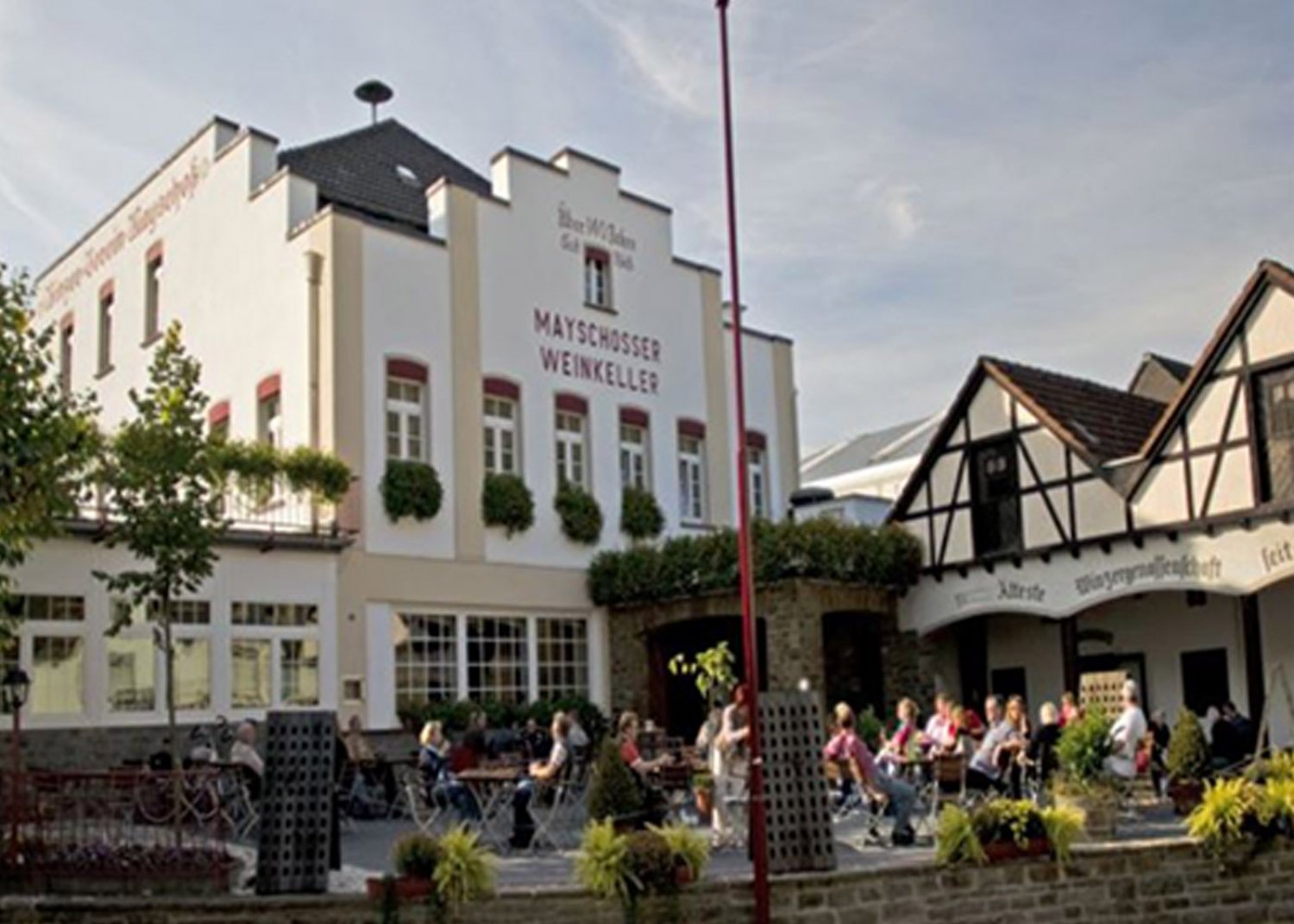
Where the Ahr Gorge Does the Talking
The Ahr Valley does not announce itself gradually. The road into Mayschoß drops between steep, slate-faced slopes, the river running close to the vineyard walls, and the village sitting at the base of it all with the practical, unhurried atmosphere of a place that has been making wine longer than most of its visitors have been aware of the region. Winzergenossenschaft Mayschoss-Altenahr occupies that setting with the confidence of an institution rather than the self-promotion of a destination. The cooperative's address on the Ahr-Rotweinstraße places it squarely on the route that defines the region's wine identity, and arriving here feels less like visiting a tasting room and more like reading a geological argument in person.
The surrounding terrain explains the wines before a glass is poured. The Ahr's steep valley walls force viticulture into a set of conditions that barely exist at this latitude anywhere else in Germany: south-facing slopes that trap heat, blue and grey slate that retains warmth into the evening, and volcanic Devonian soils in certain parcels that push a mineral edge into the finished wines. The result is a Spätburgunder (Pinot Noir) tradition that has little in common with the soft, commercially adjusted versions that dominated German red wine for much of the twentieth century. The better Ahr examples read more like cool-climate Burgundy than like their domestic counterparts from warmer regions further south.
The Cooperative Model in a Prestige Region
German wine cooperatives occupy an awkward position in contemporary wine culture. For most of the post-war era, the cooperative system prioritised volume and price accessibility over terroir expression, and the reputational damage from that period still colours how international buyers approach the category. The Ahr, however, developed differently. The valley's extreme topography made large-scale mechanisation impractical, which meant cooperative membership retained a closer connection to individual parcel work than was typical elsewhere. Winzergenossenschaft Mayschoss-Altenahr, founded in 1868, is widely cited as one of the oldest wine cooperatives in Germany, a credential that carries weight not as heritage decoration but as evidence of accumulated knowledge about how specific sites behave across different vintages.
The 2025 Pearl 2 Star Prestige award places the cooperative inside a peer set defined by measurable quality signals rather than marketing positioning. In a region where single-estate producers like Schlossgut Diel in Rümmelsheim and Weingut Clemens Busch in Pünderich have built reputations through focused, parcel-level work, a cooperative earning prestige recognition signals something about the quality floor the Ahr now holds across producer types. For comparison, estates such as Kloster Eberbach in Eltville and Schloss Vollrads in Oestrich-Winkel in the Rheingau operate with historic institutional weight behind them; the Mayschoss cooperative draws on comparable institutional depth but applied to a red wine terroir with a much smaller international profile.
Spätburgunder and the Ahr's Case for Itself
The Ahr produces roughly 560 hectares of vines, making it one of Germany's smallest designated wine regions. Approximately 85 percent of that area is planted to red varieties, with Spätburgunder accounting for the dominant share. That concentration gives the region a coherence that larger, more diverse German appellations lack: the Ahr is, essentially, a single-argument region, and the argument is about whether slate-grown, cool-climate Pinot Noir from a narrow valley in western Germany can hold its own against the international Burgundy benchmark.
Answer, at the better end of production, is credible. The Ahr's Spätburgunder typically shows lighter colour than warmer-climate examples, with a tighter structure and a mineral persistence that comes directly from the slate parent rock. Older vintages from leading producers age with more grace than the wines' modest price positioning might suggest. This is the editorial context in which Winzergenossenschaft Mayschoss-Altenahr operates: not as a curiosity from an obscure German backwater, but as a significant contributor to a small region making a serious case for itself in the international Pinot Noir conversation.
For visitors exploring Germany's wider wine geography, the contrast with Riesling-dominated regions is instructive. Estates like Weingut A. Christmann in Neustadt an der Weinstraße and Weingut Bassermann-Jordan in Deidesheim in the Pfalz operate within a white wine tradition anchored in limestone and sandstone soils; Weingut Battenfeld-Spanier in Hohen-Sülzen works in the Rheinhessen. The Ahr's slate-and-red-wine identity is a different geological and stylistic proposition entirely, and understanding that difference is part of what a visit here offers.
The Flood Recovery Context
Any honest account of the Ahr Valley in the mid-2020s has to acknowledge the July 2021 floods, which caused catastrophic damage to vineyards, infrastructure, and communities throughout the valley. Mayschoß was among the hardest-hit villages. The recovery effort has been extensive, and the cooperative's continued operation and 2025 award recognition suggest a meaningful degree of restoration. The floods did not erase the terroir, but they did remind the region and its visitors that the same topography that creates ideal vine conditions also concentrates weather events in ways that flat agricultural land does not. Visiting the Ahr now carries that awareness, and the wines from post-flood vintages carry a specific kind of significance for anyone tracking the region's trajectory.
Planning a Visit
The Ahr Valley sits in the Rhineland-Palatinate, roughly 30 kilometres south of Bonn. The nearest train connections run through Remagen, from which the Ahrtalbahn rail line follows the river valley west through Altenahr toward Mayschoß, making the journey accessible without a car and giving a first view of the vine-covered slopes before arrival. The Ahr-Rotweinstraße running through the village is the primary wine tourism axis for the region, and Winzergenossenschaft Mayschoss-Altenahr sits directly on it at address Ahr-Rotweinstraße 42.
Given the cooperative's institutional scale and regional standing, visiting outside peak summer weekends will generally allow more considered time with the range. The Ahr's wine tourism season runs from spring through autumn, with the harvest period in September and October bringing the heaviest traffic. For visitors combining wine with food and accommodation, our full Mayschoß restaurants guide, our full Mayschoß hotels guide, and our full Mayschoß bars guide cover the local options in detail. The broader wine picture is in our full Mayschoß wineries guide, and anyone wanting to extend beyond wine should check our full Mayschoß experiences guide.
For those building a longer German wine itinerary that includes the Ahr alongside Mosel, Franken, or Nahe producers, the cooperative makes a logical anchor stop: it is accessible, historically grounded, and representative of what makes the Ahr's case for quality red wine production genuinely worth attention. German wine institutions of comparable historic depth, such as Weingut Bürgerspital zum Heiligen Geist in Würzburg, operate in different regional traditions but share the same sense of accumulated institutional authority that makes cooperative and estate visits more than retail transactions. For producers from entirely different traditions, Abadía Retuerta in Sardón de Duero and Aberlour in Aberlour offer instructive contrasts in how geography shapes the character of what ends up in the bottle.
Frequently Asked Questions
- How would you describe the overall feel of Winzergenossenschaft Mayschoss-Altenahr?
- The feel is closer to working institution than polished destination. The village setting in the Ahr gorge is physically dramatic, the cooperative's 1868 founding date is visible in the sense of accumulated purpose, and the 2025 Pearl 2 Star Prestige recognition positions it at the more serious end of the region's quality spectrum. Prices at German cooperatives of this type typically remain more accessible than equivalent-quality single-estate producers, which gives the visit a practical as well as editorial value.
- What's the signature bottle at Winzergenossenschaft Mayschoss-Altenahr?
- Spätburgunder is the Ahr's defining variety and the cooperative's primary argument. The region's slate and volcanic soils push a mineral, cool-climate character into the wine that distinguishes it from warmer German red wine regions. Specific current releases and winemaker credits are not confirmed in our data, so checking directly with the cooperative before visiting is the reliable approach for current range details.
- What makes Winzergenossenschaft Mayschoss-Altenahr worth visiting?
- The combination of historical depth (founded 1868), current quality recognition (Pearl 2 Star Prestige, 2025), and direct access to one of Germany's most geologically specific red wine terroirs makes it a serious stop for anyone tracking the Ahr's continued recovery and development post-2021. The Mayschoß location on the Ahr-Rotweinstraße also places it at the centre of the valley's wine tourism route, making it a practical anchor for broader regional exploration.
- How hard is it to get in to Winzergenossenschaft Mayschoss-Altenahr?
- As a cooperative rather than a small private estate, access is generally more open than at allocation-only boutique producers. That said, the Ahr Valley draws significant visitors during harvest season and summer weekends, and the post-2021 flood recovery has reduced some regional capacity. Confirming opening hours and any tasting appointment requirements in advance is advisable. Phone and website details are not confirmed in our current data; the address at Ahr-Rotweinstraße 42, 53508 Mayschoß is the reliable starting point for direct enquiry.
Peer Set Snapshot
These are the closest comparables we have in our database for quick context.
| Venue | Awards | Notes |
|---|---|---|
| Winzergenossenschaft Mayschoss-Altenahr | Pearl 2 Star Prestige | This venue |
| Schloss Johannisberg | 50 Best Vineyards #2 (2025); Pearl 4 Star Prestige | |
| Weingut Dr. Loosen | 50 Best Vineyards #16 (2025); Pearl 4 Star Prestige | |
| Weingut Balthasar Ress | Pearl 2 Star Prestige | |
| Weingut Battenfeld-Spanier | Pearl 3 Star Prestige | |
| Schloss Vollrads | 50 Best Vineyards #33 (2019); Pearl 3 Star Prestige |
Access the Cellar?
Our members enjoy exclusive access to private tastings and priority allocations from the world's most sought-after producers.
Get Exclusive Access