
Weingut Klumpp operates from Bruchsal in Baden, a wine region where loess soils and a warm continental climate push ripeness without sacrificing structure. Recognised with a Pearl 2 Star Prestige award in 2025, the estate sits within a peer set of German producers defined by terroir precision rather than volume. Visiting means engaging directly with Baden winemaking at a credentialed address.
 Discover on Pearl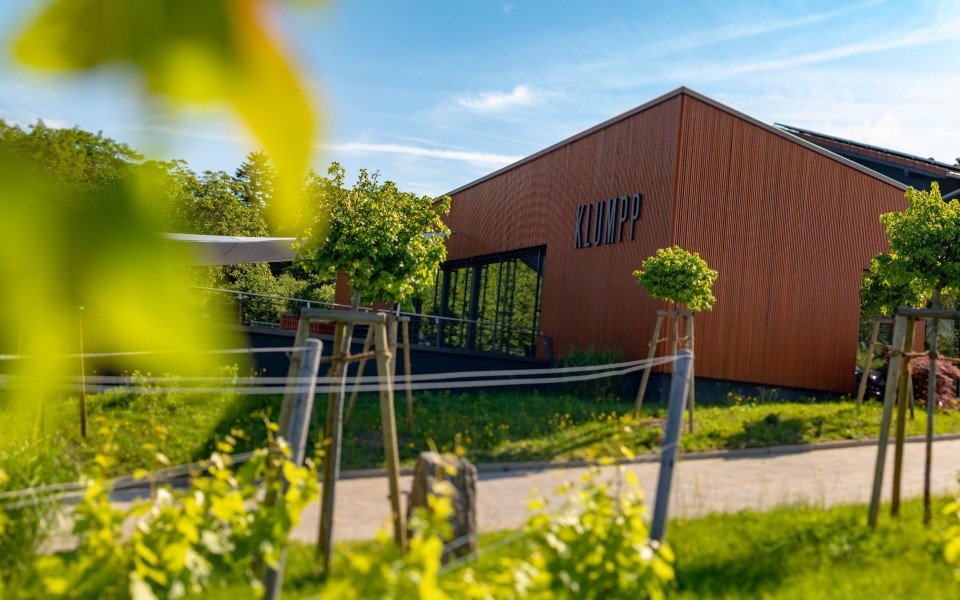
Baden's Loess Country and What Grows Here
The stretch of Baden running north from Karlsruhe toward Heidelberg is not where most wine travellers instinctively head. The Kaiserstuhl gets the coverage; the Ortenau gets the tourism infrastructure. But the Kraichgau, the hilly terrain between the Rhine plain and the Odenwald where Bruchsal sits, has its own argument to make. The soils here shift between loess, loam, and pockets of shell limestone — a combination that produces wines with a particular textural weight, not the lean mineral precision of the Mosel or the extract-heavy style sometimes associated with Kaiserstuhl Spätburgunder. This is quieter, rounder country, and the wines tend to reflect that.
Bruchsal itself is an administrative town rather than a wine destination, which means producers here compete on quality signals rather than foot traffic. The address at Heidelberger Str. 100 places Weingut Klumpp at the edge of that context: a working estate in a city better known for its baroque palace than its cellars. That positioning, somewhat removed from the well-marked wine routes of southern Baden, shapes the kind of producer that survives here. The visitor base skews toward those who have already done the research, not those following tourist board signage. For Our full Bruchsal wineries guide, Klumpp is among the addresses that anchor the region's credentialed tier.
Approaching the Estate
Arriving at a working Weingut in a German mid-sized city carries a specific register. There is no grand gate or curated approach lane. The estate sits on a main road, and the initial impression is functional rather than theatrical: production buildings, the logic of a place that makes things rather than stages experiences. This is characteristic of Kraichgau producers generally. The drama, if there is any, happens in the glass rather than the architecture.
What that means practically is that a visit to Weingut Klumpp rewards preparation. Coming without an appointment or clear intent is unlikely to yield much. The estate's recognition — a Pearl 2 Star Prestige designation in 2025 , places it within a tier of German producers where the cellar door interaction is structured around the wine, not around ambient hospitality theatre. Visitors who treat it as they would a tasting room in a high-volume tourist region will find the register different. Those who approach it as they would an estate appointment in Burgundy or the Nahe will be better calibrated.
What the Prestige Award Signals
The 2025 Pearl 2 Star Prestige recognition is the clearest public signal of where Weingut Klumpp sits in the current German wine hierarchy. Pearl designations, within the award framework that assigns them, indicate estates operating at a level of consistent quality that places them above the regional average without necessarily commanding the national conversation. A 2 Star Prestige rating within that tier suggests depth across the range rather than a single standout bottling , the kind of consistency that matters more to buyers and collectors than a single high-scoring wine in an off year.
For context, Baden as a region has historically underperformed relative to its viticultural potential in national and international recognition systems. The warm, dry climate , Baden is one of Germany's sunniest wine regions , produces fruit with natural ripeness that can be difficult to translate into wines of genuine tension without careful canopy and yield management. The estates that have broken through, whether through Spätburgunder that competes with entry-level Burgundy on structural terms or through white varieties that hold acidity despite the warmth, tend to be those making specific choices about how to work with the climate rather than simply letting it do the work. Klumpp's 2025 recognition suggests it belongs to that more deliberate cohort.
Among comparable German estate addresses, the peer set for a 2 Star Prestige producer in Baden includes names that have built reputations through VDP membership and export markets. Further south and into the Pfalz, estates like Weingut A. Christmann in Neustadt an der Weinstraße and Weingut Bassermann-Jordan in Deidesheim represent the tier of German wine production where terroir articulation and classification are central to the identity. On the Mosel, Weingut Clemens Busch in Pünderich works with a similarly specific site logic. In the Nahe, Schlossgut Diel in Rümmelsheim has long operated at the intersection of place-specificity and national recognition. Klumpp's 2025 award places it in conversation with that broader grouping of producers where the estate's geographic identity is the primary frame.
The Kraichgau Terroir Argument
Baden's wine identity has long been argued in terms of its climate, but the soil argument is less frequently made in English-language wine writing. The Kraichgau's loess deposits are among the deeper in Baden, laid down during glacial periods, and they create a specific drainage and water-retention dynamic. In dry years, loess acts as a reservoir; in wet years, it drains well enough to avoid waterlogging. The result is a consistency of growing conditions across vintages that more variable soils don't provide. For producers trying to build a coherent range across red and white varieties, that consistency matters.
Shell limestone, where it appears in the Kraichgau mosaic, adds a mineral dimension that loess alone does not supply. Pinot-family varieties , Spätburgunder and, in some estates, Grauburgunder or Weissburgunder , respond differently to each soil type, and producers working across parcels of both can, with the right winemaking choices, produce a range that reflects those differences rather than smoothing them into a house style. Whether Klumpp works explicitly in this direction is not something the available public record confirms in detail, but the award profile suggests a range with sufficient quality breadth to have been assessed across multiple expressions.
For those planning a broader itinerary through Germany's estate wine country, Bruchsal is within reach of the Rheingau, where Kloster Eberbach in Eltville and Schloss Vollrads in Oestrich-Winkel represent a very different kind of wine history and institutional scale. The contrast is instructive. The Rheingau estates carry centuries of documented viticulture and are structured for visitors in a way that Kraichgau producers are not. Bruchsal offers the opposite: less infrastructure, more direct engagement with a producer at the working-estate level. In Franconia, Weingut Bürgerspital zum Heiligen Geist in Würzburg represents yet another model, the charitable foundation estate with centuries of records, that provides useful contrast to the family-scale operation Klumpp represents.
Planning a Visit
Bruchsal is served by regional rail connections from Karlsruhe, roughly 20 kilometres to the south, making it accessible without a car, though an estate visit almost always benefits from having transport of your own. The town's baroque Schloss, substantially reconstructed after wartime destruction, is a logical secondary visit. Those building a longer wine itinerary through Baden and the adjacent Pfalz should consult our full Bruchsal hotels guide for overnight options, and our full Bruchsal restaurants guide for dining that complements rather than competes with an estate tasting. The Bruchsal bars guide and Bruchsal experiences guide cover the broader leisure context for those spending more than a day in the area.
Because the estate's phone and website details are not publicly confirmed in the current record, approaching via advance contact through wine merchants who carry the range, or through the regional Badischer Winzerkeller network, is the more reliable route than arriving without prior arrangement. The 2025 award recognition makes Klumpp a producer that specialist German wine importers are likely to list, and those channels often have the most current visiting information. For those building an itinerary that also includes international comparison points, Weingut Battenfeld-Spanier in Hohen-Sülzen in the Rheinhessen offers a useful benchmark from a producer working with similar quality ambitions in a different soil context.
Frequently Asked Questions
- What's the atmosphere like at Weingut Klumpp?
- Klumpp operates as a working estate in Bruchsal rather than a curated wine tourism destination. The atmosphere is functional and producer-focused, more suited to those seeking direct engagement with a 2025 Pearl 2 Star Prestige-recognised estate than to casual drop-in visits. The city context means less ambient wine-country scenery and more emphasis on the wines themselves.
- What wines should I try at Weingut Klumpp?
- The estate's 2025 Pearl 2 Star Prestige award suggests quality across the range rather than a single standout bottling. Baden's warm climate and the Kraichgau's loess and shell limestone soils favour Spätburgunder and white Burgundy varieties including Grauburgunder and Weissburgunder. The specific current portfolio is leading confirmed directly with the estate or through specialist German wine importers.
- What's the main draw of Weingut Klumpp?
- The primary draw is engagement with a credentialed Baden producer operating in a part of the region that receives less tourism attention than the Kaiserstuhl or Markgräflerland. The 2025 Pearl 2 Star Prestige recognition provides an external quality benchmark, and the Kraichgau terroir gives the wines a specific character distinct from better-known Baden sub-regions. Bruchsal's proximity to Karlsruhe makes it a manageable addition to a wider Baden or Pfalz itinerary.
- Can I walk in to Weingut Klumpp?
- Walk-in visits to working German estates are generally discouraged without prior arrangement, and this is particularly true for producers recognised at the Pearl 2 Star Prestige level, where cellar door interactions tend to be structured rather than open-door. No phone or website details are confirmed in the current public record for Klumpp specifically, so advance contact through a specialist importer or direct outreach to the Heidelberger Str. 100 address is the recommended approach before visiting.
- How does Weingut Klumpp's Kraichgau location affect the style of its wines compared to other Baden producers?
- The Kraichgau sits north of the more celebrated Kaiserstuhl and Breisgau sub-regions, and its combination of loess-dominated soils and a continental climate with good heat accumulation produces wines with natural ripeness and textural roundness rather than the more volcanic intensity sometimes associated with Kaiserstuhl Spätburgunder. This makes Klumpp's terroir context distinct within Baden, and the 2025 Pearl 2 Star Prestige recognition suggests the estate is translating that specific site character into wines of consistent quality. For reference, producers such as Weingut A. Christmann in Neustadt an der Weinstraße in the adjacent Pfalz work with comparably serious intent in a different but geographically proximate soil system.
Peer Set Snapshot
These are the closest comparables we have in our database for quick context.
| Venue | Awards | Notes |
|---|---|---|
| Weingut Klumpp | Pearl 2 Star Prestige | This venue |
| Schloss Johannisberg | 50 Best Vineyards #2 (2025); Pearl 4 Star Prestige | |
| Weingut Dr. Loosen | 50 Best Vineyards #16 (2025); Pearl 4 Star Prestige | |
| Weingut Balthasar Ress | Pearl 2 Star Prestige | |
| Weingut Battenfeld-Spanier | Pearl 3 Star Prestige | |
| Schloss Vollrads | 50 Best Vineyards #33 (2019); Pearl 3 Star Prestige |
Access the Cellar?
Our members enjoy exclusive access to private tastings and priority allocations from the world's most sought-after producers.
Get Exclusive Access