
Falstaff Winery - Listed
Angove Family Winemakers operates from Renmark in South Australia's Riverland. One of Australia's most enduring family wine operations, Angove draws on the Murray River corridor's warm continental climate to produce wines that sit across a broad stylistic range. The address at 271 Bookmark Avenue places it at the heart of a region increasingly recognised for serious viticulture.

Pearl is the En Primeur Club membership app — saves, bookings, and concierge access live there. Same editors, same standards.
- Address
- 271 Bookmark Ave, Renmark South SA 5341
- Phone
- +61 8 8580 3100
- Website
- angove.com.au
- Directions
- Get directions
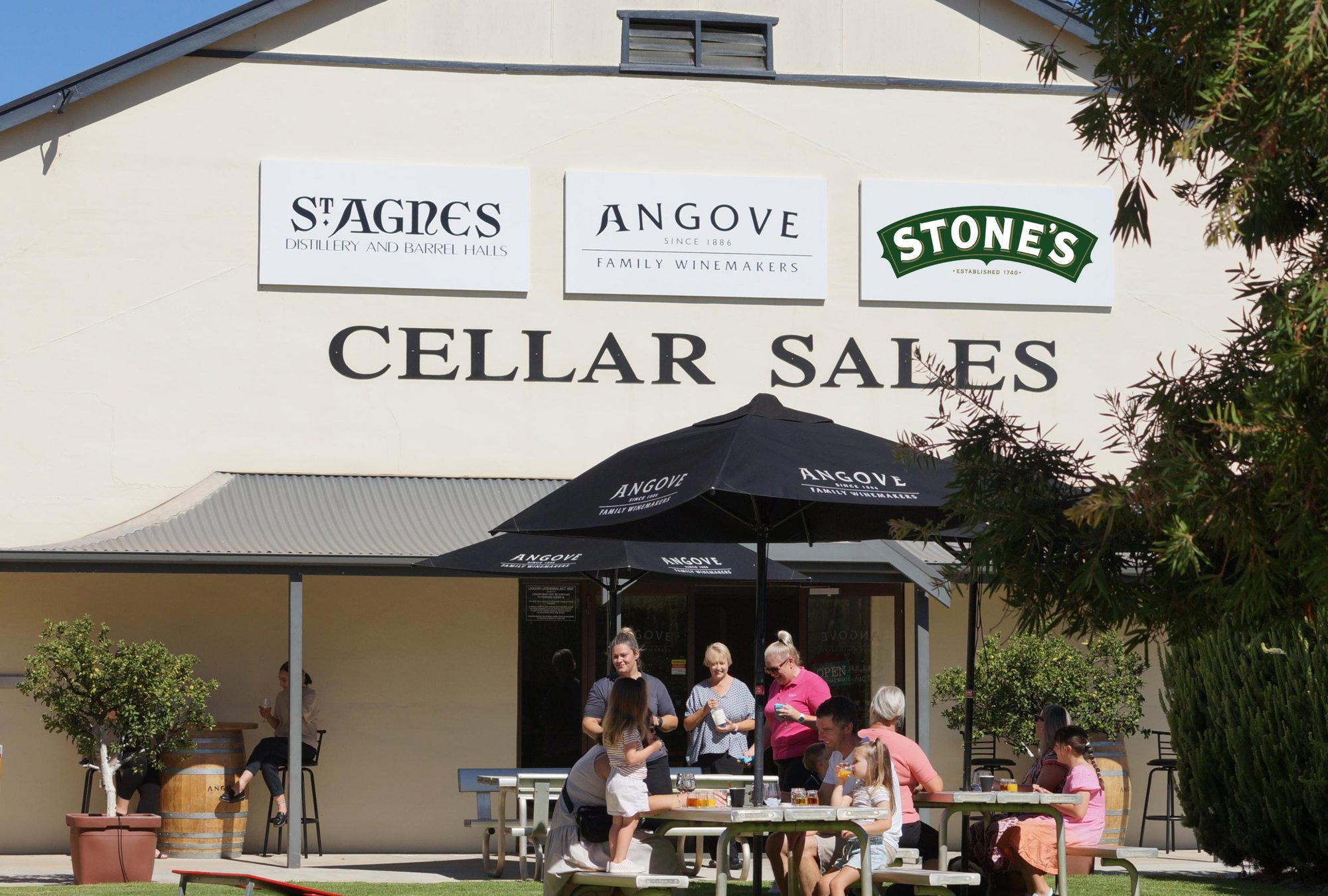
Where the Murray Shapes the Wine
The Riverland stretches along the Murray River through South Australia's arid interior, a stretch of irrigated country that has produced wine commercially for well over a century. The climate here is warm and dry, with long ripening seasons and soils that shift between sandy loams and heavier clay-based ground depending on the proximity to the river. Those conditions favour wines with concentration and approachable fruit character rather than the leaner, more angular profiles that come out of cooler zones like the Adelaide Hills or Coonawarra. Angove Family Winemakers, based at 271 Bookmark Avenue in Renmark South, operates within that Riverland tradition while carrying one of the longer institutional memories in Australian wine.
Renmark is the Riverland's commercial hub, a town built on the river trade and the irrigation schemes that made large-scale agriculture possible in an otherwise inhospitable stretch of semi-arid South Australia. For wine producers in this corridor, the land itself is the primary argument: high sunshine hours, reliable warmth through the growing season, and access to Murray River water create conditions that support volume without sacrificing ripeness. What distinguishes serious producers from the bulk co-operative model is how they choose to use those conditions — which varieties they commit to, how they manage canopy and irrigation, and how they pitch the resulting wines against a national market where regional credibility increasingly matters.
That kind of recognition carries weight in a national context where the Riverland's reputation has historically been measured more by volume than by fine-wine credentials. The award is a signal, not just of individual wine quality, but of sustained production discipline across a range broad enough to earn external assessment at the prestige level.
Producers like Henschke in the Eden Valley and Clarendon Hills in McLaren Vale operate in a premium tier defined by small production, high land values, and decades of critical accumulation. Penfolds, as a different kind of benchmark, carries a brand architecture built on national scale and blending across regions. That is a harder credential to build and a more durable one to hold.
Riverland Terroir and What It Produces
Terroir in the Riverland is a more contested concept than it is in Barossa or Margaret River, partly because the irrigation model complicates the traditional relationship between vine stress and wine character. In drier, non-irrigated environments, vines root deeply and draw on mineral-rich subsoils, producing wines with greater structural complexity. In the Riverland, the intervention of irrigation changes that equation, and the argument for place-specificity has to be made differently: through the particular warmth of the growing season, the sandy alluvial soils closer to the river, and the diurnal temperature variation that preserves acidity even in a hot climate.
The Murray River corridor does deliver meaningful temperature swings between day and night during the critical ripening window, a climatic feature that separates the Riverland from purely tropical or subtropical growing regions and allows aromatic retention alongside fruit concentration. Varieties that thrive in these conditions include Shiraz, Grenache, Cabernet Sauvignon, and Chardonnay, all of which appear extensively across the Riverland's producer landscape. At the same time, the region has seen increasing experimentation with Mediterranean and Iberian varieties that tolerate heat and dry conditions more naturally than classic French cultivars. That shift is happening across warm Australian regions generally, from the Barossa's Grenache revival to the growing interest in Tempranillo and Fiano in multiple states.
Angove's operation at the Renmark end of the Riverland puts it close to the South Australian border with Victoria, a stretch of river country where the landscape flattens and the light takes on a particular bleached intensity through summer. The address at Bookmark Avenue sits south of the main Renmark township, in a corridor where winery infrastructure is part of the working agricultural fabric rather than a curated tourism destination built for cellar-door theatre.
A Family Operation in a Long-Horizon Business
Family ownership in wine tends to produce a different kind of decision-making than corporate or investment-driven structures. The time horizons are longer, the relationship to land is less purely transactional, and the tolerance for stylistic continuity tends to be higher. Angove has operated within a family model across multiple generations, a structural fact that shapes how the business responds to market cycles, drought, and shifting critical tastes. Family producers of this scale and duration sit in an interesting position in Australian wine: large enough to hold shelf space nationally, rooted enough to maintain regional identity, and experienced enough to have navigated the consolidation waves that reshaped the Australian wine industry through the 1990s and 2000s.
In the Riverland specifically, several long-established family operations have maintained that balance while the broader region remains associated in many buyers' minds with cheaper grocery-aisle wine. Nearby producers like St Agnes Distillery and Twenty Third Street Distillery have added to the region's craft credentials, broadening Renmark's identity beyond wine into spirits production and giving visitors more reasons to engage with the area's broader drinks culture.
How Angove Fits Within Australia's Family Wine Tier
Placed within a national context, Angove occupies a segment of the Australian wine market that includes other long-standing family estates operating at scale with regional roots. Brown Brothers in King Valley offers a useful comparison: a family producer with a wide range, strong generational continuity, and a cellar door that functions as a gateway to a broader regional story. Leading's Wines in Great Western represents a smaller, more focused variant of the same archetype. At the premium end, producers like Bass Phillip in Gippsland and Bird in Hand in Adelaide Hills show what family wine production looks like when it narrows to fewer labels and higher price points.
Internationally, the family-producer model in warm inland regions finds parallels with estates like Accendo Cellars in St. Helena, where family ownership and a strong regional identity intersect with serious critical recognition. The operating logic is similar even when the terroir and variety profiles diverge significantly.
Within South Australia's broader fine-wine ecosystem, Angove sits in a different competitive bracket than McLaren Vale cult producers or Barossa icon labels like those tracked alongside Brokenwood in Hunter Valley or Cape Mentelle in Margaret River. It is not competing for collector allocation lists or international auction placement. Its market position is built on consistent range quality, regional authenticity, and the kind of institutional depth that comes from operating across multiple generations in a single place.
Planning a Visit to Renmark
Renmark sits approximately 250 kilometres northeast of Adelaide by road, a drive of roughly two and a half hours through the Barossa and Murray Riverland corridors. The Sturt Highway provides the main access route. The town itself is small, and the cellar-door and wine tourism infrastructure in the Riverland is less developed than in the Barossa or McLaren Vale, which means visits tend to be deliberate rather than casual. Those travelling to the region specifically for wine should consult our full Renmark restaurants guide for a broader picture of what the town offers across food, wine, and spirits. The addition of distillery operations through St Agnes and Twenty Third Street means a day in Renmark can now cover more ground than a single cellar-door stop. Contact details and opening hours for Angove were not available at time of publication; confirming visit logistics directly with the winery before travelling is advisable.
How It Stacks Up
Comparable venues nearby, for context on price, style, and recognition.
| Venue | Cuisine | Price | Awards | Notes |
|---|---|---|---|---|
| Angove Family WinemakersThis venue — the venue you are viewing | Shiraz, Chardonnay | $10–20 | Falstaff Winery - Listed | Not listed |
| Mountadam Vineyards | Chardonnay, Riesling | $30–50 | Not listed | High Eden |
| Koomilya | Shiraz, Cabernet Sauvignon | Not listed | Not listed | McLaren Vale |
| Wirra Wirra | Shiraz, Grenache | $20–30 | Not listed | McLaren Vale |
Recognition history
Dated appearances from independent guides and award organizations, with the underlying list record or original source where available.
Falstaff Winery - Listed
Falstaff
Continue exploring
More in Renmark
Wineries in Renmark
Browse all →
Details
- Rustic
- Classic
- Scenic
- Wine Education
- Family
- Group Outing
- Vineyard Tour
- Historic Building
- Estate Grounds
- Organic
- Vineyard
- Shiraz
- Chardonnay
- Grenache
- Chenin Blanc
- Sangiovese
- Fiano
- Merlot
- Sauvignon Blanc
- Still Red
- Still White
- Still Rosé
- Sparkling
- Fortified
- Cellar Door Tasting
Historic working winery atmosphere in the heart of the Riverland with a focus on family-friendly tastings and premium organic wines.