
Campotinto sits along the rural backroads of Colonia Estrella outside Carmelo, earning a Pearl 2 Star Prestige rating in 2025 that places it among the Río de la Plata's more credentialed wine properties. The address alone signals its character: a gravel-road destination removed from Carmelo's small centre, where the physical setting and the wine share equal billing. For Uruguay's southwest wine corridor, it represents a serious entry point.
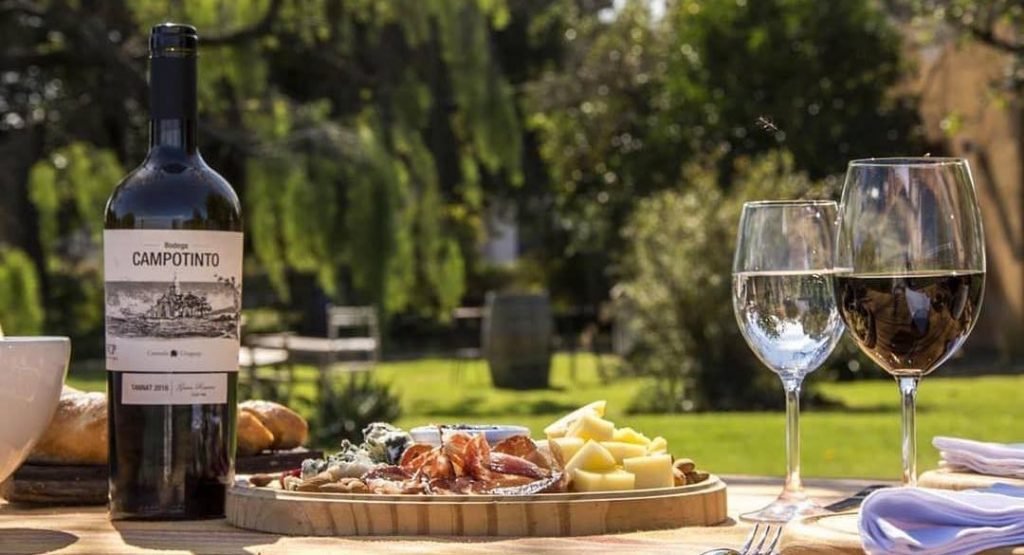
Where the Road Runs Out and the Vines Begin
The approach to Campotinto along Camino de los Peregrinos tells you something about what kind of property this is before you arrive. Rural Colonia — the department that holds both Carmelo and the broader Colonia Estrella subzone — does not put its serious wine estates on main roads. The properties that matter here are found past unpaved turnoffs, through gates, across land that still looks and feels agricultural. That physical remove is not incidental to the experience; it is the experience. Uruguay's wine culture, particularly in this southwestern corridor, has always been more rooted in working estancias and family-held parcels than in purpose-built visitor centres, and Campotinto carries that character in its location alone.
Colonia as a wine department sits at the western edge of Uruguay's producing regions, separated from the Río de la Plata by low hills and clay-heavy soils that behave differently from the granite-influenced terroir around Canelones. The proximity to the river moderates temperatures and lifts humidity, conditions that suit Tannat , Uruguay's signature red grape , but also reward patient producers working with Merlot, Cabernet Franc, and white varieties that benefit from cooler overnight temperatures. Carmelo itself has emerged over the past decade as the reference town for this subregion, with several credentialed estates operating within a short radius of one another.
The shortlist, unlocked.
Hard-to-book tables, cellar releases, and concierge-planned trips.
Get Exclusive Access →The 2025 Pearl 2 Star Prestige Rating in Context
Campotinto holds a Pearl 2 Star Prestige rating from EP Club for 2025. Within the Carmelo peer set , which includes El Legado, Familia Irurtia, and Narbona Wine Lodge , a Prestige-tier award signals that the property is operating at a level where the wine, the setting, and the visitor format are all being held to a higher standard than functional competence. The 2 Star designation within that tier marks a meaningful degree of distinction rather than baseline qualification.
Uruguay's wine recognition infrastructure has developed unevenly across its producing regions. Canelones, immediately north of Montevideo, still claims the largest concentration of credentialed producers, with estates like Varela Zarranz and Bodega Bouza anchoring a more densely visited circuit. Further afield, properties in Las Piedras (Bodega Carrau), Rivera (Cerro Chapeu), and even Maldonado (Bodega Oceánica José Ignacio) have built distinct identities tied to their local terroir and distance from Montevideo's day-trip radius. Campotinto's Colonia Estrella address places it firmly in the slower, more deliberate travel category , a property you plan for rather than pass through.
Colonia's Wine Geography and What It Produces
The Colonia department's wine identity rests on sedimentary soils with significant clay and limestone content, conditions that slow drainage and force vine roots deeper than the sandier profiles found in coastal subzones. This matters practically for Tannat: slower ripening and higher natural acidity tend to produce wines with more structural grip and longer aging potential than the same variety grown in warmer, faster-draining ground. The southwest also sees less diurnal temperature swing than higher-altitude Uruguayan regions, which gives the wines a rounder mid-palate even as they hold acidity.
Carmelo has positioned itself as the logical base for exploring this corner of Colonia's wine geography. The town is small, the infrastructure for wine tourism is improving but not yet over-built, and the concentration of serious estates within the Colonia Estrella corridor creates a logical itinerary for visitors prepared to spend two or more nights. Comparable regional wine corridors in South America , Mendoza's Luján de Cuyo, the Casablanca Valley in Chile , have moved through a developmental arc from agricultural obscurity to international visibility over two to three decades; Carmelo appears to be at an earlier, quieter point on that same curve. That relative unfamiliarity is part of what makes properties like Campotinto worth attention now, before the visitor infrastructure catches up.
For broader context on how this subregion compares to Uruguay's other producing zones, the estates at Bodega Los Cerros de San Juan near Colonia del Sacramento and Bodega Cerro del Toro in Piriápolis offer reference points for how different Uruguayan departments handle proximity to water and the specific constraints of small-scale production.
Getting There and Planning the Visit
Campotinto's address at Camino de los Peregrinos S/N, Colonia Estrella, places it outside of Carmelo proper, in agricultural land where GPS navigation and a vehicle with reasonable ground clearance are both advisable. Carmelo is reachable from Buenos Aires by ferry across the Río de la Plata to Colonia del Sacramento, then roughly an hour by road northwest , a route that makes this part of Uruguay a logical extension of an Argentine itinerary rather than a separate trip. Alternatively, direct road access from Montevideo covers approximately three hours, making Carmelo a viable overnight rather than a day excursion from the capital.
Phone and website details are not publicly listed in the current record for Campotinto, which is consistent with how several Colonia Estrella estates handle reservations , through local tourism networks, hotel concierge referrals in Carmelo, or by direct contact established on arrival. Visitors planning around this property should confirm current visit formats before departure; the situation may have evolved. Our full Carmelo restaurants and experiences guide covers the broader logistics for building an itinerary in the region.
For travelers interested in the broader Uruguayan wine map, the contrast between the southwest Colonia corridor and the more international-facing production at properties like Gin Pinares (Sacramento Spirits) in Punta del Este illustrates how different Uruguay's producing zones have positioned themselves relative to tourism. Colonia reads as agricultural and serious; the eastern coast reads as resort-adjacent and accessible. Campotinto falls squarely in the former category.
What the Setting Signals
The physical setting of a wine property is rarely neutral information. When an estate positions itself on an unmarked road in an agricultural subzone, without a phone number or website in public circulation, it is communicating something about the kind of engagement it is designed for. This is not a drop-in format or a tasting room attached to a retail operation. Properties like Campotinto, particularly those carrying a Prestige-tier recognition, tend to reward visitors who arrive with some preparation: knowledge of the region, a reason to be there beyond convenience, and enough time to engage with the wine and the landscape on their own terms.
Uruguay's slower-paced wine regions demand a different kind of travel logic than the heavily signposted routes of Mendoza or the Douro Valley. The roads are quieter, the estates less likely to have multilingual staff and laminated tasting menus, and the wines less likely to carry international distribution. For some travelers, that absence of infrastructure is the draw. Campotinto's location in Colonia Estrella, its 2025 Pearl 2 Star Prestige standing, and its deliberate remove from Carmelo's centre suggest it has been built for exactly that audience.
Camino de los Peregrinos S/N, Colonia Estrella, 70100 Carmelo, Colonia, Uruguay
+59845427744
The Quick Read
A compact peer snapshot based on similar venues we track.
| Venue | Notes | Price |
|---|---|---|
| Campotinto | This venue | |
| El Legado | ||
| Familia Irurtia | ||
| Narbona Wine Lodge |
Access the Cellar?
Our members enjoy exclusive access to private tastings and priority allocations from the world's most sought-after producers.
Get Exclusive AccessThe shortlist, unlocked.
Hard-to-book tables, cellar releases, and concierge-planned trips.
Get Exclusive Access →