Bluemont Vineyard

Bluemont Vineyard sits at one of the higher elevations in Loudoun County's wine corridor, where Blue Ridge air currents and well-drained slopes shape a distinctly cooler growing environment than the Virginia Piedmont below. The property holds a Pearl 2 Star Prestige rating for 2025, placing it among a select tier of Virginia estates drawing serious attention beyond the state's borders.
 Discover on Pearl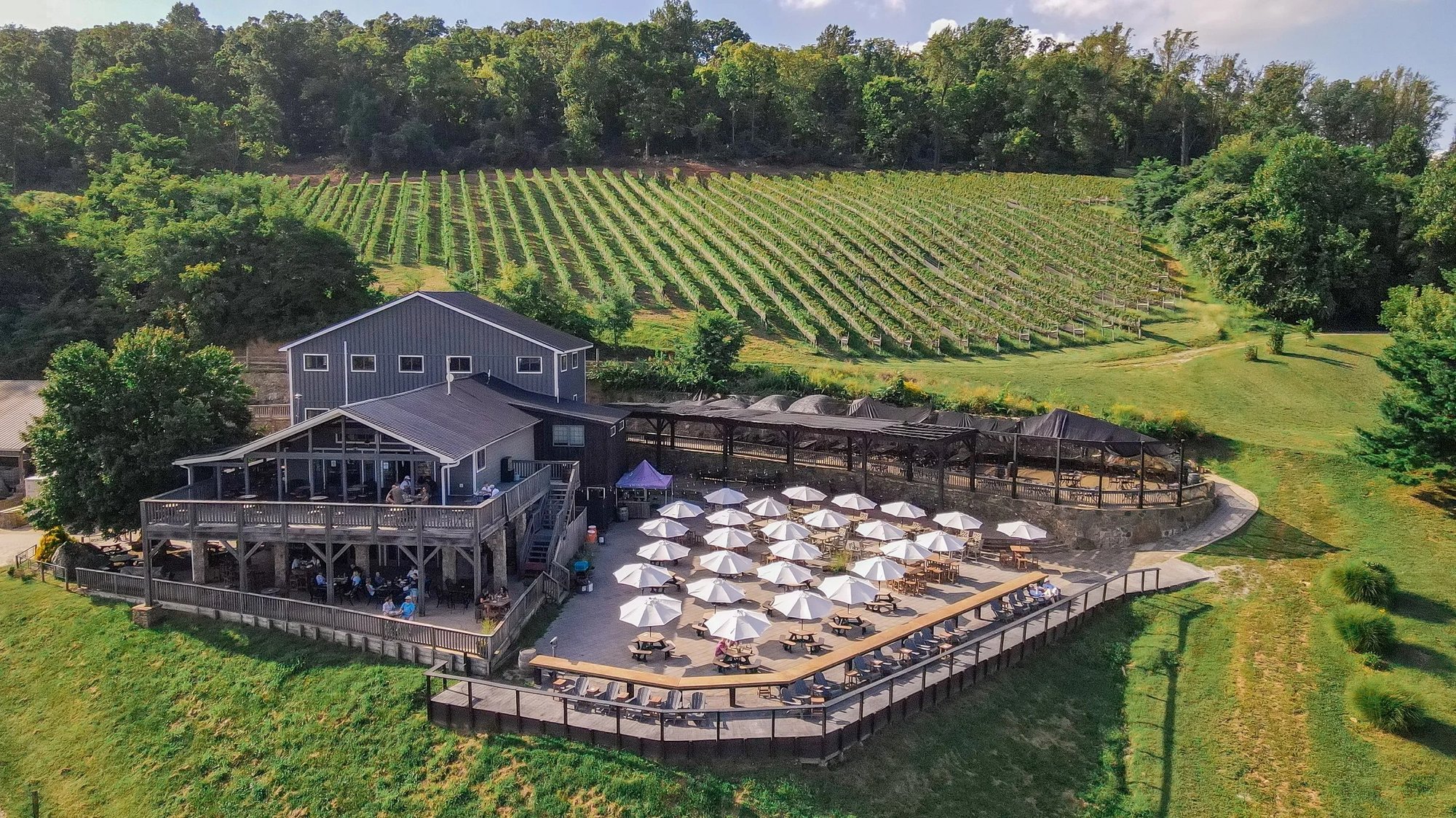
Blue Ridge Elevation and What It Does to Virginia Wine
Drive west from Leesburg on Route 7, turn south into the foothills, and the road climbs quickly. By the time you reach 18755 Foggy Bottom Rd, the air temperature has dropped a few degrees from the valley floor, the horizon has opened into a wide Blue Ridge panorama, and the vines you see planted on those slopes are working with a fundamentally different set of conditions than most Virginia estates. Elevation winegrowing in Virginia's Loudoun County is still a minority pursuit — most of the state's recognized properties sit lower, where soils are warmer and growing seasons are longer. The trade-off, made deliberately at properties like Bluemont Vineyard, is slower ripening, higher natural acidity, and a tighter growing window that demands more from both fruit and winemaker.
That context matters when you arrive. This is not a rolling Piedmont property with long, warm afternoons and generous fruit weight as the default. What the Blue Ridge foothills produce, in good vintages, is tension: wines that carry both ripeness and structure because the site forces the vine to work for both. That editorial premise — terroir as constraint, constraint as quality signal , is what positions Bluemont Vineyard inside a serious conversation about Virginia's upper tier.
The Site and Its Competitive Position
Virginia's wine scene has matured considerably over the past fifteen years, and the state now has enough producers operating at a high level to make differentiation meaningful. Within that broader picture, the Loudoun County wine corridor has emerged as one of the more concentrated zones for quality-oriented estates, with elevation becoming an increasingly important variable. Bluemont Vineyard holds a Pearl 2 Star Prestige rating from EP Club for 2025 , a designation that places it in the upper bracket of recognized Virginia wineries and signals a level of quality consistency that goes beyond local reputation.
For comparative reference, Virginia's Blue Ridge foothills share certain structural qualities with other high-elevation American wine zones: the diurnal temperature swings, the drainage characteristics of mountain foothill soils, the protection from excessive summer humidity that lower-lying Virginia vineyards contend with. Where operations like Adelsheim Vineyard in Newberg work with Oregon's Willamette Valley benchland conditions, or Adelaida Vineyards in Paso Robles capitalizes on the Templeton Gap's cooling winds, Bluemont's elevation advantage is the Blue Ridge itself , a genuine geographic differentiator within the state. That elevation shapes acidity retention, canopy management decisions, and ultimately the structural profile of the wines.
Terroir in Detail: What the Land Is Actually Doing
The geology of Virginia's Blue Ridge foothills is old and complex: metamorphic and volcanic rock bases, soils that tend toward coarser textures, and drainage that reduces the vine stress of wet summers, which is a persistent challenge across the Mid-Atlantic. At elevation, Bluemont's vines experience longer hang time relative to growing-degree-day accumulation , meaning fruit can develop phenolic maturity without the sugar rush that low-elevation sites sometimes produce. The practical result, in appropriate grape varieties, is wine with genuine depth rather than extracted weight.
Virginia's leading winemakers have increasingly oriented toward varieties that suit this kind of environment: Viognier, which was essentially introduced to the state in the 1990s; Petit Verdot, which ripens more reliably here than it does as a Bordeaux blending grape; and Cabernet Franc, which has become something of a signature for the Mid-Atlantic precisely because its thinner skins and moderate alcohol ceiling fit the climate. Bluemont's position in the foothills suggests an alignment with this regional variety logic, though the specific varietal program would need to be confirmed on a visit or through current release lists.
What the site cannot fully escape is Mid-Atlantic humidity in summer. Canopy management and vine spacing become consequential decisions , properties that get this right produce clean, structured fruit; those that don't face disease pressure that undermines otherwise good terroir. The Pearl 2 Star Prestige recognition implies that quality control at this level has been maintained, which is itself a meaningful signal.
The Experience at the Property
Virginia's better wine estates have developed a tasting room culture that is more considered than it was a decade ago, moving away from informal barn-format pours toward more structured, curated formats. Properties with elevation views have a natural advantage in this regard: the setting does part of the work. At Bluemont, the panorama across the Loudoun Valley toward the Potomac watershed is a significant part of what the visit delivers. The physical experience of being at altitude, with a wide sky and the Blue Ridge ridge line visible, creates a context for the wine that low-lying estates simply cannot replicate.
For visitors planning around wine tourism, the Loudoun County corridor works well as a dedicated day or weekend trip from Washington D.C. , the drive is around 55 miles from central D.C., mostly on Route 7 west, and the Bluemont area sits at the far western end of the county's wine cluster, making it a natural anchor for a route that picks up other properties on the way back east. For accommodation options in the area, our full Bluemont hotels guide covers the regional options, and our Bluemont restaurants guide maps the dining picture for those building a longer itinerary.
Virginia in National Context
It is useful to calibrate Virginia wine against the national conversation. The state does not compete with Napa's Cabernet-dominant luxury tier , properties like Accendo Cellars in St. Helena or Alpha Omega Winery in Rutherford occupy a price and prestige category that Virginia has not attempted to match and arguably should not. Virginia's stronger argument is for a distinct regional identity: Mid-Atlantic terroir expressing itself through varieties suited to a humid continental climate, with elevation sites providing the quality ceiling. That is a legitimate and increasingly coherent argument.
The comparison is perhaps more instructive with properties making similar elevation-and-variety arguments in other American regions. Alban Vineyards in Arroyo Grande built its reputation on Rhône varieties in a cool coastal California site; Andrew Murray Vineyards in Los Olivos operates in a similar Rhône-focused discipline. Virginia's equivalent argument runs through Viognier and Cabernet Franc , two varieties where the state has genuine claim to a regional identity rather than imitation of a California or European template. Bluemont's elevation position in that regional argument is its most defensible asset.
For those interested in how Old World elevation models translate to American winemaking, Abadía Retuerta in Sardón de Duero offers a useful European reference point for how site-specific terroir work at altitude drives quality separation. The ambition, if not the geology, is comparable.
Planning a Visit
Bluemont Vineyard sits at 18755 Foggy Bottom Rd, Bluemont, VA 20135. The property is at the refined western edge of Loudoun County's wine zone, and the drive itself is part of the experience , the road climbs through classic Virginia foothills countryside. Visitors are advised to confirm current tasting hours and formats directly with the property before travel, as operating schedules at Virginia estate wineries vary seasonally and can change. Weekend visits during the growing season tend to draw the largest crowds; midweek visits in the shoulder season offer a quieter format more suited to serious tasting engagement.
The broader Bluemont and Loudoun wine area is well-served by our editorial coverage: our full Bluemont wineries guide maps the competitive set for context, while our Bluemont bars guide and Bluemont experiences guide cover adjacent options for building a complete visit. For those extending the trip westward or into other American wine regions, our coverage includes Artesa Vineyards and Winery in Napa and Alexander Valley Vineyards in Geyserville for California comparisons, and Aberlour in Aberlour for a sense of how elevation and climate interact in a very different Old World context.
Frequently Asked Questions
- What is the atmosphere like at Bluemont Vineyard?
- The property sits at one of the higher elevation points in Loudoun County's wine corridor, and the atmosphere reflects that physical setting: wide Blue Ridge views, cooler air than the valley below, and a sense of remove from the suburban edge of Northern Virginia. Tasting room formats at Virginia estate wineries at this tier have moved toward more structured experiences over the past decade. Bluemont holds a Pearl 2 Star Prestige rating for 2025, which places it in a tier where the wine itself, not just the setting, is the reason to make the drive.
- What is the leading wine to try at Bluemont Vineyard?
- Virginia's Blue Ridge foothills have developed the strongest regional case for Cabernet Franc and Viognier , varieties where the state's cool-side climate and elevation sites produce wines with structure and identity rather than simply approximating warmer-climate models. At a property with Bluemont's elevation position and Pearl 2 Star Prestige recognition, the wines most worth seeking out are likely those where the site's natural acidity and diurnal shift are most directly expressed. Current release information should be confirmed with the property directly, as vintage variation and production volumes affect availability.
Peer Set Snapshot
These are the closest comparables we have in our database for quick context.
| Venue | Awards | Notes |
|---|---|---|
| Bluemont Vineyard | Pearl 2 Star Prestige | This venue |
| Robert Mondavi Winery | 50 Best Vineyards #39 (2025); Pearl 3 Star Prestige | Geneviève Janssens, Est. 1966 |
| Jordan Vineyard & Winery | 50 Best Vineyards #13 (2025); Pearl 3 Star Prestige | |
| Brooks Winery | 50 Best Vineyards #35 (2025); Pearl 2 Star Prestige | |
| Aperture Cellars | 50 Best Vineyards #14 (2025); Pearl 2 Star Prestige | |
| Joseph Phelps Vineyards | 50 Best Vineyards #37 (2025); Pearl 4 Star Prestige | Ashley Hepworth, Est. 1973 |
Access the Cellar?
Our members enjoy exclusive access to private tastings and priority allocations from the world's most sought-after producers.
Get Exclusive Access