
One of Épernay's most methodical Champagne houses, Alfred Gratien has produced wine since 1864 using oak-fermented, non-malolactic techniques that separate it from the house style of its larger neighbours. Winemaker Nicolas Jaeger continues that discipline today. The house holds a Pearl 4 Star Prestige rating (2025), reflecting both its historical continuity and the precision of its current releases.
 Discover on Pearl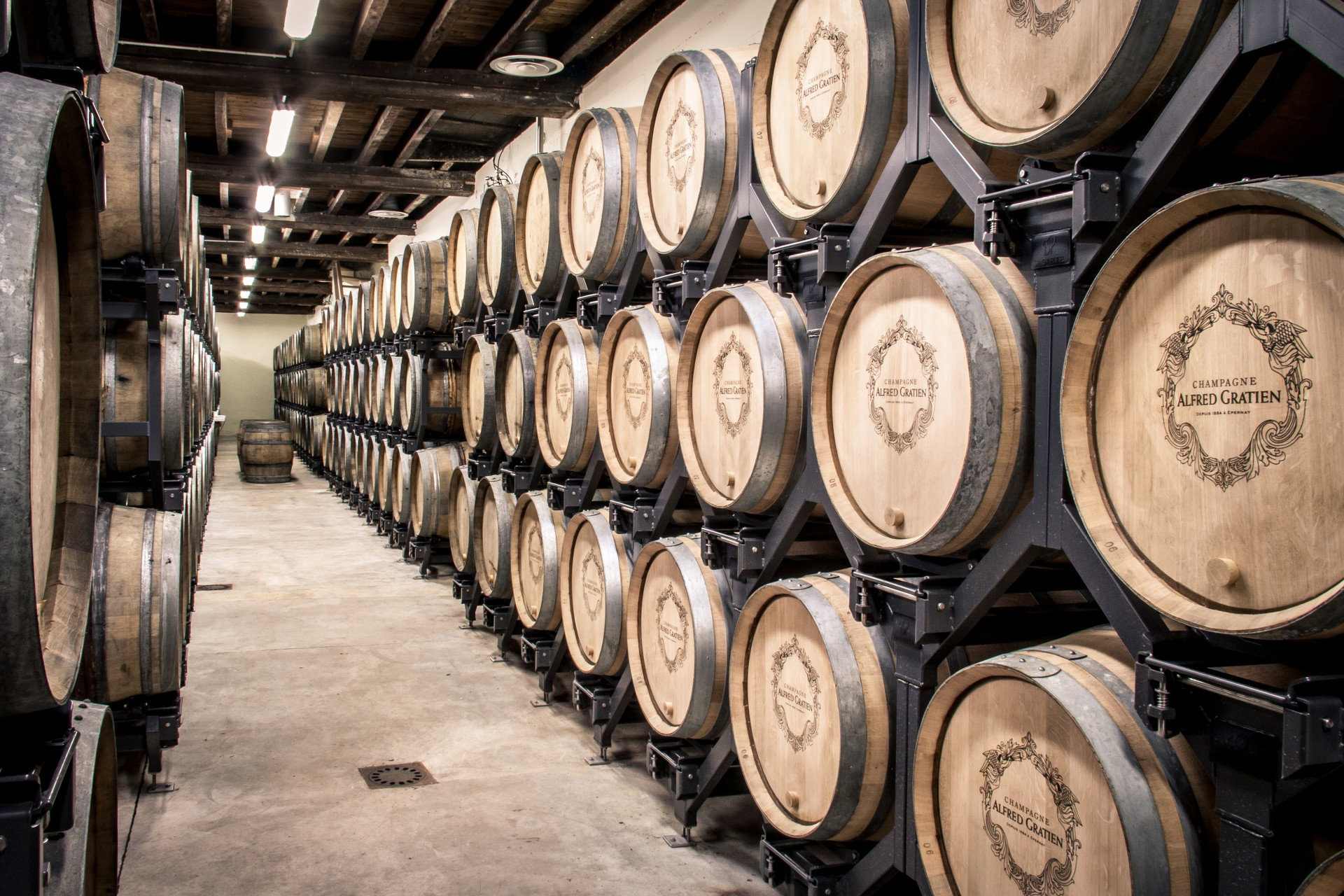
A Different Kind of Épernay
The Avenue de Champagne draws the famous names: Moët & Chandon, Perrier-Jouët, the grand façades that signal volume and reach. Alfred Gratien operates from a quieter address on Rue Maurice Cerveaux, and the contrast is instructive. Smaller Épernay houses have always competed less on distribution and more on method, and few have held to their method as consistently as this one. Founded in 1864, Alfred Gratien sits in a narrow peer group of Champagne producers who have resisted the homogenising pull of stainless steel fermentation and malolactic softening. That choice shapes everything in the glass.
What Terroir Looks Like at This Scale
Champagne terroir is a layered concept. The chalk subsoil that runs beneath Épernay and the surrounding villages acts as a slow thermal regulator, keeping vine roots cool in summer and draining excess moisture without stripping hydration. At house level, however, terroir expression is also a winemaking decision: how you ferment, what vessels you use, and whether you allow malolactic conversion all determine how much of the vineyard's mineral tension reaches the finished wine. Alfred Gratien's practice of fermenting in small oak casks rather than temperature-controlled tanks preserves micro-oxidative complexity that stainless steel excludes. The result is a structural quality in the wine — a tensile, reductive edge in youth that softens across extended ageing — that reads less like a branding choice and more like a geological one.
This approach connects Alfred Gratien to a longer Champagne tradition, one that predates the industry's post-war rationalisation. Houses like Gosset and Pol Roger each carry their own signatures , Gosset's non-vintage depth, Pol Roger's precision in vintage years , but all three sit outside the broad centre of the category, where consistency and accessibility drive the dominant style. Alfred Gratien's position in that specialist tier is underpinned by continuous operation since the Second Empire, a span that gives winemaker Nicolas Jaeger a reference library that few houses of any size can match.
The Role of Nicolas Jaeger
Winemaker credentials matter in Champagne because the chef de cave carries continuity across vintages and non-vintage blends. At Alfred Gratien, Nicolas Jaeger works within a framework defined by oak fermentation and blocked malolactic conversion, which means his work is less about introducing a personal signature than sustaining a house character through variable harvests. That discipline is harder than it sounds. Years with high natural acidity, like those increasingly common as Champagne's climate shifts, benefit from blocked malo. In warmer, lower-acidity years, the same choice demands more careful oak management to avoid over-extraction. The house's Pearl 4 Star Prestige rating from EP Club (2025) reflects that this balance has been maintained to a standard that peers acknowledge.
Reading the House Against the Region
Épernay as a production base covers a range of house sizes and styles that the tourist-facing identity of the city can obscure. The Avenue de Champagne's grandeur is real, but it represents one stratum. Below it , in commercial scale, not quality , houses like Alfred Gratien occupy a tier where allocation, not volume, governs distribution. This matters to the reader planning a visit: the experience at a smaller house is calibrated differently. There is less choreographed theatre and more direct engagement with the production process. Visits to Alfred Gratien at 30 Rue Maurice Cerveaux begin from that premise. For broader context on what Épernay offers across price points and formats, our full Épernay wineries guide maps the category comprehensively.
The comparison with other French wine regions is also worth holding in mind. Where a domaine like Albert Boxler in Niedermorschwihr expresses Alsace terroir through single-vineyard demarcation, and where Château Bastor-Lamontagne in Preignac anchors its identity in Sauternes botrytis conditions, Alfred Gratien's terroir argument is made through process retention rather than geographical specificity. The house does not own premier cru or grand cru vineyards as a defining asset; its claim is methodological. That is a rarer positioning in Champagne than it once was.
A First Vintage Worth Noting
The year 1864 places Alfred Gratien's founding in the mid-nineteenth century expansion of the Champagne trade, when the region's international reputation was consolidating and houses were establishing the stylistic positions they would carry into the following century. Very few Champagne producers operating today can trace continuous production to that period. For comparison, the Crimean War had ended less than a decade earlier, and Pasteur's foundational work on fermentation was still in progress when Alfred Gratien released its first wine. The age of the house is not merely a marketing figure; it is evidence of a supply chain, a cellar infrastructure, and a winemaking culture that has survived two world wars, phylloxera, and repeated economic disruption. Longevity of this kind, documented and continuous, is one of the more reliable trust signals in any wine region.
Planning a Visit
Alfred Gratien is located at 30 Rue Maurice Cerveaux in Épernay, within reasonable distance of the city's other cellar visits and accommodation options. For those planning time around multiple producers, our Épernay hotels guide covers properties across the range, and our Épernay restaurants guide provides options for dining before or after a cellar visit. The city's bar scene, mapped in our Épernay bars guide, skews predictably toward Champagne, and the Épernay experiences guide covers structured visits beyond the individual houses. Specific opening hours, booking requirements, and pricing for Alfred Gratien are leading confirmed directly with the house, as visit formats at smaller producers can change seasonally. Phone and website details were not available at time of publication.
For readers building a broader French wine itinerary, the methodological comparison points extend beyond Champagne: Chartreuse in Voiron, Château Batailley in Pauillac, and further afield, Abadía Retuerta in Sardón de Duero each illustrate how traditional process commitments read differently across regions. And for those drawn to the craft distillery parallel in the spirits category, Aberlour in Aberlour offers a useful comparison in how extended maturation shapes a house character over time.
Frequently Asked Questions
- What is Alfred Gratien known for?
- Alfred Gratien is known among Champagne specialists for fermenting in small oak casks and blocking malolactic conversion, a combination that most major houses in Épernay abandoned during the post-war rationalisation of the industry. The house has produced wine continuously since 1864 and holds a Pearl 4 Star Prestige rating from EP Club (2025). Its positioning in the market is closer to the allocation-driven, method-led tier than to the volume-oriented houses that dominate the Avenue de Champagne.
- What's the signature bottle at Alfred Gratien?
- Alfred Gratien's range is defined by oak-fermented, non-malolactic Champagnes made under winemaker Nicolas Jaeger. The house's approach to both non-vintage and vintage cuvées reflects that same methodological discipline, and the Pearl 4 Star Prestige rating (2025) applies to the house as a whole rather than a single bottling. For specific current releases and availability, contacting the house directly at 30 Rue Maurice Cerveaux, Épernay is the most reliable route.
- Do I need a reservation for Alfred Gratien?
- For a smaller Champagne house of this standing, advance contact before visiting is strongly advisable. Alfred Gratien operates from 30 Rue Maurice Cerveaux in Épernay, away from the main visitor infrastructure of the Avenue de Champagne, and visit formats at houses of this scale are typically less walk-in friendly than those of larger producers. Specific booking details, pricing, and available formats should be confirmed directly with the house, as contact details were not available at time of publication.
- How does Alfred Gratien's ageing approach compare to other Épernay houses?
- Alfred Gratien is among a small number of Champagne houses that combine oak-cask fermentation with blocked malolactic conversion across their range, a pairing that produces wines structured for extended cellaring rather than immediate accessibility. Where many houses in the region target approachability at release, this method builds in a tension that develops across years in bottle. The house's continuous production since 1864, overseen today by winemaker Nicolas Jaeger, and its Pearl 4 Star Prestige recognition (2025) place it in a peer set defined by process discipline rather than production scale.
Peer Set Snapshot
These are the closest comparables we have in our database for quick context.
| Venue | Awards | Notes |
|---|---|---|
| Alfred Gratien | Pearl 4 Star Prestige | This venue |
| Gosset | Pearl 4 Star Prestige | Odilon de Varine, Est. 1584 |
| Moët & Chandon | 50 Best Vineyards #57 (2025); Pearl 3 Star Prestige | Benoît Gouez, Est. 1743 |
| Pol Roger | Pearl 4 Star Prestige | Dominique Petit, Est. 1849, 110,000 cases, Grand Cru |
| A. Margaine | Pearl 2 Star Prestige | |
| Agrapart & Fils | Pearl 4 Star Prestige | Pascal Agrapart, Est. 1986 |
Access the Cellar?
Our members enjoy exclusive access to private tastings and priority allocations from the world's most sought-after producers.
Get Exclusive Access