Zubora Tei

Zubora Tei belongs to Kitakyushu’s low-price, high-specificity dining tier: counter seating, okonomiyaki focus, and recognition in the Tabelog Okonomiyaki 100 for 2024 and 2025. In Kokurakita’s Konyamachi area, it offers a useful read on how flour-based cooking, cabbage, sauce, and griddle technique remain serious regional food rather than a casual afterthought.
Pearl is the En Primeur Club membership app — saves, bookings, and concierge access live there. Same editors, same standards.
- Address
- 11-15 Konyamachi, Kokurakita Ward, Kitakyushu, Fukuoka 802-0081, Japan
- Phone
- +81 93-551-2301
- Website
- tabelog.com
 Saves & bookings on Pearl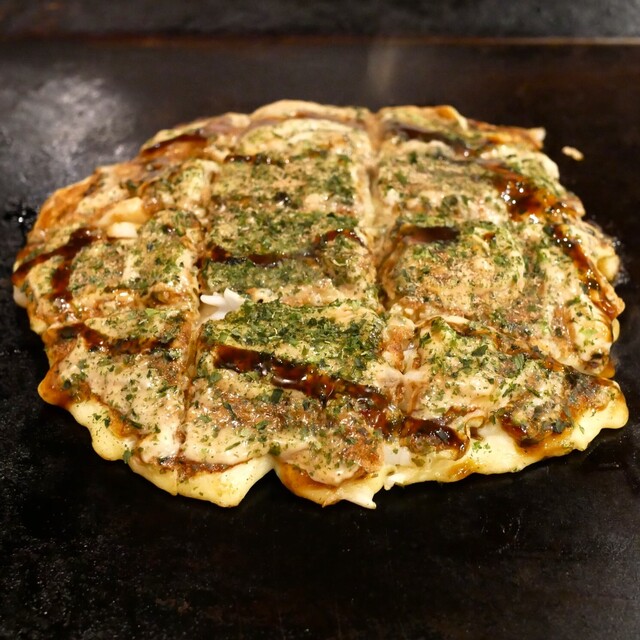
Counter seating changes the terms of okonomiyaki. The cooking is not hidden behind a kitchen door; the griddle is part of the room’s logic, and the meal is built around timing, heat control, and repetition. In Kitakyushu, where casual restaurants often carry more local meaning than their price tier suggests, Zubora Tei sits in the category of small-format places that treat flour, cabbage, egg, sauce, and griddle work as a disciplined cuisine rather than late-night ballast.
That distinction matters in northern Kyushu. Kitakyushu’s food culture is shaped by movement: port trade, rail links, industrial labor, market shopping, and the practical appetite of Kokura. Okonomiyaki fits that city grammar. It is economical, modular, and social, but it is not careless. The better versions depend on ingredient proportion and heat management, with cabbage doing structural work rather than acting as garnish, and batter functioning as binder rather than bulk.
Okonomiyaki treated as craft, not convenience
Japan’s okonomiyaki conversation is often dominated by Osaka and Hiroshima, but the national field is wider than those two reference points. Tabelog’s Okonomiyaki 100 list is useful because it separates serious specialists from generic grill rooms. Zubora Tei was selected for the Tabelog Okonomiyaki 100 in both 2024 and 2025, placing it among a narrower group where category expertise matters more than ceremony.
The ingredient story here is less about luxury sourcing than about restraint. Okonomiyaki is a cuisine of ratios: chopped cabbage, batter, protein, egg, sauce, and heat. Small changes alter the result. Too much batter and the pancake becomes heavy; too much filling and it loses structure; poor heat control leaves the interior and surface out of sync. At a counter-led shop, those choices are visible as process rather than presented as narrative.
This is also why price alone can mislead. Kitakyushu has restaurants operating at much higher dinner brackets, including Spice & Dining KĀLA and Yakitori Asahina, while neighborhood institutions such as Hountei occupy a lower-cost band. Zubora Tei belongs to the latter end of the city’s spectrum, but its Tabelog category recognition puts it in a more selective conversation than the spend might imply. The point is not luxury; it is category precision.
Kokurakita rewards that kind of precision. Nearby dining can move from ramen to udon, eel, sweets, and grilled cooking without requiring a formal itinerary. For a wider read on the city’s food routes, start with Our full Kitakyushu restaurants guide, then use places such as Gyoran Tei Honten, Hountei, Imanami Udon, Inaka An Kokura honten, and Hyo Kashiya KOMARU as markers of how compact the local dining map can be.
The Kokura counter format keeps the meal direct
A 22-seat room with counter seating creates a different rhythm from a larger izakaya. It favors small groups, solo diners, and diners who are content to let the grill set the pace. Take-out is part of the format, but the counter is the clearer expression of the place: okonomiyaki is a food that benefits from being close to the heat cycle, even when the restaurant does not frame itself as theatrical.
The format also keeps expectations honest. There is no chef mythology to carry the story, no tasting-menu architecture, and no imported prestige language. The meaningful signals are practical and public: category selection in Tabelog’s Okonomiyaki 100, a modest spend band, a small seat count, reservations available, and a location in Konyamachi rather than a hotel dining room or a destination complex. In a city where casual cooking often does the strongest cultural work, those signals are enough.
For travelers building a Kitakyushu stay around food rather than a single dinner, the useful comparison is not only restaurant to restaurant, but category to category. Okonomiyaki gives one reading of the city’s appetite; udon, ramen, eel, and sweets give others. Lodging and evening plans can be layered through Our full Kitakyushu hotels guide, Our full Kitakyushu bars guide, Our full Kitakyushu wineries guide, and Our full Kitakyushu experiences guide, but the restaurant map is where the city’s everyday food intelligence is clearest.
How to place it in a wider Japan itinerary
The restaurant is useful for travelers who want Japan’s regional cooking without turning every meal into a reservation trophy. It offers a compact lesson in how a humble dish becomes serious through repetition, sourcing discipline, and griddle technique. That makes it a strong counterpoint to higher-budget dining in Kitakyushu and to more formal meals elsewhere in Japan.
Seen nationally, it belongs to a broad class of focused specialists rather than general-purpose restaurants. That category stretches across cuisines and cities, from -Grilled beef Sukiyaki- KAMAKURA TANUKIAN 鎌倉 たぬき庵 in Kamakura to. 鮪と炭火焼き うお炭 秋葉原店 in Tokyo.cafe in Osaka.know in Kumamoto, (Shoku) Vietnam in Kawasaki, and [Curry Senmon Ten] Maruyama Kyoju. in Sapporo. For readers extending the same casual-specialist logic beyond Japan, Jōdo Saké Bar in Los Angeles and Onigiri Time in Pasadena show how tightly defined formats can carry more editorial weight than broader menus.
The editorial case is simple: go for okonomiyaki as a category, not for spectacle. The reward is a view of Kitakyushu dining at ground level, where a low spend can still point to serious selection, and where the city’s everyday ingredients are given enough focus to explain why the dish continues to matter.
At-a-Glance Comparison
Comparable venues by cuisine and price in the same metro.
| Venue | Cuisine | Price | Notes |
|---|---|---|---|
| Zubora Tei | Traditional Okonomiyaki & Teppan-yaki | $$ | Kokurakita Ward |
| Tsudaya Shokudo | Japanese cafeteria & izakaya set-meal house | $ | Kokurakita Ward |
| Miyoshino | Traditional Yakitori & Chicken Dishes | $$ | Kokura Kita Ward |
| teppan sakaba hitojiman | Teppan izakaya with okonomiyaki & monjayaki | $$ | Kokuraminami-ku |
| Inaka An Kokura honten | Traditional Unagi (Grilled Eel) Restaurant | $$$ | Kokurakita-ku |
| Terasawa | Traditional Japanese Fine Dining | Not listed | Ōdōri |
Recognition history
Dated appearances from independent guides and award organizations, with the underlying list record or original source where available.
Tabelog 100 #62 · No. 62
Tabelog · Tabelog 100 - Okonomiyaki - 2025
Continue exploring
More in Kitakyushu
Restaurants in Kitakyushu
Browse all →
Bars in Kitakyushu
Browse all →
At a Glance
- Classic
- Cozy
- Lively
- Solo
- Family
- Casual Hangout
- After Work
- Late Night
- Open Kitchen
- Standalone
- Sake Program
Current opening hours
- Monday
- Closed
- Tuesday
- Closed
- Wednesday
- 6 PM–12 AM
- Thursday
- 6 PM–12 AM
- Friday
- 6 PM–12 AM
- Saturday
- 6 PM–12 AM
- Sunday
- 6–11:30 PM
Hours can change for holidays and private events. Last verified .
Small and retro with a classic teppan counter, the atmosphere is cozy and lively as guests sit close to the grill watching okonomiyaki and bone‑in cuts cook in front of them; it feels like a warm neighborhood favorite rather than a polished modern restaurant.