
Yuan Chun Famous Lor Mee on Balestier Road has been feeding the neighbourhood since the hawker era, serving the Hokkien-influenced braised noodle dish that defines Singapore comfort food at its most elemental. A Michelin Plate recipient in 2024, it operates at the single-dollar price tier where accessibility and culinary recognition coexist without contradiction. Find it at 586 Balestier Road, #01-01.
Pearl is the En Primeur Club membership app — saves, bookings, and concierge access live there. Same editors, same standards.
- Address
- 586 Balestier Rd, #01-01, Singapore 329898
- Website
- lormee.sg
- Directions
- Get directions
 Saves & bookings on Pearl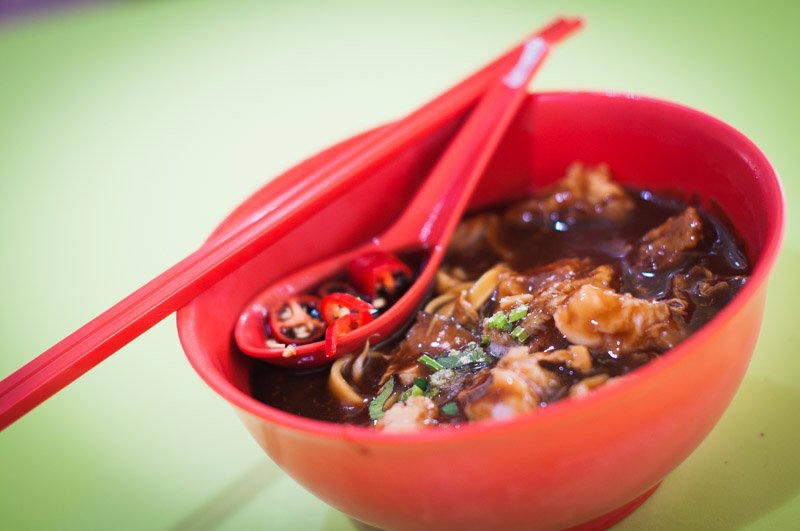
Braised, Not Forgotten: Lor Mee and the Long Game of Singapore Hawker Culture
Singapore's hawker culture did not survive decades of urban redevelopment, shifting demographics, and the economics of food courts by accident. It survived because specific stalls, rooted in specific neighbourhoods, kept making the same dish in the same way long enough for a generation to call it memory. Yuan Chun Famous Lor Mee is a restaurant in Singapore serving Traditional Singaporean Lor Mee. It occupies a corner unit in a shophouse row on a street that remains one of the city's most legible hawker corridors, and it has long been part of the city's hawker landscape.
Lor mee itself is a dish that resists Instagram logic. The Hokkien-derived braised noodle preparation arrives in a thick, starchy gravy, dark from soy and five-spice, carrying a combination of noodles, braised pork, fish cake, and a hard-boiled egg. It is not visually clean. It does not plate well. Its appeal is entirely in the depth of the braise, the texture of the gravy, and the accumulated hours of cooking behind the bowl. That Michelin has recognised a stall making this dish at the single-dollar price tier says something useful about the Guide's Singapore posture: it treats hawker food as a culinary category deserving the same evaluative rigour applied to tasting-menu restaurants in the CBD.
Balestier as Culinary Address
Balestier Road occupies a particular position in Singapore's food geography. It is not a tourist corridor in the way that Chinatown or Kampong Glam can function, and it lacks the food-court density of the hawker centres near Tanjong Pagar or Lau Pa Sat. What it has is continuity. The road has sustained a concentration of traditional Chinese coffeeshop and hawker formats for decades, making it one of the more reliable addresses in the city for this style of eating. Yuan Chun sits within that continuity, at a shophouse address that places it in walking distance of the neighbourhood's other long-running food operations.
That self-selection matters for the atmosphere: this is not a stall calibrated for first-timers who need an English explanation of the menu.
The Sustainability Logic Built Into Hawker Cooking
The editorial angle most often missed when writing about Michelin-recognised hawker stalls is that the cooking model is, by structure, a low-waste one. Lor mee is a braised dish, which means it uses secondary cuts, accumulated cooking liquid, and a slow process that extracts value from ingredients that higher-margin kitchens discard or underprice. The gravy is built over time, not made fresh per service, and its quality is a direct function of how much cooking history it carries.
This contrasts sharply with how sustainability is marketed at the upper end of the Singapore dining market. Restaurants at the $$$$ tier, from creative tasting menus in Marina Bay to European contemporary formats in the Raffles corridor, increasingly frame their environmental credentials as a differentiator and communicate them explicitly to guests. At the hawker level, the same principles, minimal waste, whole-ingredient use, extended cooking processes, operate as default rather than strategy. The Michelin Plate at Yuan Chun sits within a food culture where craft and economy are not in opposition.
That dynamic is visible across Singapore's noodle-focused hawker tier. Hill Street Tai Hwa Pork Noodle, which holds a Michelin star, operates with the same structural efficiency. 545 Whampoa Prawn Noodles and Adam Rd Noo Cheng Big Prawn Noodle build flavour from prawn shells and heads that would be binned in a European kitchen. 91 Fried Kway Teow Mee works a wok over a single heat source with near-total ingredient utilisation. The model is consistent: low price point, high craft, minimal waste by design.
What the Google Score Tells You (and What It Doesn't)
In a city where hawker stalls routinely carry scores above 4.0, a 2.5 signals something specific. Stalls with this kind of divergence between formal recognition, here a 2024 Michelin Plate, and aggregated public scores tend to fall into one of two categories: those where the product has declined from a prior peak, and those where the format or experience generates friction for reviewers expecting something the stall was never designed to provide. Service speed, queuing conditions, and no-frills physical environments all generate negative reviews at hawker stalls without those factors bearing any relationship to the quality of what is cooked. Reading the score without that context produces a misleading picture. The Michelin Plate is a more specific instrument than a crowd-aggregated rating for this type of evaluation.
Stalls in George Town with formal recognition, such as 888 Hokkien Mee (Lebuh Presgrave) and Ah Boy Koay Teow Th'ng, operate in physical environments where expectations around seating, wait times, and engagement with staff rarely match those of casual diners unfamiliar with the format. A Pong Mae Sunee in Phuket and Anuwat in Phang Nga follow the same pattern at the street-food level across the Thai peninsula.
Planning Your Visit
Yuan Chun Famous Lor Mee is at 586 Balestier Road, #01-01, Singapore 329898. No booking is available or required for this walk-in-friendly restaurant, which is open daily from 8 AM to 8 PM. The low price tier makes it an easy stop for a simple meal.
A Noodle Story offers a contemporary interpretation of the same hawker-noodle tradition at a different price point and format, providing a useful before-and-after comparison for how the genre is being reinterpreted by a younger generation of hawker-trained cooks.
Air Itam Duck Rice, Air Itam Sister Curry Mee, and Ali Nasi Lemak Daun Pisang in George Town share the same structural logic: a single dish, cooked in volume, refined over time, and priced for the neighbourhood rather than the tourist. Banana Boy in Hong Kong applies a comparable single-product discipline to a different format. The category is consistent even when the geography shifts.
A Credentials Check
Comparable venues nearby, for context on price, style, and recognition.
| Venue | Cuisine | Price | Awards | Notes |
|---|---|---|---|---|
| Yuan Chun Famous Lor MeeThis venue — the venue you are viewing | Traditional Singaporean Lor Mee | $ | Michelin Plate | Not listed |
| Shanyuan Teochew Kway Teow Mian | Teochew Kway Teow Mian | $ | Michelin Plate | BALESTIER |
| Traditional Hakka Lui Cha | Traditional Hakka Thunder Tea Rice | $ | Michelin Plate | ALJUNIED |
| Heng Gi Goose and Duck Rice | Teochew Braised Duck Rice | $ | Michelin Plate | FARRER PARK |
| Hougang Traditional Famous Wanton Noodle | Traditional Singaporean Wanton Noodles | $ | Michelin Plate | ALJUNIED |
| 545 Whampoa Prawn Noodles | Singaporean Prawn Noodles | $ | Michelin Plate | FARRER PARK |
Recognition history
Dated appearances from independent guides and award organizations, with the underlying list record or original source where available.
Michelin Plate
Michelin
Continue exploring
More in Singapore
Restaurants in Singapore
Browse all →
Bars in Singapore
Browse all →
At a Glance
- Classic
- Casual Hangout
- Standalone
Current opening hours
- Monday
- 8 AM–8 PM
- Tuesday
- 8 AM–8 PM
- Wednesday
- 8 AM–8 PM
- Thursday
- 8 AM–8 PM
- Friday
- 8 AM–8 PM
- Saturday
- 8 AM–8 PM
- Sunday
- 8 AM–8 PM
Hours can change for holidays and private events. Last verified .
Casual hawker centre atmosphere with busy queues during peak hours and self-service style.