
A Michelin Plate-recognised hawker stall at Geylang East serving traditional Hakka lui cha, the herb-dense pounded tea rice dish that remains one of Singapore's most nutritionally deliberate street foods.
Pearl is the En Primeur Club membership app — saves, bookings, and concierge access live there. Same editors, same standards.
- Address
- 129 Geylang East Ave 2, #01-100, Singapore 380129
- Phone
- +65 9339 8979
- Website
- facebook.com
- Directions
- Get directions
 Saves & bookings on Pearl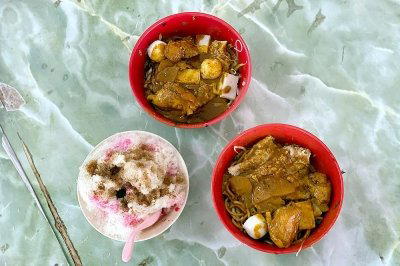
The Dish Before the Stall: What Lui Cha Actually Is
Hakka lui cha, sometimes rendered as lei cha or pounded tea rice, belongs to a category of Chinese peasant food that time has not simplified. The preparation involves grinding raw herbs, tea leaves, and aromatics into a thick paste, then loosening it with hot water into a broth that arrives alongside a bowl of rice topped with blanched vegetables, preserved radish, dried tofu, and peanuts. The diner combines the two at the table. It is nutritionally dense, resolutely savoury, and entirely unlike anything in the Cantonese or Hokkien registers that dominate Singapore's hawker centres. For many Singaporeans raised on char kway teow or bak chor mee, the first encounter with lui cha reads as a correction: this is food built around restraint and function, not fat and fire.
The Hakka diaspora brought lui cha from the Meizhou and Ganzhou regions of Guangdong and Jiangxi provinces. In those originating communities, it was festival food and daily sustenance simultaneously, the herbs used vary by household and season, and the specific blend is where family identity lives. Singapore's Hakka population settled primarily in areas like Geylang, and the dish has never migrated far from those communities in terms of its core audience, even as hawker culture has become a national tourism asset. That geographic and cultural rootedness is part of why lui cha remains a minor note against the dominant street food canon, surfacing reliably in Michelin's Bib Gourmand and Plate designations but rarely in the conversations visitors have before they arrive.
Geylang East and the Hawker Hierarchy
The address at 129 Geylang East Avenue 2 places this stall within one of Singapore's most functionally mixed districts. Geylang operates on a different register from the tourist-facing hawker centres at Maxwell or Lau Pa Sat. The HDB-adjacent coffeeshops and food centres here serve a residential population, which means pricing, portion logic, and operating hours align to the neighbourhood rather than to visitor footfall patterns. At the single-dollar price tier, Traditional Hakka Lui Cha sits in the same bracket as Singapore's most democratic eating, the category that draws Michelin's attention precisely because the food's quality cannot be attributed to rent position or imported ingredients. It is worth noting how Singapore's Michelin programme has consistently flagged hawkers in outer districts; the pattern reflects an editorial position at Michelin that cheap, technically precise food in unfashionable postcodes deserves the same institutional attention as a fine dining room. Traditional Hakka Lui Cha received a Michelin Plate in 2024, a designation that signals cooking worth seeking rather than a full star recommendation, and one that places it in a recognition tier shared with considerably more expensive addresses across the city.
For context: elsewhere in Singapore's street food scene, Hill Street Tai Hwa Pork Noodle carries a full Michelin star, 545 Whampoa Prawn Noodles operates at a similar community hawker register, and A Noodle Story has built a following that bridges local and visitor audiences. The lui cha format remains more niche than any of those: it has a narrower audience by default, which makes the Plate recognition a more pointed statement about culinary value than it would be for a prawn noodle or wonton mee stall with built-in mass appeal.
The Collaborative Logic of a Hawker Counter
Lui cha is more labour-intensive than most hawker formats because the pounded paste cannot be made in bulk without degrading, the volatile aromatics in the herbs dissipate quickly once ground. This means the preparation rhythm is not a production line but a small, ongoing collaboration timed to the queue. At stalls where this coordination breaks down, the broth arrives thin and the herbs taste flat. At stalls where it holds, the paste is dense enough to coat the back of a spoon and the broth carries a grassiness that reads almost medicinal in the leading sense.
The herbs typically deployed in lui cha include Thai basil, mint, ginger, green tea leaves, and various local greens, though the specific composition at any given stall is proprietary in the way that a ramen tare or a curry rempah is proprietary. The toppings, preserved radish (chai poh), long beans, spinach, dried tofu skin, and ground peanuts, are standardised enough that the version of the dish across Singapore is recognisably the same food, but differentiated enough at the paste stage that regulars develop stall-specific loyalty. This is the same dynamic that governs 91 Fried Kway Teow Mee or Adam Rd Noo Cheng Big Prawn Noodle, the dish is common, the execution is individual, and the queue forms around a specific version, not the category.
Lui Cha in the Wider Street Food Context
Singapore's hawker scene is frequently compared to its Southeast Asian neighbours, and the comparison is worth making here. The herb-led, grain-based logic of lui cha has loose parallels in the street food traditions documented at A Pong Mae Sunee in Phuket and Anuwat in Phang Nga, food where the primary variable is the quality and freshness of aromatic plant material rather than protein or fat. The distinction is that lui cha has no regional tourist infrastructure around it. George Town's hawker culture, documented at venues like 888 Hokkien Mee, Ah Boy Koay Teow Th'ng, and Air Itam Duck Rice, benefits from Penang's food tourism positioning. Lui cha in Singapore has no equivalent promotional apparatus. It remains primarily a dish for people who already know what it is.
That insularity is not a weakness. It means the stall at Geylang East is calibrated entirely to repeat customers and community standards rather than to visitor legibility. The Michelin Plate functions as a bridge, a credential that makes the address visible to audiences who would not otherwise encounter the dish, without changing what the food is or whom it is primarily for. Visitors eating here for the first time are the secondary audience. The primary audience is the Geylang East resident who has been ordering the same bowl for years.
Planning a Visit
The stall is located at 129 Geylang East Avenue 2, unit #01-100, within a HDB-adjacent food centre that draws a largely residential crowd. The price tier sits at the single-dollar end of Singapore's hawker range, consistent with comparable addresses in outer districts.
Price and Positioning
Comparable venues nearby, for context on price, style, and recognition.
| Venue | Cuisine | Price | Awards | Notes |
|---|---|---|---|---|
| Traditional Hakka Lui ChaThis venue — the venue you are viewing | Street Food | $ | Michelin Plate | Not listed |
| Jin Hua | Not listed | $ | Michelin Plate | ALJUNIED, Northern Chinese Dumplings and Noodles |
| Shanyuan Teochew Kway Teow Mian | BALESTIER, Teochew Kway Teow Mian | $ | Michelin Plate | Not listed |
| Guan Kee Fried Carrot Cake | Not listed | $ | Michelin Plate | VICTORIA, Singaporean Fried Carrot Cake (Chye Tow Kway) |
| Fatty Ox HK Kitchen | Not listed | $ | Michelin Plate | CHINATOWN, Hong Kong-style Cantonese Noodles |
| Hup Kee Teochew Fishball Mee | MEI CHIN, Teochew Fishball Noodles | $ | Michelin Plate | Not listed |
Recognition history
Dated appearances from independent guides and award organizations, with the underlying list record or original source where available.
Michelin Guide Plate
Michelin Guide
Michelin Plate
Michelin
Continue exploring
More in Singapore
Restaurants in Singapore
Browse all →
Bars in Singapore
Browse all →
At a Glance
- Rustic
- Cozy
- Casual Hangout
Current opening hours
- Monday
- 9 AM–2 PM
- Tuesday
- 9 AM–2 PM
- Wednesday
- 9 AM–2 PM
- Thursday
- 9 AM–2 PM
- Friday
- 9 AM–2 PM
- Saturday
- 9 AM–2 PM
- Sunday
- 9 AM–2 PM
Hours can change for holidays and private events. Last verified .
Casual hawker stall atmosphere in a bustling food centre, focused on clean, wholesome eating with simple, no-frills setup.