Our verdict
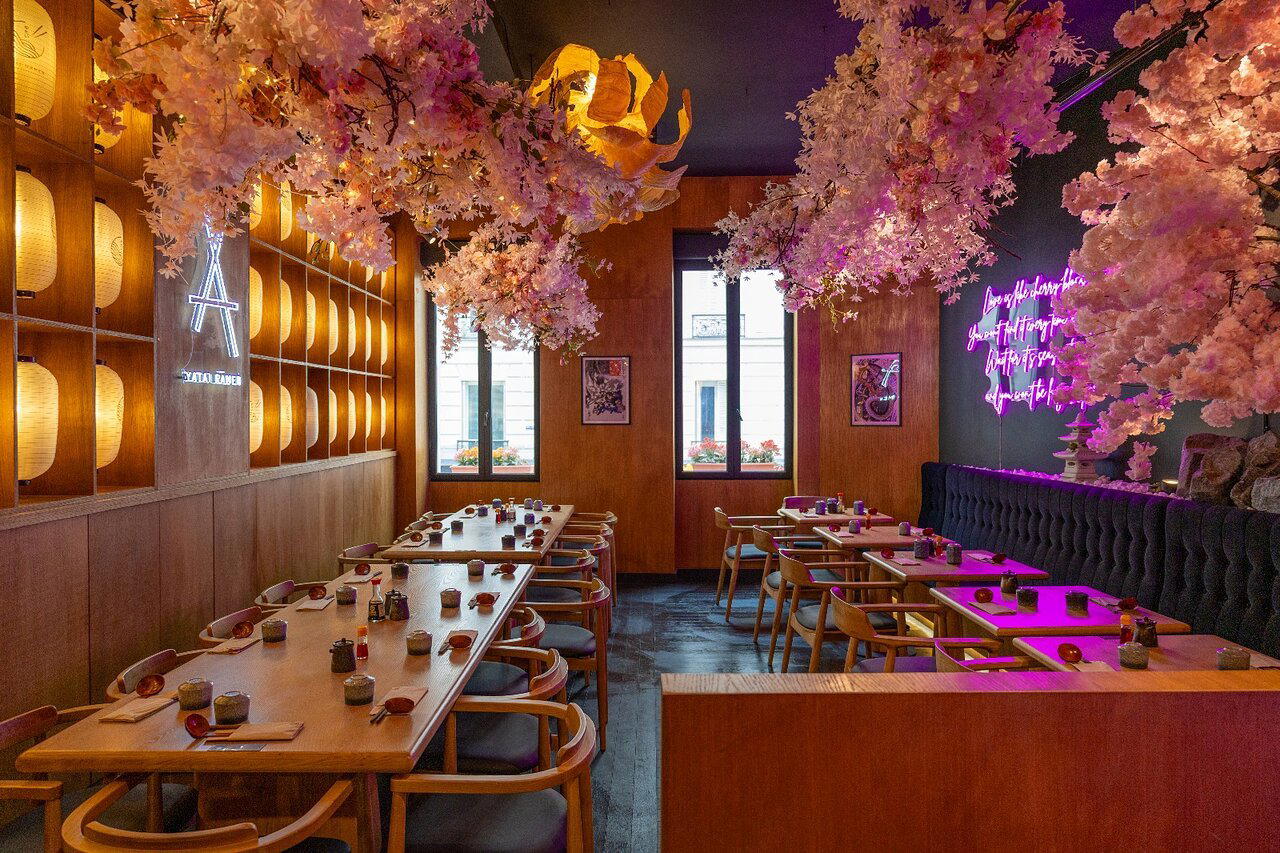
On Rue de la Gaité, one of Montparnasse's oldest entertainment streets, Yatai Ramen brings the informal Japanese street-stall format to the 14th arrondissement. The yatai tradition — compact, counter-led, built around a single disciplined bowl — translates with particular coherence into a Paris neighbourhood better known for theatre and brasseries than for Japanese street food.

Pearl is the En Primeur Club membership app — saves, bookings, and concierge access live there. Same editors, same standards.
- Address
- 11 Rue de la Gaité, 75014 Paris, France
- Phone
- +33142790111
- Hours
- Daily 11:30 AM–2:30 PM, 6:30–10:30 PM
- Website
- yatairamen.fr
- Directions
- Get directions
- Booking
- Book on OpenTable
The menu
What to order
- Yatai Signature Ramen
- Tonkotsu Ramen with Wagyu and Truffle
- Gyoza Maison
- Magret Slices
Ramen on a Street Built for Theatre
Rue de la Gaité has been Paris's entertainment corridor since the nineteenth century, when its cabarets and theatres drew crowds from across the Left Bank. Today the street runs a more eclectic programme: concert halls, independent restaurants, and a handful of spots that sit somewhere between local canteen and destination dining. Yatai Ramen Montparnasse, at number 11, belongs to a format that has spread steadily through Paris over the past decade: the Japanese yatai model, transplanted from Fukuoka's outdoor stalls into fixed urban counters, where the discipline of a single broth done well becomes the entire proposition.
The yatai format matters as context. In Japan, yatai are small wheeled stalls, often six to eight seats, serving ramen or yakitori to commuters and late-night workers. The compactness is structural, not decorative: a small operation means a tighter supply chain, less waste, and a menu narrow enough to maintain consistency. When that format migrates to European cities, the leading versions carry those operational constraints with them rather than expanding into full-service restaurant territory. Paris has seen both outcomes — sprawling ramen restaurants that lose the point, and tighter counters that keep faith with the original logic.
The Sustainability Case for Small-Format Ramen
Across Paris, the restaurants drawing the most sustained editorial attention for environmental practice tend to fall into two clusters: the grand kitchens — venues like Arpège, whose kitchen garden in Versailles has become a reference point for sourcing discipline, or Bras in Laguiole, where Michel Bras's relationship with the Aubrac plateau defined a generation of farm-to-table thinking in France, and the small-format specialists, where low seat counts and focused menus structurally reduce waste before any sourcing decision is made.
Ramen, as a category, carries its own sustainability logic. The broth is, at its core, a nose-to-tail exercise: bones, carcasses, aromatics, and time. A well-run ramen kitchen generates less protein waste than a traditional French kitchen running multiple protein-forward courses, because the primary vehicle for flavour is extraction rather than portion. That doesn't make every ramen shop an environmental model, but it does mean the category has inherent structural advantages that a focused operator can lean into.
The broader French dining scene has been working through these questions at every price tier. At the high end, Mirazur in Menton operates a biodynamic garden and has made waste reduction a documented part of its kitchen practice. Flocons de Sel in Megève sources within tight regional boundaries. Further afield, Troisgros in Ouches rebuilt its entire supply chain around a single farm. These are high-investment moves at high price points. The more interesting question, for a neighbourhood ramen counter, is whether similar principles can operate at accessible price levels, and whether the yatai format's inherent constraints make that easier to achieve.
Montparnasse as a Dining District
The 14th arrondissement has never carried the dining prestige of the 1st or 8th. The Michelin-starred concentration that defines addresses like Alléno Paris au Pavillon Ledoyen, Le Cinq at the Four Seasons George V, or L'Ambroisie on the Place des Vosges belongs to other arrondissements. The 14th's dining identity is more neighbourhood-facing: it rewards locals and repeat visitors rather than first-time tourists navigating a checklist. That positioning suits a yatai counter well. The format was never designed for occasion dining; it was designed for frequency, for the person who returns on a Tuesday because the broth is reliable and the seat is available.
Rue de la Gaité specifically sits between the Montparnasse tower complex to the north and the quieter residential blocks that extend south toward the Parc Montsouris. The street itself generates foot traffic from theatre-goers and office workers, which matters for a counter format that depends on consistent turnover rather than special-occasion bookings. Compared to the more touristic stretches of the Marais or Saint-Germain, the Gaité corridor trades in local regularity, a better environment, arguably, for sustaining a disciplined small-format kitchen.
Paris's Japanese food scene has matured considerably since the early concentration in the 1st arrondissement's Rue Sainte-Anne corridor. Quality ramen has spread into the 2nd, 9th, 11th, and now further into the Left Bank. The 14th's entry into that map is relatively recent, which means Yatai Ramen operates with less direct competition than counters in denser Japanese-dining corridors, a structural advantage for building a local customer base. For broader context on how Paris's restaurant scene layers across arrondissements and price tiers, the EP Club Paris guide covers the full competitive picture.
French ramen culture has also benefited from cross-pollination with the country's existing technical food culture. The same rigour applied to stock-making in classical French kitchens, the long-simmered fonds, the clarified consommés documented in establishments like Paul Bocuse's Auberge du Pont de Collonges, translates naturally into tare and broth construction. Whether that cross-pollination shows up in the bowl at Rue de la Gaité is a question of kitchen practice rather than geography, but the context is there.
For comparison across French regional dining that has taken sourcing seriously, Auberge de l'Ill in Illhaeusern, Au Crocodile in Strasbourg, Assiette Champenoise in Reims, and Auberge du Vieux Puits in Fontjoncouse each represent a different regional approach to ingredient provenance. The contrast with a Parisian street-counter format is stark in price and formality, but the underlying question, where does the ingredient come from, and how little does the kitchen need to do to it, connects across the tier gap. At the opposite extreme internationally, Le Bernardin in New York and Atomix represent what happens when Asian culinary traditions meet Western fine-dining infrastructure at the highest price point. Kei in Paris occupies a related hybrid position within the city, holding three Michelin stars for Japanese-French technique. AM par Alexandre Mazzia in Marseille approaches similar hybridisation from a Southern French base. Yatai Ramen Montparnasse operates at a completely different scale and price register, but the question of how Japanese culinary discipline integrates into French dining runs through all of them.
Planning Your Visit
Address: 11 Rue de la Gaité, 75014 Paris. Getting there: Edgar Quinet (line 13) and Montparnasse-Bienvenüe (lines 4, 6, 12, 13) are both within walking distance, making this direct to reach from most of central Paris. Reservations: Hours, price range, and dress code: Budget: Ramen counters in Paris at this format level typically run in the €12–20 range per bowl, though this is a category estimate rather than confirmed pricing for this address.
Frequently asked questions
Is Yatai Ramen Montparnasse suitable for children?
Ramen counters at this format and price point in Paris typically accommodate children without issue, and the casual setting on Rue de la Gaité, 75014, makes it less formal than the arrondissement's sit-down restaurants. That said, yatai-style seating can be compact, so younger children may find limited elbow room.
Is Yatai Ramen Montparnasse better for a quiet night or a lively one?
Rue de la Gaité has functioned as Paris's theatre and cabaret strip since the nineteenth century, so the street itself carries energy on most evenings. A yatai format — open, counter-driven, built around communal bowl culture — aligns far more naturally with a lively night out than a hushed dinner. If silence is the priority, the surrounding 14th arrondissement has quieter bistrot options.
How does Yatai Ramen Montparnasse fit into Paris's wider ramen scene?
Paris has developed a credible ramen circuit over the past decade, concentrated largely in the 1st, 2nd, and 10th arrondissements. Yatai Ramen Montparnasse operates in the 14th, a district with fewer dedicated Japanese noodle bars, which positions it as one of the more accessible options south of the Seine for the Montparnasse-Bienvenüe and Edgar Quinet catchment. The yatai concept — rooted in Japanese outdoor stall culture — is still a minority format in Paris compared to full sit-down ramen restaurants.
What should I order at Yatai Ramen Montparnasse?
As a general principle at yatai-style ramen counters in Paris, the tonkotsu and shoyu bowls tend to define the kitchen's identity — but the precise lineup at 11 Rue de la Gaité is best verified on arrival or via the venue directly.
What's the address for Yatai Ramen Montparnasse?
Yatai Ramen Montparnasse is located at 11 Rue de la Gaité, 75014 Paris, France, Paris.
Do they take walk-ins at Yatai Ramen Montparnasse?
No reservation policy is documented for Yatai Ramen Montparnasse. Counter-format ramen spots in Paris at this address type generally operate on a walk-in basis, particularly during off-peak hours, though weekend evenings on a busy corridor like Rue de la Gaité can mean a short queue. Arriving before the dinner rush is the most reliable approach.
What is Yatai Ramen Montparnasse known for?
Yatai Ramen Montparnasse draws its identity from the yatai format — the Japanese street-stall tradition of counter seating and bowl-focused service — translated onto one of Paris's oldest entertainment streets in the 14th arrondissement. Its address on Rue de la Gaité places it within a corridor historically associated with performance and street-level dining culture, which suits the informal register of ramen service well.
Cuisine-First Comparison
Comparable venues nearby, for context on price, style, and recognition.
| Venue | Cuisine | Price | Notes |
|---|---|---|---|
| Yatai Ramen MontparnasseThis venue — the venue you are viewing | Japanese Ramen with French Fusion | $20–30 | Not listed |
| Takara | Traditional Japanese | $50–100 | Louvre / Palais-Royal |
| AO Izakaya | Franco-Japanese Izakaya | $50–100 | 9th Arr. |
| Ojii | Modern Japanese Fine Dining | $50–100 | Saint-Germain-des-Prés |
| Passage 53 | Modern French-Japanese Fusion | $150–200 | Grands Boulevards |
| Mun | Modern Asian Fusion with Japanese Influences | $200–300 | 8th Arr. - Élysée |