
Tabelog 100 #31
Our verdict
A 10-seat counter in Nishinakajima puts Osaka’s unagi tradition into a compressed, serious format. Unagiya Unagi has been selected for Tabelog 100 Unagi in 2018, 2019, 2022, and 2024, with a daytime-evening split that matters: lunch is higher-budget, Saturday night is the narrow reservation window, and most other service runs on a walk-in rhythm until sold out.

Pearl is the En Primeur Club membership app, where members save venues, book tables and use the concierge.
The menu
What to order
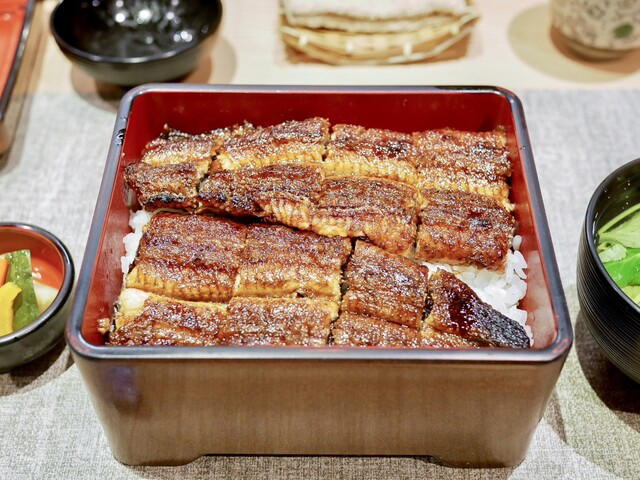
- Unaju (grilled eel over rice)
- Hitsumabushi-style grilled eel rice
- Kansai-style charcoal-grilled unagi
Osaka is not only its polished hotel quarters or its loudest dining circuits. It is also a city of focused specialist meals, where a narrow category can matter more than atmosphere or spectacle. That setting suits unagi. The form rewards attention rather than breadth: a clear purpose, a limited culinary identity, and a meal where repetition is part of the appeal. At Unagiya Unagi, the draw is especially direct, with the restaurant defined by eel rather than by a broad Japanese menu or a grand dining-room performance.
Osaka visitors often arrive with okonomiyaki, takoyaki, ramen, and department-store sweets in mind. Eel sits in a different lane. It is less about grazing and more about choosing a single meal with intent, which is why the lunch-versus-dinner question matters here. Daytime unagi in Japan can feel ceremonial without becoming formal; evening service shifts the meal closer to a planned appointment. That divide is part of the appeal: the same cuisine reads differently depending on whether it interrupts the workday or anchors a night in Osaka.
A focused unagi meal in a city built for faster eating
Unagi is a specialist category, not a generalist Japanese-restaurant offering. The craft sits in preparation, grilling, sauce discipline, and timing, and the better rooms tend to be judged on consistency rather than breadth. Selection for Tabelog 100 Unagi in 2024 places this restaurant inside Japan’s national eel conversation rather than merely Osaka’s everyday dining map. The Tabelog score of 3.78 adds another useful signal in a category where local diners tend to judge with little patience for decorative excess.
The restaurant’s narrow identity also clarifies the experience. This is not the broad, flexible Osaka meal pattern represented by ramen counters such as Jinrui Mina Menrui or curry-focused rooms such as Spice Curry Shunka To. Nor does it resemble the casual daytime feel of Nishinakajima Koryumasu or OSORACAFE. Even compared with Trattoria Cielo, where Italian dining divides more conventionally between lunch and dinner, eel behaves differently: the value is tied to ingredient intensity, specialist labor, and a clear menu identity rather than range.
That distinction is useful for planning an Osaka food itinerary. A visitor could fill a day with other Osaka dining rooms, coffee stops, bakeries, or a longer Italian meal. Eel asks for a different kind of slot. It is not a snack between stations; it is the meal around which the rest of the day should stay light. Unagiya Unagi makes the most sense when treated as a purpose-built stop rather than a casual add-on to an already crowded route.
The lunch-versus-dinner split is the real decision
The published budget pattern is unusual enough to shape the editorial recommendation: dinner is listed at JPY 6,000 to JPY 7,999, while lunch is listed at JPY 8,000 to JPY 9,999. In many Japanese restaurants, lunch is the softer entry point; here the daytime bracket sits higher. That does not automatically make lunch richer or dinner leaner, but it does tell readers not to assume the usual hierarchy. The smarter reading is that time of day affects access and mood as much as spend.
Lunch suits diners who want the meal as the main event before returning to the rest of Osaka. Evening carries a different feel, especially for travelers who prefer to anchor the night around one focused restaurant rather than build a long crawl. The point is not to overread the schedule, but to treat unagi as a meal that benefits from planning. Specialist shops can feel less forgiving than broad casual restaurants, and that is part of their appeal when the category is this specific.
For travelers comparing Osaka restaurants, the useful contrast is not “casual versus fancy.” It is elasticity versus precision. Pizza, casual cafés, ramen, curry, and a wider city crawl through Our full Osaka restaurants guide allow more improvisation. A specialist eel meal rewards a tighter plan. Pair it with a hotel base from Our full Osaka hotels guide if the day involves early movement, or keep evening drinking separate with Our full Osaka bars guide. The category does not need a long night around it.
Where this fits in a wider Japan itinerary
Japan’s regional dining map is increasingly useful when read by category rather than city alone. Beef meals, tuna and charcoal cooking, cafés, Vietnamese cooking, curry shops, Kyoto counters, sake bars, and casual rice-focused stops all tell different stories about how Japanese dining travels and adapts. For that wider lens, compare this Osaka eel stop with other dining across Japan and beyond in category terms rather than by name alone: the useful question is how tightly a restaurant commits to one idea, and how much of the experience depends on that focus.
Osaka’s wider travel frame also matters. The city is often treated as Japan’s appetite capital, but its stronger lesson is specialization: the ability to move from street-level speed to rooms where a single ingredient defines the whole encounter. Unagiya Unagi belongs to the second camp. It is an award-recognized eel restaurant with enough category authority to reward a planned slot. For broader trip architecture, keep Our full Osaka wineries guide and Our full Osaka experiences guide separate from the meal itself; eel works better as a focused pause than as one stop in an overfilled circuit.
Frequently asked questions
Where is Unagiya Unagi located?
Osaka.
What's the price range at Unagiya Unagi?
Pricing at Unagiya Unagi is listed as JPY 6,000 - JPY 7,999 JPY 8,000 - JPY 9,999 View spending breakdown.
Is Unagiya Unagi reservation-only?
The provided listing does not establish a reservation-only policy. Plan ahead and confirm current access directly with the restaurant in Osaka.
What's the signature at Unagiya Unagi?
The defining draw is unagi, which is exactly how Tabelog classifies the restaurant. Its Tabelog 100 Unagi selection for 2024 points to a specialist eel house rather than a broad Japanese menu.
Recognition Snapshot
Comparable venues for context, by category and price tier.
| Venue | Cuisine | Price | Awards | Notes |
|---|---|---|---|---|
| Unagiya UnagiThis venue (the venue you are viewing) | Traditional Kansai-style unagi (eel) counter | $30–50 | Tabelog 100 #31 | Not listed |
| epais | Premium Tonkatsu & Curry | $30–50 | Tabelog 100 #58 | Kita |
| Sumibi Yakitori Kichizo | Charcoal-Grilled Yakitori & Izakaya | $50–100 | Tabelog 100 #47 | Nishi |
| Yasubee | Japanese Yakiniku | $50–100 | Tabelog 100 #26 | Konohana |
| Soba Kappou Soba Fuji | Soba-focused Kappou & Kaiseki | Not listed | Tabelog 100 #59 | Toyonaka (Seifu-so residential area) |
| CHIKICHIKI Tenma ten | Yakitori | $50–100 | Tabelog 100 #37 | Kita |
Recognition history
Dated appearances from independent guides and award organizations, with the underlying list record or original source where available.
Tabelog 100 #31 · No. 31
Tabelog · Tabelog 100 - Unagi - 2024
Continue exploring
More in Osaka
Restaurants in Osaka
All restaurants in Osaka →



Bars in Osaka
All bars in Osaka →



Hotels in Osaka
All hotels in Osaka →



Wineries in Osaka
Browse all →
Details
- Cozy
- Classic
- Solo
- Casual Hangout
- After Work
- Chefs Counter
- Standalone
- A La Carte
- Counter Dining
- Tea
- Beer
- Pescatarian Friendly