
Taniguchi Curry belongs to Osaka’s serious everyday-curry circuit: small, counter-led, inexpensive, and shaped for repeat lunches rather than occasion dining. Its Tabelog Curry WEST 100 selections in 2019, 2020, 2023, and 2024 put it in a recognized regional group, while the Kitahama setting keeps the experience closer to office-day rhythm than nightlife theatre.
Pearl is the En Primeur Club membership app — saves, bookings, and concierge access live there. Same editors, same standards.
- Address
- 1 Chome-2-1 Hiranomachi, Chuo Ward, Osaka, 541-0046, Japan
- Website
- twitter.com
 Saves & bookings on Pearl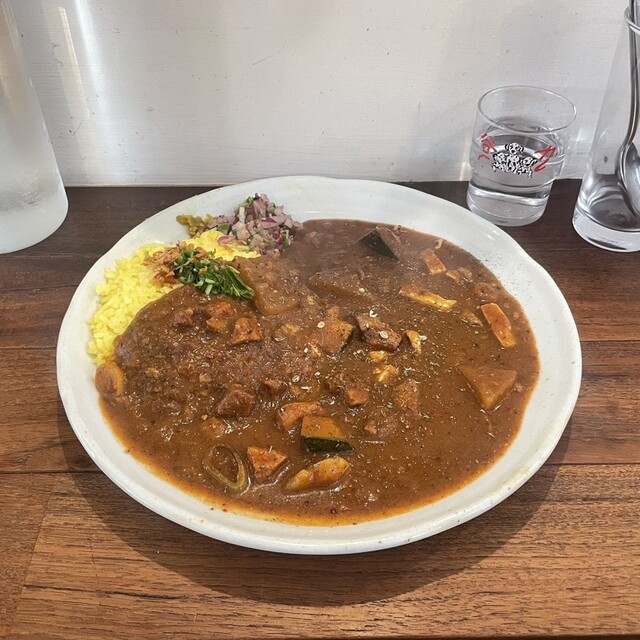
Kitahama’s weekday lunch streets have a sound: office shoes, shutters lifting, short queues forming before noon, then vanishing. Taniguchi Curry fits that rhythm. The room is compact, counter seating is the format, and the appeal is repetition over ceremony: a curry specialist for people who know a serious lunch should waste little time.
Osaka treats curry as more than convenience. Its better curry counters sit between canteen culture and obsessive specialization, with regulars reading the day by spice, rice, pace, and the line outside. Taniguchi Curry belongs there, not in the luxury-dining conversation of -Grilled beef Sukiyaki- KAMAKURA TANUKIAN 鎌倉 たぬき庵 in Kamakura or the kaiseki register represented locally by Koryu. The point is narrower and useful: a low-cost curry counter with regional recognition beyond its neighbourhood.
Osaka curry as a regulars' lunch, not a special-occasion performance
The strongest curry shops in western Japan work by habit. Regulars return because the format is legible: arrive, eat, leave, repeat. Unlike tasting-menu dining, where novelty carries value, Taniguchi Curry signals consistency in a small format: 20 seats, counter seating, no private rooms, non-smoking, and repeated inclusion in Tabelog’s Curry WEST 100 list.
Those selections matter in Kansai’s crowded curry field. Tabelog’s Curry WEST 100 is not a luxury award but a category filter, separating serious curry destinations from countless casual shops around stations and office districts. The restaurant was selected in 2019, 2020, 2023, and 2024, suggesting durability rather than a one-year spike. For regulars, recognition validates the counter and makes the lunch window more competitive.
The price tier explains the loyalty. The listed average sits below JPY 999, while review-based spending is commonly JPY 1,000 to JPY 1,999. In Osaka, that zone demands return value, not spectacle. Compared with yacipoci or Ebishi, both listed around JPY 2,000 to JPY 2,999 in the comparison set, or Rasa Bojun in the JPY 1,000 to JPY 1,999 band, the restaurant is leaner: a specialist lunch for diners willing to cross a few blocks, not commit to a long evening or larger bill.
That regulars’ view helps visitors. Osaka’s dining reputation is often flattened into takoyaki, okonomiyaki, and neon-lit eating, but weekday lunch culture is just as revealing. This counter shows how office districts sustain small specialists: limited seats, tight service, and customers who know the practical rules. The experience rewards decisiveness more than lingering.
Kitahama gives the counter its tempo
Location matters because Kitahama is not Namba. Its appeal is commercial and civic rather than carnival: banks, offices, older buildings, and a workday pulse around the river corridor. Curry shops here serve people on a clock, so the room needs order, turnover, and a reason for regulars to keep the address in their mental lunch map, not plushness.
The restaurant opened in 2013, giving it more than a decade inside that pattern. Longevity in a compact lunch format is a credential; small counters can be fragile, especially when they depend on weekday trade and repeat customers rather than destination dinners. The Tabelog score of 3.65 adds another public signal: not novelty, but accumulated confidence inside a competitive curry category.
For travellers building an Osaka food day, this differs from the city’s famous quick bites. 551 Horai (551蓬莱) is portable and crowd-pleasing; 52CHO-ME BAKERY and .cafe fit the café-and-bakery circuit; 99 Pizza Napoletana Gourmet and a canto (Italian) show Osaka’s broad absorption of non-Japanese formats. Curry is a local comfort category with national depth, and the restaurant represents the side where specialization makes the case.
The comparison extends beyond Osaka. [Curry Senmon Ten] Maruyama Kyoju. in Sapporo shows how regional curry cultures diverge across Japan, while [ki:] in Kyoto.know in Kumamoto, (Shoku) Vietnam in Kawasaki, and. 鮪と炭火焼き うお炭 秋葉原店 in Tokyo occupy different local registers. The lesson is that Japan’s everyday dining depth often appears in narrow categories: curry counters, bakeries, ramen shops, izakaya grills, and specialist cafés.
How to place it in an Osaka itinerary
Use the restaurant as a precise lunch stop, not the anchor for a slow night. Reservations are unavailable, card and electronic payments are not accepted, and parking is not provided, though coin parking exists nearby. The nearest station is Kitahama, with the listed walking distance 529 meters. Those details suit solo diners and small parties better than groups coordinating a loose schedule.
Because it closes on weekends and public holidays, it belongs to a weekday Osaka plan. That restriction is part of its identity: the meal tracks the office district, not the tourist weekend. Visitors staying in Umeda, Honmachi, or around the river can fold it into central Osaka eating without making lunch a detour. Diners from Namba should treat it as a deliberate northward stop.
For a broader itinerary, use it as the curry point in a larger map. Our full Osaka restaurants guide gives the wider dining frame; Our full Osaka hotels guide helps place the stay around transport corridors; Our full Osaka bars guide covers the evening shift after weekday lunch; Our full Osaka experiences guide structures the hours around meals. Our full Osaka wineries guide is narrower, but helps separate restaurant planning from bottle-led travel. For trips beyond Japan, Jōdo Saké Bar in Los Angeles and Onigiri Time in Pasadena show how Japanese formats shift outside their home context.
The editorial case is simple: the restaurant is for diners who want Osaka’s everyday food culture at its disciplined end. It is inexpensive, recognized, compact, and shaped by weekday regulars, a more revealing combination than another grand dinner for understanding how the city eats between work, trains, and repeat habits.
City Peers
Comparable venues at the same tier.
| Venue | Cuisine | Price | Notes |
|---|---|---|---|
| Taniguchi CurryThis venue — the venue you are viewing | Osaka spice curry & Japanese curry | $ | Not listed |
| Dahl | Japanese curry house | $ | Chūō |
| Hirokawa Tailor | Japanese stand-up bar (tachinomi) | $ | Chūō |
| Ikareta Noodle Fish Tons | Japanese Ramen & Tsukemen | $ | Nishi |
| Men Genso | Ramen & Tsukemen | $ | Kita |
| Daikoku | Traditional Osaka cafeteria (teishoku & obanzai) | $ | Chūō |
Recognition history
Dated appearances from independent guides and award organizations, with the underlying list record or original source where available.
Tabelog 100 #54 · No. 54
Tabelog · Tabelog 100 - Curry - WEST - 2024
Continue exploring
More in Osaka
Restaurants in Osaka
Browse all →




Bars in Osaka
Browse all →



Hotels in Osaka
Browse all →




Wineries in Osaka
Browse all →
At a Glance
- Cozy
- Solo
- After Work
- Casual Hangout
- Standalone
- Design Destination
- Zero Waste
Current opening hours
- Monday
- 11:30 AM–2:30 PM
- Tuesday
- 11:30 AM–2:30 PM
- Wednesday
- 11:30 AM–2:30 PM
- Thursday
- 11:30 AM–2:30 PM
- Friday
- 11:30 AM–2:30 PM
- Saturday
- Closed
- Sunday
- Closed
Hours can change for holidays and private events. Last verified .
Casual and low‑key lunchtime spot inside a used book store, with counter seating, simple decor, and a relaxed atmosphere that feels more like a friendly neighborhood hangout than a formal restaurant.