
Osaka’s udon culture is not confined to quick lunches and station counters. Udon Izakaya Mugiwara sits in the evening-friendly end of the category, pairing wheat noodles with izakaya rhythms, a compact room, and Tabelog 100 Udon WEST selections in 2020, 2022, and 2024.
Pearl is the En Primeur Club membership app — saves, bookings, and concierge access live there. Same editors, same standards.
- Address
- Japan, 〒537-0025 Osaka, Higashinari Ward, Nakamichi, 1 Chome−10−19 レジデンスカナイ
- Phone
- +81 6-6971-0972
- Website
- mugiudn0507.amebaownd.com
 Saves & bookings on Pearl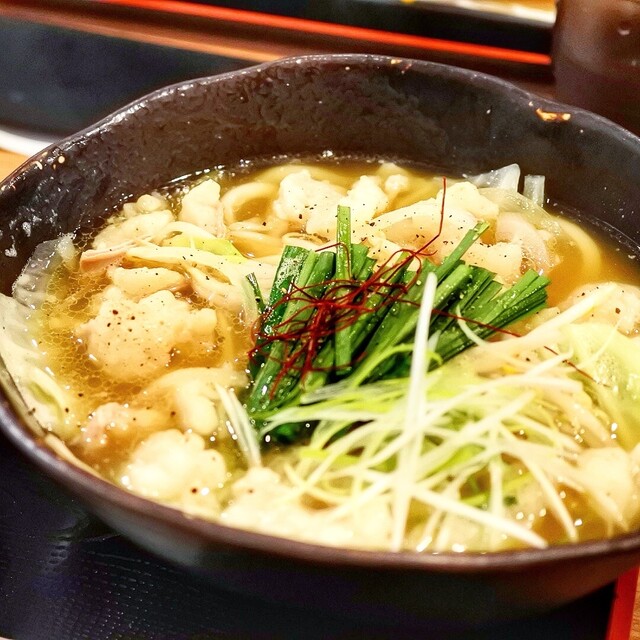
The first cue is scale. Osaka’s noodle rooms announce themselves through proximity: counter seats close to the kitchen, tables set for quick turnover, and orders shifting from lunch pace to evening drinking pace. Udon Izakaya Mugiwara belongs to a Kansai category: the udon shop that does not stop at noodles. The format accommodates family meals, friends, small parties, and the casual izakaya grammar of a table that stretches beyond one bowl.
That matters in Osaka, where wheat noodles compete with ramen, soba, takoyaki, okonomiyaki, department-store dining floors, and late-night drinking streets. Udon is not a fallback dish. It is a texture culture: chew, broth, temperature, and portion all carry meaning. The city rewards places that take the bowl seriously without requiring fine-dining behavior. Udon Izakaya Mugiwara sits in that middle lane: more substantial than a transit-station stop, less formal than a kappo counter, and best understood as a neighborhood udon-izakaya hybrid rather than a single-purpose noodle shop.
Osaka udon with izakaya timing, not a quick-bowl script
The distinction is format. A pure udon shop often means speed, lunch value, and a clean exit. An udon izakaya lets the meal loosen: noodles remain the anchor, but the room can absorb groups, children, and evening drinking without becoming a full restaurant production. In Osaka, that hybrid role gives travelers a route into local everyday dining without defaulting to Dotonbori’s louder tourist circuits or Kitashinchi’s luxury rooms.
The award signal matters. Selection for Tabelog 100 Udon WEST in 2020, 2022, and 2024 places the restaurant within a competitive western Japan noodle category, not a generic Osaka dining list. Tabelog’s udon category is useful because it evaluates a craft often overshadowed internationally by sushi, kaiseki, and ramen. A 3.71 Tabelog score adds a public benchmark, but the stronger editorial read is repeated inclusion across multiple years. In udon, consistency matters more than novelty.
Among Osaka peers, the comparison is instructive. Gokuraku Udon TKU represents the tighter, lower-budget udon-counter lane, while Ramen Jinsei JET 600 sits in the ramen economy of fast, focused bowls. Sobakiri Imose points toward soba’s quieter buckwheat discipline, and Kitashinchi Yumiba Shinnosuke belongs to a more expensive Japanese dining bracket. Udon Izakaya Mugiwara occupies a different decision point: choose it when the meal needs noodle credibility and a room that can carry dinner conversation.
The room works because the category is tactile
Udon is a sensory cuisine before it is a luxury cuisine. The draw is not spectacle, but wheat noodles meeting broth, dipping sauce, tempura, or drinking food depending on the order. In Osaka, pleasure often comes from restraint: a complete bowl without elaborate plating, a counter where the kitchen’s rhythm is audible, and a room that does not turn a casual meal into an occasion. The restaurant’s 28-seat layout, with counter seating, tables, and a small semi-private room, fits that culture: compact enough for noodle-shop energy, flexible enough for a family or group.
That flexibility separates it from destination tasting-menu dining. There is no need to read the room as performance. The better lens is Kansai practicality: value at lunch, broader spend at dinner, and a no-smoking setting that keeps the focus on food rather than bar haze. Children are welcomed, and the kids menu is not incidental; it places the restaurant inside everyday Osaka dining, where quality and usefulness are not opposing ideas.
The izakaya element also changes pace. Rather than a final refuel between sightseeing stops, udon can become a low-pressure dinner. That makes it a counterpoint to other Osaka eating modes. For bakery and coffee detours, Osaka has 52CHO-ME BAKERY, .cafe, and Ban Coffee Ten. For snack culture, 551 Horai (551蓬莱) speaks to a different Osaka appetite. For a sit-down meal with imported technique, 99 Pizza Napoletana Gourmet and a canto (Italian) show how the city absorbs non-Japanese formats without losing informality.
Where it fits in a wider Osaka itinerary
The Higashinari Ward location, around the Morinomiya and Tamatsukuri side of the city, gives the meal a different texture from central hotel-and-shopping zones. This is not instant-neon Osaka. It is a more residential dining context, useful for travelers who want a serious noodle meal without building the day around a formal reservation. The restaurant opened in 2007, another signal that its reputation is not a short-cycle trend.
For an Osaka food day, think in contrasts. Use udon for wheat texture and everyday comfort, ramen for intensity and speed, soba for restraint, and Kitashinchi for higher-spend Japanese dining. The city becomes clearer when those categories stay distinct. A meal here pairs naturally with a broader scan of Our full Osaka restaurants guide, while lodging, drinking, wine, and cultural planning sit separately in Our full Osaka hotels guide, Our full Osaka bars guide, Our full Osaka wineries guide, and Our full Osaka experiences guide.
Travelers building a Japan-wide dining map should keep category discipline. Sukiyaki in Kamakura, tuna and charcoal grilling in Tokyo, curry in Sapporo, Kyoto dining rooms, and overseas Japanese formats are not interchangeable with Osaka udon; they teach different things. For comparison across styles, see -Grilled beef Sukiyaki- KAMAKURA TANUKIAN 鎌倉 たぬき庵 in Kamakura. 鮪と炭火焼き うお炭 秋葉原店 in Tokyo.know in Kumamoto, (Shoku) Vietnam in Kawasaki, [Curry Senmon Ten] Maruyama Kyoju. in Sapporo, [ki:] in Kyoto, Jōdo Saké Bar in Los Angeles, and Onigiri Time in Pasadena. Against that wider field, Osaka udon’s appeal is direct: a craft food that remains social, affordable, and grounded in daily use.
In Context: Similar Options
Comparable venues for cuisine and category context.
| Venue | Cuisine | Price | Notes |
|---|---|---|---|
| Udon Izakaya MugiwaraThis venue — the venue you are viewing | Udon-focused Japanese Izakaya | $$ | Not listed |
| yacipoci | Modern Japanese standing bar (izakaya-style) | $$ | Chūō |
| Tapioca Shokudo | Okonomiyaki & Negiyaki | $$ | Tennōji |
| Konamon Dokoro Mitsukuni Ura nanba ten | Premium Okonomiyaki & Creative Monjayaki | $$ | Chūō |
| Ginza Kagari Ruku a oosaka ten | Modern Japanese Ramen | $$ | Kita |
| AT THE 21 | Osaka okonomiyaki & teppan-yaki | $$ | Toyonaka |
Recognition history
Dated appearances from independent guides and award organizations, with the underlying list record or original source where available.
Tabelog 100 #36 · No. 36
Tabelog · Tabelog 100 - Udon - WEST - 2024
Continue exploring
More in Osaka
Restaurants in Osaka
Browse all →




Bars in Osaka
Browse all →




Hotels in Osaka
Browse all →



Wineries in Osaka
Browse all →
At a Glance
- Cozy
- Lively
- Casual Hangout
- After Work
- Group Dining
- Solo
- Late Night
- Standalone
- Beer Program
- Sake Program
Current opening hours
- Monday
- 11 AM–3 PM, 6–10 PM
- Tuesday
- 11 AM–3 PM, 6–10 PM
- Wednesday
- 11 AM–3 PM, 6–10 PM
- Thursday
- 11 AM–3 PM, 6–10 PM
- Friday
- 11 AM–3 PM, 6–10 PM
- Saturday
- 11 AM–3 PM, 6–10 PM
- Sunday
- Closed
Hours can change for holidays and private events. Last verified .
Casual, lively local spot with the feel of a small udon shop that turns into an izakaya at night, simple interiors and an easygoing neighborhood atmosphere.