
Udon Bo Oosaka honten brings Sanuki-style udon into the basement rhythm of Umeda, where station-building dining favors speed, precision, and repeat custom over ceremony. Selected for Tabelog 100 Udon WEST 2024, it is a compact 19-seat shop built around handmade noodles, tempura, udon-suki, sake, and shochu rather than luxury signals.
Pearl is the En Primeur Club membership app — saves, bookings, and concierge access live there. Same editors, same standards.
- Address
- Japan, 〒530-0001 Osaka, Kita Ward, Umeda, 1 Chome−1−3 Osaka Station 3 Building, 地下2F F37-2
- Phone
- +81 6-6458-5518
- Website
- udonbo.co.jp
 Saves & bookings on Pearl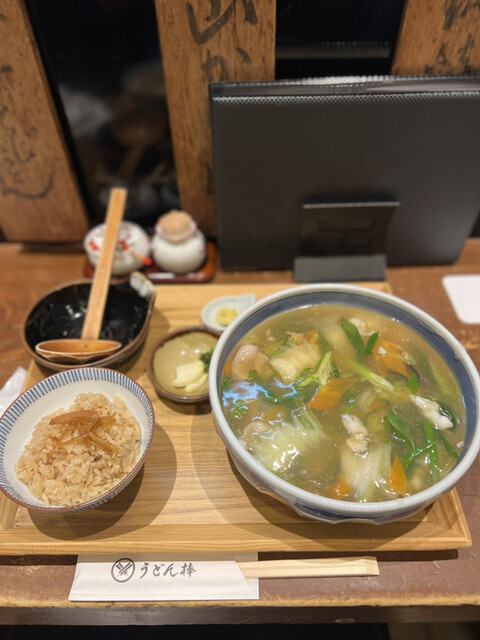
Osaka Station 3 Building has its own weather: fluorescent light, tiled corridors, office workers moving with purpose, and the low percussion of basement kitchens turning over lunch at speed. In that setting, udon is not treated as a consolation prize between grander meals. It is infrastructure, a daily form with enough regional nuance to reward attention. Umeda’s underground dining floors compress the city’s appetite into short counters and small tables, and that compression suits Sanuki-style udon: wheat aroma, chew, broth discipline, and a pace that does not ask the room to slow down.
Udon Bo Oosaka honten belongs to the serious end of that casual category. Its selection for Tabelog 100 Udon WEST 2024 places it among a curated group where noodle craft matters more than polish, and its repeat selections across earlier Tabelog 100 udon lists signal durability rather than novelty. The room is small, with 19 seats split between counter and tables, which gives the experience the tight focus of a neighborhood noodle shop rather than the anonymity of a station complex tenant.
Sanuki udon in Umeda's basement dining culture
Osaka’s reputation often leans toward sauce, griddle, and late-night excess, but the city’s noodle culture is more layered than that shorthand allows. Udon here sits between commuter practicality and regional argument. Kansai diners tend to read broth, noodle texture, tempura timing, and value quickly; a bowl has little room to hide behind presentation. Sanuki udon, associated with Kagawa, raises the stakes around wheat character and elasticity, and that focus explains why a basement shop can draw critical notice without behaving like a destination tasting counter.
The menu categories frame the point clearly: udon, tempura, and udon-suki, with sake and shochu available for a meal that can stay simple or expand slightly. The house description emphasizes handmade udon prepared fresh each morning rather than machine production, a detail that matters because the genre is judged in the bite as much as the broth. Cold tempura udon and champon udon are identified by the restaurant as key orders, both priced at JPY 800, but the larger lesson is not one dish. It is the persistence of a low-cost, high-scrutiny format in a district better known to visitors for transit, shopping, and department-store food halls.
That value context is part of the appeal. Nearby Umeda casual addresses such as Sunshine and Odoru Udon Umeda ten also occupy the under-JPY-1,000 lunch logic, while restaurants such as Pineapple operate in a different Osaka price tier altogether. The comparison matters because udon at this level is not trying to imitate luxury dining. It competes on repetition: the office lunch, the quick solo counter seat, the weekend family stop, the bowl that has to justify itself without theatrical service.
A compact room where the noodle is the main sound
The atmosphere is defined by proximity. Seven counter seats and 12 table seats leave little distance between the kitchen rhythm and the diner, which is exactly why the format works. In a larger room, udon can become background food; in a small one, the sequence of ordering, boiling, draining, and serving becomes the experience. The listed non-smoking policy keeps the focus on wheat, broth, and frying rather than the haze that once marked many older casual restaurants in Japan.
There is no chef biography to inflate into mythology here, and that is a strength editorially. Osaka has enough restaurants built on personality. This one reads through format: handmade noodles, restrained seating, a station-adjacent basement address, children welcome, and a reputation recognized by Tabelog’s udon category rather than by international fine-dining awards. The audience split also says something useful about the room: weekdays bring business diners, while weekends bring couples and families. That is the pattern of a restaurant woven into city life, not a stage set for culinary tourism.
For travelers mapping Osaka through meals, this is the kind of stop that pairs well with broader exploration rather than replacing it. The city’s restaurant range runs from bakeries and cafes to counters, pizzerias, and regional Japanese specialists; compare the casual grammar here with .cafe, 52CHO-ME BAKERY, 551 Horai (551蓬莱), 99 Pizza Napoletana Gourmet, and a canto (Italian). The broader city rails are useful too: Our full Osaka restaurants guide, Our full Osaka hotels guide, Our full Osaka bars guide, Our full Osaka wineries guide, and Our full Osaka experiences guide.
How to read the reputation
Tabelog’s Hyakumeiten selections are especially useful in categories such as udon because they highlight shops where craft and local approval overlap. A 2024 WEST udon selection, a Tabelog score of 3.78, and a history reaching back to 2004 give Udon Bo Oosaka honten more substance than a passing queue. The signal is not luxury; it is consistency inside a demanding everyday genre.
Reservations are unavailable for regular dining, so the decision is less about securing a table weeks ahead and more about timing a small room intelligently. Lunch is the natural context, particularly for travelers already moving through Umeda, but the weekday evening window adds another use case: a focused bowl before trains, bars, or a later second stop. The restaurant notes that service can end when items sell out, a practical detail that matters more here than dress or ceremony.
For readers building a Japan-wide food map, this Osaka udon stop sits in a useful contrast with other formats: beef sukiyaki at -Grilled beef Sukiyaki- KAMAKURA TANUKIAN 鎌倉 たぬき庵 in Kamakura, charcoal and tuna cooking at. 鮪と炭火焼き うお炭 秋葉原店 in Tokyo, regional dining at.know in Kumamoto, Vietnamese cooking at (Shoku) Vietnam in Kawasaki, curry specialization at [Curry Senmon Ten] Maruyama Kyoju. in Sapporo, Kyoto dining at [ki:] in Kyoto, and Japanese drinking culture abroad at Jōdo Saké Bar in Los Angeles and Onigiri Time in Pasadena. The through-line is specialization. In Osaka, that specialization can be as compact as a basement counter and a bowl of handmade udon.
Budget and Context
Comparable venues for cuisine and category context.
| Venue | Cuisine | Price |
|---|---|---|
| Udon Bo Oosaka hontenThis venue — the venue you are viewing | Not listed | $ |
| Hakugin Tei | Chūō, Japanese Curry | $ |
| Menya Tsumugu | Ibaraki, Ramen shop | $ |
| Umaiya Takoyaki | Tenma, Traditional Osaka Takoyaki | $ |
| Okashi Tsukasa Takaoka Fukunobu | Chūō, Traditional Japanese wagashi shop | $ |
| Kama Hiro | Higashisumiyoshi, Japanese Udon | $ |
Recognition history
Dated appearances from independent guides and award organizations, with the underlying list record or original source where available.
Tabelog 100 #45 · No. 45
Tabelog · Tabelog 100 - Udon - WEST - 2024
Continue exploring
More in Osaka
Restaurants in Osaka
Browse all →




Bars in Osaka
Browse all →




Hotels in Osaka
Browse all →



Wineries in Osaka
Browse all →
At a Glance
- Lively
- Classic
- Cozy
- Solo
- Casual Hangout
- After Work
- Family
- Group Dining
- Standalone
- Local Sourcing
Current opening hours
- Monday
- Closed
- Tuesday
- 11 AM–3 PM, 5:30–8 PM
- Wednesday
- 11 AM–3 PM, 5:30–8 PM
- Thursday
- 11 AM–3 PM, 5:30–8 PM
- Friday
- 11 AM–3 PM, 5:30–8 PM
- Saturday
- 11 AM–3 PM
- Sunday
- 11 AM–3 PM
Hours can change for holidays and private events. Last verified .
A compact, no-frills basement udon shop with counter and table seating, bright functional lighting, and a bustling atmosphere driven by office workers, couples, and families waiting for freshly cooked bowls.