
Tabelog 100 #65
Our verdict
Udon Biyori places Higashiosaka’s everyday noodle culture inside a serious craft frame: udon and tempura, low pricing, small-room scale, and repeat Tabelog 100 Udon WEST selections in 2020, 2022, and 2024. It is a practical counterpoint to Osaka’s higher-spend dining, built around a compact 14-seat format rather than ceremony.

Pearl is the En Primeur Club membership app, where members save venues, book tables and use the concierge.
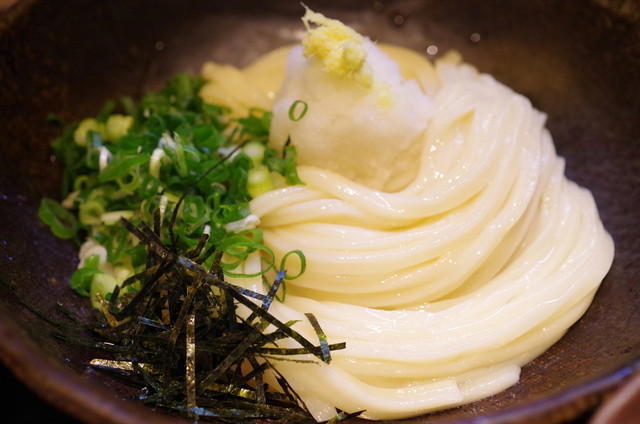
Approaching Udon Biyori in Osaka, the dining mood shifts away from the city’s department-store food halls and neon drinking blocks into a quieter, local register. Udon here is not framed as a luxury performance; it is a daily food with a demanding audience. Serious shops in this category are judged on noodle texture, broth balance, fry work, pacing, and value, not on theatrical plating. Udon Biyori belongs to that category: an udon-and-tempura address where the craft sits inside the rhythms of ordinary lunch and dinner eating.
That distinction matters in Osaka. The city’s food identity is often reduced to takoyaki, okonomiyaki, and late-night counter drinking, but its noodle culture is more revealing. Kansai udon is commonly associated with a lighter, dashi-led profile than the darker, soy-heavy associations of eastern Japan, and Osaka diners tend to be unforgiving about consistency. A shop recognised in Tabelog’s 2024 Hyakumeiten context is operating in a crowded regional field where familiarity does not soften judgment.
Osaka udon judged by texture, tempura, and restraint
The useful way to read this address is not as a destination restaurant in the fine-dining sense, but as a precision version of a local staple. Udon and tempura form the core grammar: wheat noodles, broth or dipping formats, and fried elements that have to land cleanly without overwhelming the bowl. The global-technique angle here is subtle rather than imported spectacle. Tempura itself is a Japanese technique shaped through centuries of adaptation, and in a contemporary udon shop it functions less as garnish than as a test of timing and oil control.
Osaka’s broader casual dining range gives the comparison sharper edges. Other local options can sit in very different registers, from Yakitori Tokei to Marusho Gyoza Ten Dai2 hanna ten and Marusho Gyoza Ten Honten. Menya Jikon Daitou honten offers another point of comparison within Osaka’s everyday dining economy, while Patisserie Rielg shows how narrow-format craft can also exist outside savoury dining. Against that field, the appeal here is concentration: an inexpensive udon room competing on execution rather than breadth.
The room’s appeal reinforces the point. This is best understood through the lens of focused, everyday dining rather than a group-dining spectacle. That kind of format suits udon better than it would suit many cuisines: meals can be straightforward, solo dining is easy to imagine, and the experience is shaped by the immediacy of the kitchen rather than by a long service arc. For travellers comparing Osaka’s dining registers, it offers a different lesson from a tasting-menu reservation. The city’s culinary intelligence often appears in formats that look modest until the details are measured.
Where low pricing meets serious recognition
Price is part of the editorial story. A listed average of - JPY 999 - JPY 999 places the restaurant in a category where value is not a side note but a defining pressure. Low pricing can expose weak kitchens because there is little room for luxury ingredients to cover imprecision. In udon, the fundamentals carry the meal: dough handling, water, heat, dashi discipline, and the temperature at which fried elements reach the table. Recognition from Tabelog’s 2024 Hyakumeiten source matters because it identifies a shop within a specialist context rather than rewarding broad popularity across all cuisines.
That specialist recognition also places Osaka in the frame. Central visitor districts receive much of the attention, but the city’s serious everyday cooking often sits beyond the most obvious entertainment circuits. Udon Biyori is useful for readers who want to understand how Osaka eats outside a single tourist route. It also pairs naturally with wider planning across Our full Osaka restaurants guide, Our full Osaka hotels guide, Our full Osaka bars guide, Our full Osaka wineries guide, and Our full Osaka experiences guide.
Osaka’s casual spectrum is broad enough that a single noodle shop should not carry the whole itinerary. A traveller could read this alongside other quick-service staples, bakery-focused stops, cafe formats, international cooking, or other imported techniques elsewhere in the city. The contrast is instructive: Osaka absorbs outside methods easily, but its strongest casual food culture remains grounded in repeatable craft.
How to place it in a wider Japan food itinerary
For a Japan trip built around regional eating, udon in Osaka works as a counterweight to richer or more specialised stops elsewhere. The same itinerary might include unnamed regional specialists in other Japanese cities, contemporary dining, curry shops, or casual counters, but Osaka’s udon culture is harder to translate because its power lies in local repetition. It is not only about a bowl of noodles; it is about the expectation that a modest format can still be judged with real seriousness.
The critical reading is simple: this is not the place to seek spectacle. It is the kind of address that explains why Kansai noodle shops can sit at the centre of serious dining conversation while remaining inexpensive and casual. Udon Biyori’s value is in that tension, an everyday format assessed by specialist standards.
Frequently asked questions
How much does it cost to eat at Udon Biyori?
Pricing at Udon Biyori is listed as - JPY 999 - JPY 999.
Where is Udon Biyori in Osaka?
Osaka.
What's the best way to book Udon Biyori?
For booking or visit planning, use the latest official information or contact the restaurant directly at the listed phone number, +81-72-966-8854. The location should be treated simply as Osaka for guide purposes.
What's the signature at Udon Biyori?
The clearest anchor is udon, paired with tempura, which is the cuisine listing supplied for Udon Biyori. Its 2024 Tabelog Hyakumeiten recognition also places the noodle shop in a narrower field than a generic local diner.
Can Udon Biyori handle vegetarian requests?
The menu frame is udon and tempura, so a vegetarian diner should confirm the broth and any tempura batter before ordering. In Japanese udon shops, dashi can be fish-based, which makes a quick check especially useful.
Is Udon Biyori a family-friendly restaurant?
The available venue data does not provide a specific family policy. Families, solo diners, and small groups should check the venue's official channels for the latest details before visiting.
A Pricing-First Comparison
Comparable venues to calibrate price, style, and recognition.
| Venue | Cuisine | Price | Awards | Notes |
|---|---|---|---|---|
| Udon BiyoriThis venue (the venue you are viewing) | Udon and Tempura | $10–20 | Tabelog 100 #65 | Not listed |
| Teramae | Okonomiyaki / Teppanyaki | Not listed | Tabelog 100 #38 | Kowakae, Okonomiyaki / Teppanyaki |
| Chuka Soba Fukuhara | Classic Japanese ramen (chuka soba) | $10–20 | Tabelog 100 #18 | Higashiosaka, Classic Japanese ramen (chuka soba) |
| Menya Hanabusa | Nagoya Cochin chicken ramen & chuka soba | $10–20 | Tabelog 100 #29 | Chūō, Nagoya Cochin chicken ramen & chuka soba |
| Rika Shokudo Tenma honten | Japanese Curry House | $1–10 | Tabelog 100 #68 | Kita, Japanese Curry House |
| Menya Saisai Shouwa chou honten | Ramen shop specializing in chicken-based broth | $1–10 | Tabelog 100 #46 | Abeno, Ramen shop specializing in chicken-based broth |
Recognition history
Dated appearances from independent guides and award organizations, with the underlying list record or original source where available.
Tabelog 100 #65 · No. 65
Tabelog · Tabelog 100 - Udon - WEST - 2024
Continue exploring
More in Osaka
Restaurants in Osaka
All restaurants in Osaka →


Bars in Osaka
All bars in Osaka →


Hotels in Osaka
All hotels in Osaka →




Wineries in Osaka
Browse all →
Details
- Cozy
- Quiet
- Classic
- Solo
- Family
- Casual Hangout
- After Work
- Group Dining
- Standalone
- A La Carte
- Counter Dining
A compact, non-smoking neighborhood udon shop with counter and small tables, relaxed and unpretentious, suited to solo diners and families looking for a quiet, casual meal.