
Tabelog 100 #99
Our verdict
Tonkatsu Iwai belongs to Tokyo’s serious tonkatsu tier: compact, focused, and priced in a range that keeps the meal closer to everyday luxury than ceremony. Its Tabelog Tonkatsu 100 selections, 21-seat room, cash-only policy, and no-reservations format make it a disciplined Shibakoen address for travelers who value craft over theatrics.

Pearl is the En Primeur Club membership app, where members save venues, book tables and use the concierge.
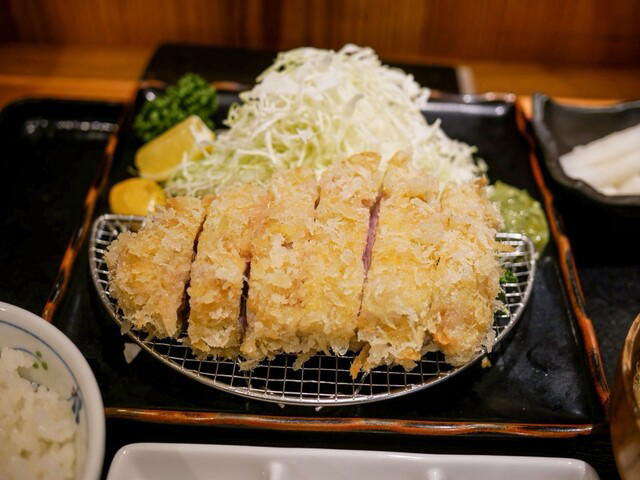
The menu
What to order
- Roppaku Kurobuta tonkatsu set
- Rosu katsu teishoku
- Hire katsu teishoku
Tokyo’s dining rhythm can be quieter than the city’s counter culture or late-night sprawl. Around practical everyday dining areas, lunch can still feel like a working Tokyo ritual: narrow stairways, compact rooms, clipped service, and a queue logic that rewards diners who understand timing. Tonkatsu fits that setting well. It is not a cuisine that needs spectacle; it needs frying discipline, pork, rice, cabbage, soup, and the confidence to let a cutlet carry the meal.
That is the useful frame for Tonkatsu Iwai. Tokyo has no shortage of breaded pork cutlets, but the serious tonkatsu houses separate themselves through restraint rather than decoration. At this tier, value is not about low spend alone. It is about how much focus and consistency a diner gets before the bill starts resembling a formal tasting menu. The restaurant’s 2026 Tabelog Hyakumeiten recognition places it inside the city’s specialist conversation rather than the casual lunch-counter category.
Why Tokyo's tonkatsu value tier matters
Tonkatsu occupies a particular place in Tokyo eating: humble in form, exacting in execution. The dish asks for technical control that is easy to underestimate. Pork thickness, breading texture, oil temperature, resting time, sauce, mustard, rice quality, and cabbage cut all affect the result. When those details are handled well, the meal feels generous without drifting into luxury theater.
Tonkatsu Iwai’s price bracket, JPY 2,000 to JPY 2,999, is the central argument. In Tokyo, that sits above everyday chain tonkatsu but below the city’s high-ceremony counters and tasting-menu rooms. The comparison is useful for travelers deciding where to spend limited meals. A formal Japanese booking, a focused counter dinner, or a casual curry stop each solves a different Tokyo dining problem. Tonkatsu solves the problem of a meal that is focused, filling, and craft-driven without consuming the evening.
The restaurant’s public category is Tonkatsu, with Curry also listed. Those details matter because tonkatsu’s pleasure depends on balance as much as crunch. The better Tokyo examples do not chase heaviness. They aim for a cutlet that reads as pork first and fried food second, with the oil used as a medium rather than a mask.
A Tokyo stop built for specialists, not ceremony
The restaurant is best understood through its specialist category rather than through ceremony. That framing affects the experience more than décor ever could. Tonkatsu restaurants work on rhythm. Orders, frying, resting, plating, and turnover have to remain tight, particularly when the kitchen is dealing with a product that loses clarity if mistimed. This is why the format suits travelers who are comfortable with direct, functional dining rather than leisurely table possession.
Setting also changes the way the meal fits into a Tokyo itinerary. This is practical Tokyo rather than performative Tokyo, with the city’s everyday movement shaping how diners use restaurants through the day. Nearby comparison points underline the spread: Shoutai En Shibadaimon ten sits in a higher dinner spend bracket, Jikasei Sanuki Udon to Niku Jinza Daimon ten occupies a cheaper noodle-and-meat lane, and Le Pain Quotidien Shibakouen ten serves a different all-day function. Tonkatsu Iwai belongs in the middle: more purposeful than a convenience meal, less formal than destination dining.
That middle position is valuable in Tokyo, where travelers often overcorrect toward famous counters and tasting menus. A city’s food culture is not only expressed in seats that require months of planning. It is also visible in specialist restaurants that refine a single category until the ordinary format becomes exact. For a broader read on that range, Our full Tokyo restaurants guide is the useful starting point, while Our full Tokyo hotels guide, Our full Tokyo bars guide, Our full Tokyo wineries guide, and Our full Tokyo experiences guide map the surrounding trip decisions.
How to place it in a Tokyo eating plan
The better use case is not a grand occasion. It is a tightly planned lunch or dinner within a Tokyo day, especially when the itinerary benefits from something direct rather than ceremonial. The format rewards diners who arrive with a clear appetite and no need for a long menu debate. It is also a useful corrective after several meals built around omakase, wagyu, or multi-course Japanese dining: pork cutlet, rice, cabbage, and soup bring the trip back to fundamentals.
There are boundaries, as with many Tokyo specialist restaurants. The appeal is not a sprawling lounge experience or a concierge-heavy meal. It is a timing decision, a category decision, and an appetite decision. Diners should treat it as a focused stop and confirm current practical details before going, because specialist restaurants can operate with limited capacity and service windows.
Tokyo’s appeal lies partly in these category-specific rooms. A traveler might build one day around tonkatsu at Tonkatsu Iwai, another around a more formal Tokyo dining room, and another around lighter café culture elsewhere in the city. Beyond Tokyo, the same logic appears in regional specialists that commit tightly to one format. For travelers, the lesson is not to chase names for their own sake, but to understand how narrowly defined restaurants can express a city’s everyday craft.
The critical takeaway is simple: this is a value play for diners who care about tonkatsu as a craft category. The 2026 Tabelog Hyakumeiten recognition supplies the trust signal, the JPY 2,000 to JPY 2,999 price bracket keeps the decision accessible, and the specialist-restaurant logic demands a little discipline. In a city where meals can easily become overplanned, Tonkatsu Iwai makes the case for one focused plate and a clean exit.
Frequently asked questions
What are Tonkatsu Iwai's hours?
Current hours for Tonkatsu Iwai should be confirmed directly before visiting, as specialist restaurants in Tokyo can operate with limited service windows.
What should I budget for a meal at Tonkatsu Iwai?
Pricing at Tonkatsu Iwai is listed as JPY 2,000 - JPY 2,999 JPY 2,000 - JPY 2,999.
How do I find Tonkatsu Iwai?
Tonkatsu Iwai is located in Tokyo.
What do critics highlight about Tonkatsu Iwai?
Tonkatsu Iwai is listed in the Tonkatsu and Curry categories. Its 2026 Tabelog Hyakumeiten recognition and 3.92 score provide the main public signals for the restaurant.
Pricing, Compared
Comparable venues at a similar level for quick context.
| Venue | Cuisine | Price | Awards | Notes |
|---|---|---|---|---|
| Tonkatsu IwaiThis venue (the venue you are viewing) | Tonkatsu | $20–30 | Tabelog 100 #99 | Not listed |
| Kaneko Hannosuke (金子半之助) | Edo-style Tempura Rice Bowls (Tendon) | $10–20 | Not listed | Nihonbashi, Edo-style Tempura Rice Bowls (Tendon) |
| Kuya | Traditional Japanese Wagashi & Monaka | Not listed | Tabelog 100 #52 | Chūō, Traditional Japanese Wagashi & Monaka |
| Sanmalo Toukyou ten | Specialty ramen (shoyu, niboshi & seasonal chilled bowls) | $10–20 | Tabelog 100 #35 | Chiyoda, Specialty ramen (shoyu, niboshi & seasonal chilled bowls) |
| Hinadori Sonoda | Japanese chicken izakaya specializing in deep-fried young chicken | $30–50 | Tabelog 100 #93 | Shinagawa, Japanese chicken izakaya specializing in deep-fried young chicken |
| Hototogisu | Modern Seafood Soba Ramen | $10–20 | Michelin Bib Gourmand | Shinjuku, Michelin-Starred Seafood Ramen |
Recognition history
Dated appearances from independent guides and award organizations, with the underlying list record or original source where available.
Tabelog 100 #99 · No. 99
Tabelog · Tabelog 100 - Tonkatsu - 2026
Continue exploring
More in Tokyo
Restaurants in Tokyo
All restaurants in Tokyo →
Bars in Tokyo
All bars in Tokyo →

Details
- Classic
- Cozy
- Intimate
- Solo
- Casual Hangout
- Group Dining
- Standalone
- Local Sourcing
- Set Menu
- A La Carte
Current opening hours
- Monday
- 11:30 AM–1:45 PM, 5:30–7:45 PM
- Tuesday
- 11:30 AM–1:45 PM, 5:30–7:45 PM
- Wednesday
- 11:30 AM–1:45 PM, 5:30–7:45 PM
- Thursday
- 11:30 AM–1:45 PM, 5:30–7:45 PM
- Friday
- 11:30 AM–1:45 PM, 5:30–7:45 PM
- Saturday
- 11:30 AM–1:45 PM
- Sunday
- Closed
Hours can change for holidays and private events. Hours as of .
A hidden, unpretentious Japanese-style space with a compact, quiet neighborhood feel.