
Hongo’s standing udon counters belong to a Tokyo tradition where speed, restraint, and repetition carry as much weight as luxury dining rituals. TOKYO LIGHT BLUE HONGO-3 brings that format into sharp focus: a compact udon-and-tempura address near Hongo Sanchome, selected for Tabelog’s Udon EAST 100 in 2024, with breakfast hours and a no-reservations rhythm that suits solo diners as much as families.
Pearl is the En Primeur Club membership app — saves, bookings, and concierge access live there. Same editors, same standards.
- Address
- Japan, 〒113-0033 Tokyo, Bunkyo City, 文京区Hongo, 2 Chome−39−7 エチソウビル
- Website
- tabelog.com
 Saves & bookings on Pearl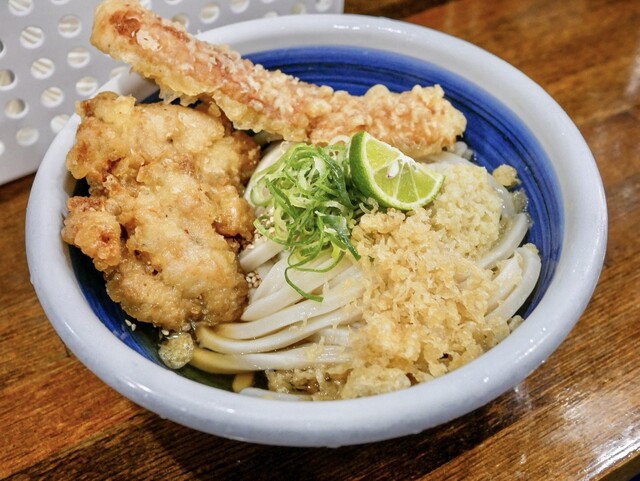
Hongo Sanchome is not Ginza theater or Shibuya spectacle. Eating here is academic Tokyo: practical, compressed, built around routines between lectures, office hours, hospital shifts, and train transfers. A standing udon counter fits Bunkyo. The room asks for attention, not ceremony: counter space, quick movement, little tolerance for lingering, and the quiet choreography of solo diners eating efficiently and making room.
That is where TOKYO LIGHT BLUE HONGO-3 belongs. Tokyo’s udon culture is discussed less loudly than ramen or sushi, but its better addresses reveal discipline: temperature, noodle texture, broth clarity, tempura timing, and the consistency with which a small shop repeats those choices through long service. Selection for Tabelog’s Udon EAST 100 in 2024 places the restaurant within a defined regional conversation, not a generic cheap-eats category.
Standing udon in Hongo, read as a Tokyo rhythm
Standing-room dining in Tokyo is often mistaken for mere function. At stronger counters, compression is the point. The format removes padding: no tasting-menu arc, wine pairing, or theatrical pacing. Udon arrives directly, and the diner reads the shop through a few signals: wheat-noodle handling, tempura treatment, counter pace, and how smoothly the room turns without chaos.
The Hongo setting sharpens that reading. Bunkyo has a different appetite from nightlife districts. Around Hongo Sanchome, density comes from students, researchers, medical workers, residents, and office traffic rather than destination dining alone. Breakfast availability matters because it ties the shop to daily use, not only lunch-hour demand. In a city where high-end restaurants often require planning, a serious low-cost counter can reveal local dining habits more clearly than a reservation-only room.
The category matters too. Udon and tempura share a long-standing relationship in Japan because texture does much of the work: wheat chew against crisp batter, warm broth against fried garnish, softness against snap. Without naming a house specialty that is not publicly listed, the point is format rather than one dish. The menu sits in the udon-and-tempura lane, giving diners a clear frame for judgment.
Recognition without ceremony
Tabelog’s Hyakumeiten lists carry weight in Japan because they reward depth within specific categories rather than broad luxury signals. A Tabelog 100 selection for Udon EAST in 2024 means the shop is evaluated among serious udon specialists across eastern Japan, not against unrelated fine-dining rooms. Earlier udon-category selections in 2022 and 2020 show this is not a one-season burst of attention.
That recognition helps because the visible format is modest. Nine standing places do not announce ambition like a tasting counter. Yet Tokyo has a long history of small, category-specific restaurants where narrowness is an advantage. A compact udon counter can focus labor and timing around limited decisions. Judge it against other specialist noodle addresses, not polished multi-course restaurants.
Comparison sets expectations. In Tokyo, Chuka Soba Nishino and Menya Suzuharu sit in the ramen and noodle-specialist conversation at different price and product angles, while Sake to Misonikomi Misonikomin points to miso-nikomi tradition with a broader dining pattern. Katsuzen and Jumbo Hanare occupy entirely different categories, reminders that Tokyo’s serious dining is not one hierarchy. The question is not whether a standing udon shop competes with a yakiniku address, but whether it expresses its category clearly enough to merit attention.
For a wider itinerary, this is the kind of restaurant that pairs with other category-led stops rather than a night built around spectacle. Tokyo rewards that approach: a day can move from noodle counter to yakitori, curry, coffee, or grilled fish without making every meal carry the same social weight. EP Club’s broader city coverage helps sort those lanes: see Our full Tokyo restaurants guide, Our full Tokyo hotels guide, Our full Tokyo bars guide, Our full Tokyo wineries guide, and Our full Tokyo experiences guide.
How to place it in a Tokyo eating day
The strongest use case is solo or low-friction dining. Counter format, take-out availability, non-smoking setting, and children-welcome note make the restaurant more flexible than its footprint suggests, but standing-room structure keeps it brisk. This is not for a drawn-out catch-up or multi-bottle evening. It works as a precise stop before or after time in Bunkyo, Ueno, Ochanomizu, or the Marunouchi Line corridor.
Cash-only conditions are part of the practical texture of older and smaller Tokyo food businesses. They also signal the operation: narrow, efficient, built around throughput rather than hospitality layers. Reservations are unavailable, which suits the category. The decision is made at street level, by timing and appetite, not a booking calendar.
Within Tokyo’s larger dining map, this address belongs beside tightly defined casual specialists rather than broad-menu restaurants. Nearby and citywide alternatives point in different directions:. 鮪と炭火焼き うお炭 秋葉原店 for tuna and charcoal-grill territory, 12/10 Shinjuku ten for a Shinjuku stop, 124. KAGURAZAKA (Yakitori) for skewers, 2D Cafe for a visual café detour, and 3 Chome no Curry Ya San for curry. Beyond Tokyo, the same category-first logic extends to -Grilled beef Sukiyaki- KAMAKURA TANUKIAN 鎌倉 たぬき庵 in Kamakura.cafe in Osaka.know in Kumamoto, (Shoku) Vietnam in Kawasaki, [Curry Senmon Ten] Maruyama Kyoju. in Sapporo, [ki:] in Kyoto, Jōdo Saké Bar in Los Angeles, and Onigiri Time in Pasadena.
The editorial value is clear: Tokyo’s serious food culture is not confined to rarefied counters. TOKYO LIGHT BLUE HONGO-3 shows the other side of the city’s dining intelligence, where a small standing udon shop can carry enough category authority to merit attention without asking the diner to dress up the experience.
Comparison Snapshot
Comparable options at the same price tier.
| Venue | Cuisine | Price | Notes |
|---|---|---|---|
| TOKYO LIGHT BLUE HONGO-3This venue — the venue you are viewing | Standing Sanuki udon & tempura | $ | Not listed |
| Men Mitsui | Refined Tokyo Ramen | $ | Taitō |
| Oniyanma Ningyouchou ten | Standing Udon Noodle Bar | $ | Chūō |
| Asada Ya | Traditional Japanese wagashi & daifuku shop | $ | Minato |
| Ichijoryu Ganko Sohonke Bunke Yotsuya Arakicho | Classic Japanese ramen counter | $ | Shinjuku |
| Kototoi Dango | Traditional Wagashi & Dango Shop | $ | Sumida |
Recognition history
Dated appearances from independent guides and award organizations, with the underlying list record or original source where available.
Tabelog 100 #33 · No. 33
Tabelog · Tabelog 100 - Udon - EAST - 2024







At a Glance
- Lively
- Casual
- Solo
- Family
- Casual Hangout
- After Work
- Standalone
Current opening hours
- Monday
- 7 AM–11 PM
- Tuesday
- 7 AM–11 PM
- Wednesday
- 7 AM–11 PM
- Thursday
- 7 AM–11 PM
- Friday
- 7 AM–11 PM
- Saturday
- 10 AM–8 PM
- Sunday
- 10 AM–8 PM
Hours can change for holidays and private events. Last verified .
A compact, standing-only counter with bright, functional lighting and a casual, bustling atmosphere typical of popular Tokyo noodle shops; guests come for a quick, satisfying bowl rather than a lingering meal.