Tok Tok Mee Bamboo Noodle

A Michelin Plate-recognised noodle shop on Lebuh Campbell where bamboo-kneaded dough is worked at the entrance in plain view, a Cantonese tradition with deep roots in George Town's hawker culture. The wonton noodle soup draws queues, while the dried noodles tossed with shrimp roe and Cantonese barbecue meats extend the appeal across a short, focused menu. Chinese pastries, including BBQ pork pie and pandan kaya dumplings, round out a visit worth planning around.
Pearl is the En Primeur Club membership app — saves, bookings, and concierge access live there. Same editors, same standards.
- Address
- 37, Lebuh Campbell, George Town, 10200 George Town, Pulau Pinang, Malaysia
- Phone
- +60 4-261 9875
- Website
- facebook.com
- Directions
- Get directions
 Saves & bookings on Pearl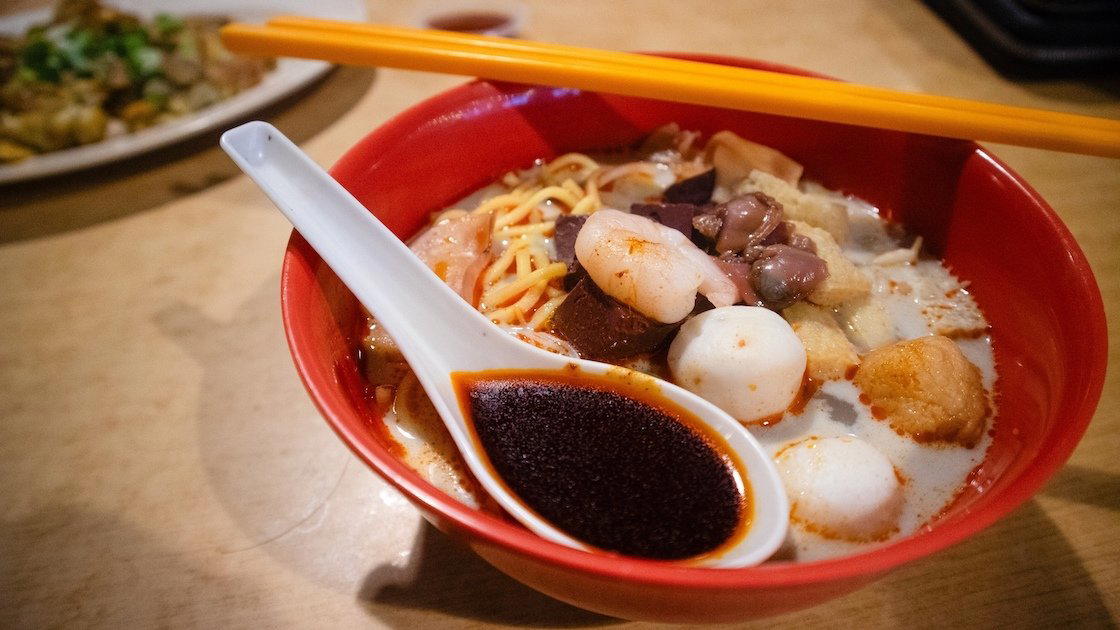
Where Bamboo Kneading Is Still the Opening Act
On Lebuh Campbell, before you order anything, you hear it: a rhythmic, hollow percussion coming from the front of the shop. The sound is the point. 'Tok tok' is onomatopoeia for the motion of kneading noodle dough with a bamboo pole, and at this Cantonese noodle shop, the technique is performed at the entrance rather than hidden in the kitchen. In a city where heritage food traditions are simultaneously celebrated and disappearing, watching the dough worked this way is a reminder that the gesture of making is as significant as the product on the plate.
George Town's noodle culture spans several dialect traditions, Hokkien, Teochew, Cantonese, and each carries its own logic of texture, broth, and topping. The Cantonese strand tends toward cleaner broths, bouncier noodles, and a more restrained use of aromatics compared to the deeper, more pungent Hokkien prawn mee tradition you find at spots like Bridge Street Prawn Noodle. Bamboo-kneaded noodles sit within the Cantonese category, their springiness a direct result of the physical compression the pole applies to the dough, a process that no machine has fully replicated to the satisfaction of those who grew up eating the real thing.
The Menu, Focused and Deliberate
The Cantonese wonton noodle soup anchors the menu. The noodles carry the elasticity that bamboo kneading produces, and the wontons are filled with shrimp, an approach that aligns with the Hong Kong-influenced Cantonese tradition rather than the pork-dominant variations more common in Kuala Lumpur. The broth is built for clarity rather than depth, letting the noodle texture and the clean shrimp flavour carry the bowl.
A second option worth noting is the dried noodle preparation: blanched noodles tossed with dried shrimp roe, which adds a saline, umami-forward edge to what might otherwise read as a simpler dish. Cantonese barbecue meats appear alongside, fitting the same grammar as the wonton soup but shifting the focus toward char and fat rather than broth. The combination of these two formats means the menu rewards a second visit with a different order, a characteristic of the better hawker counters across the city.
Beyond noodles, the Chinese pastry selection is an extension of the same Cantonese identity: BBQ pork pie and pandan kaya dumplings. Both reflect a pastry tradition that sits at the intersection of Chinese technique and Southeast Asian flavour, the kind of hybrid that George Town's Cantonese-Peranakan food history produced organically over generations. For context on the Peranakan tradition that parallels this evolution, Auntie Gaik Lean's Old School Eatery provides a thorough grounding in what that fusion looks like at the table.
Occasion Dining in a Hawker Register
The editorial angle of 'occasion dining' might seem mismatched with a single-dollar price range and an open-fronted shophouse. The city has its fine-dining tier, European Contemporary at the higher end sits in a different category entirely, but many of the meals residents remember most precisely are tied to street-level shops with generations of history behind them. Bringing visitors here for their first bowl of bamboo-kneaded wonton noodles, returning after years away, or marking a morning in George Town with something that cannot be replicated elsewhere: these are the registers in which hawker eating becomes occasion dining.
The Michelin Plate recognition in both 2024 and 2025 provides an external validation point, but it also signals something about the category: Michelin's Plate designation in Malaysia has consistently highlighted traditional hawker and kopitiam operations where the craft is the credential, regardless of setting or price. This is not the tier occupied by Dewakan in Kuala Lumpur, where tasting menus and modern Malaysian technique define the format. It is a different kind of seriousness, one measured in the consistency of dough texture and the precise sourcing of dried shrimp roe rather than in plating or service design.
Lebuh Campbell and the Noodle Shop Context
Campbell Street sits within the core of George Town's historic shophouse district, where the density of heritage food operations remains high relative to most Asian cities of comparable size. The street and its immediate surrounds contain a concentration of noodle shops, coffee stalls, and pastry counters that collectively form one of the more coherent food corridors in Penang. Hot Bowl White Curry Mee, Pitt Street Koay Teow Soup, and Fook Cheow Cafe each occupy adjacent positions in the same tradition, and a morning or midday session moving between them is how residents and informed visitors structure a serious food itinerary.
Internationally, bamboo-kneaded noodle traditions extend across the Chinese diaspora. Comparable approaches appear in mainland Chinese noodle shops like A Niang Mian Guan in Shanghai and A Bing Bao Shan Mian in Hangzhou, while the noodle culture in Taiwan shows its own variations at venues like A Kun Mian in Taichung and Ajisai in Taichung. The Fuzhou tradition adds another dimension through places like A Xin Xian Lao on Gongnong Road in Fuzhou. Positioning Tok Tok Mee Bamboo Noodle within this broader Chinese noodle network clarifies what is specific to George Town, the bamboo-kneaded Cantonese format with Southeast Asian pastry integration, versus what is shared across the wider tradition of hand-worked dough.
Elsewhere in Malaysia, Bee See Heong in Seberang Perai reflects a different strand of the same regional food culture, while the contrast with resort dining like The Planters at The Danna in Langkawi illustrates the range of formats that Malaysian food encompasses across its geography.
Know Before You Go
- Address: 37, Lebuh Campbell, George Town, 10200, Pulau Pinang, Malaysia
- Price range: $ (low cost; cash-friendly hawker pricing)
- Recognition: Michelin Plate 2024 and 2025 3 from 2,448 reviews
- Booking: Walk-in friendly
- What to order: Wonton noodle soup; dried noodles with shrimp roe; BBQ pork pie; pandan kaya dumplings
Comparable Spots, Quickly
Comparable venues nearby, for context on price, style, and recognition.
| Venue | Cuisine | Price | Awards | Notes |
|---|---|---|---|---|
| Tok Tok Mee Bamboo NoodleThis venue — the venue you are viewing | Cantonese Bamboo Noodles & Pastries | $ | Michelin Plate | Not listed |
| Bao Teck Tea House | Cantonese Dim Sum Tea House | $$ | Michelin Plate | George Town |
| Sister Yao’s Char Koay Kak | Teochew Char Koay Kak | $ | Bib Gourmand | George Town |
| The Pinn | Malaysian-Chinese Small Eats | $ | Michelin Plate | George Town |
| Lum Lai Duck Meat Koay Teow Th'ng | Teochew Duck Meat Koay Teow Th'ng | $ | Bib Gourmand | George Town |
| WhatSaeb Boat Noodles | Authentic Thai Boat Noodles | $ | Michelin Plate | George Town |
Recognition history
Dated appearances from independent guides and award organizations, with the underlying list record or original source where available.
Michelin Plate
Michelin
Michelin Plate
Michelin
Michelin Plate
Michelin
Continue exploring
More in George Town
Restaurants in George Town
Browse all →
Bars in George Town
Browse all →
At a Glance
- Lively
- Casual Hangout
- Open Kitchen
Current opening hours
- Monday
- 9:30 AM–7:30 PM
- Tuesday
- 9:30 AM–7:30 PM
- Wednesday
- 9:30 AM–7:30 PM
- Thursday
- Closed
- Friday
- 9:30 AM–7:30 PM
- Saturday
- 9:30 AM–7:30 PM
- Sunday
- 9:30 AM–7:30 PM
Hours can change for holidays and private events. Last verified .
Bustling street-side noodle shop with energetic atmosphere from on-site noodle making and constant customer traffic.