Our verdict
The Ivy Dublin on Dawson Street brings the London original's signature brasserie format to the heart of Georgian Dublin, positioning itself as a see-and-be-seen destination in a city that has grown increasingly serious about its dining rooms. The room's theatrical design and broad, accessible menu place it in a different tier from the tasting-menu houses nearby, making it a useful reference point for understanding how Dublin's dining spectrum has widened.

Pearl is the En Primeur Club membership app — saves, bookings, and concierge access live there. Same editors, same standards.
- Address
- 13-17 Dawson St, Dublin, D02 TF98, Ireland
- Phone
- +35316950744
- Hours
- Mon–Thu 11 AM–11:30 PMFri–Sun 9 AM–11:30 PM
- Website
- ivycollection.com
- Directions
- Get directions
- Booking
- Book on OpenTable
The menu
What to order
- Fish and Chips
- Shepherd's Pie
- Eggs Benedict
Dawson Street and the Business of the Grand Brasserie
Dawson Street has always occupied a specific register in Dublin's social geography. Running from St Stephen's Green northward toward Trinity College, it sits at the intersection of old professional Dublin and the newer, more international city that has grown up around it over the past two decades. The restaurants and bars along this corridor do not compete on the same terms as the tasting-menu rooms a few hundred metres away. They compete on atmosphere, availability, and the sense that a room is worth being seen in. That is the operating logic of the grand brasserie format, and it is the format The Ivy Dublin inhabits at 13-17 Dawson Street.
The Ivy brand arrived in Dublin as part of a wider UK and Ireland expansion that has seen the original London institution on West Street — a fixture of the media and theatre world since the 1990s — become a multi-site operation. The tension in any such expansion is whether the room retains enough character to justify its positioning or simply becomes a well-dressed chain. In Dublin's case, the question is sharpened by the quality of the competition. Within a short walk, Glovers Alley and D'Olier Street operate in a more technically focused register, while Patrick Guilbaud remains the city's formal fine-dining benchmark. The Ivy Dublin does not compete directly with any of them. It occupies a different category: the kind of room where lunch runs long, where the wine list needs to work as hard as the kitchen, and where the physical environment carries as much weight as what arrives on the plate.
The Room as Argument
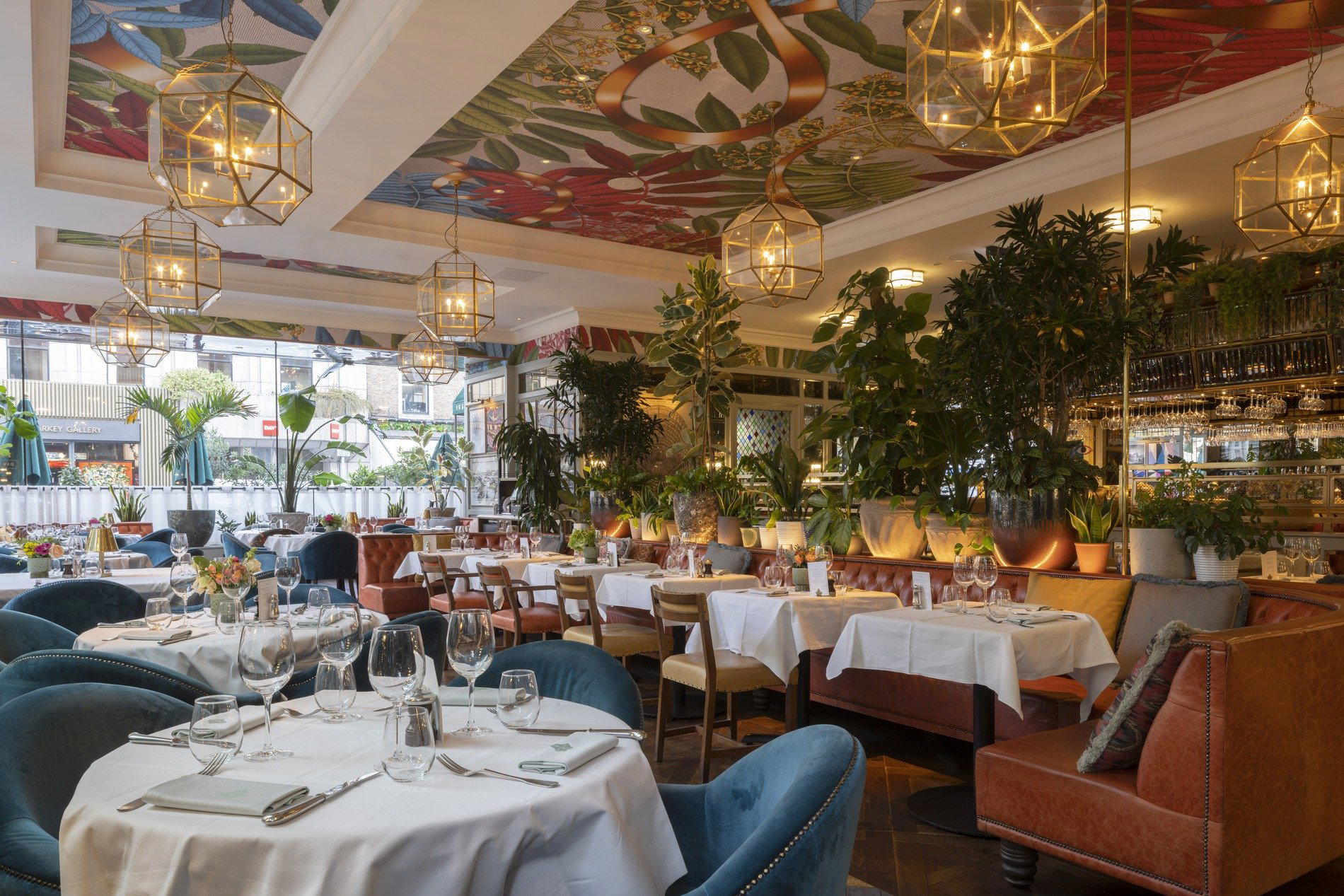
The Ivy's design language across its sites leans on a specific visual vocabulary: stained glass, dark timber, art-lined walls, and a density of seating that feels purposeful rather than cramped. The Dublin location follows this template while scaling it to a building that spans the width of several Georgian shopfronts on Dawson Street. The effect, when the room is full, is closer to a European grand café than to the stripped-back aesthetic that dominates much of contemporary Dublin dining. For a city that has spent the last decade moving toward exposed concrete and Nordic restraint, this is a deliberate counter-statement.
That counter-statement matters because it defines who the room is for. The Ivy Dublin draws on a clientele that includes tourists with a reference point from London, Dublin professionals eating on expense, and weekend visitors who want a reliable room without the commitment of a tasting menu. This is not a criticism, the brasserie format serves a real function in any serious dining city, and Dublin's growth as a destination has created genuine demand for it. What separates a good brasserie from a mediocre one, however, is the wine list and the consistency of service across the full span of the menu.
The Wine List in the Grand Brasserie Context
In the brasserie format, the wine list carries a disproportionate share of the experience. Because the food is designed to be broadly accessible rather than technically challenging, the cellar becomes the primary way a room signals its seriousness to guests who know what they are looking at. The leading brasserie wine programs in Europe operate across a wide range of styles and price points, with enough depth in Burgundy, Bordeaux, and the Rhône to satisfy the table that wants to drink well, and enough by-the-glass range to serve the solo diner or the quick lunch.
The Ivy group has built its reputation in part on wine lists that function at this level. For the Dublin location, the list represents one of the more accessible entry points to drinking well on Dawson Street without committing to the full fine-dining format. By comparison, Chapter One by Mickael Viljanen and Bastible operate wine programs that are more tightly curated and often more adventurous in terms of natural and low-intervention producers, but they are also structured around tasting menus that set the pace of the evening. The Ivy Dublin's list needs to work across a more varied set of dining occasions, which is a different and in some ways harder brief.
Ireland's own wine culture has shifted considerably. Across the country, restaurants from Aniar in Galway to Chestnut in Ballydehob have developed lists with strong natural wine credentials and a focus on small producers. Urban rooms like The Ivy sit at the other end of this spectrum, prioritising range and recognisability over curation depth. Neither approach is wrong; they serve different rooms and different expectations.
Where The Ivy Dublin Sits in Dublin's Dining Spectrum
Dublin's restaurant market has matured significantly over the past decade. The city now supports a full range of formats, from the destination tasting-menu rooms that draw international visitors to the neighbourhood bistros that have raised the floor of everyday eating. The Ivy Dublin enters at the mid-to-upper end of the casual-formal range: more expensive and more theatrical than a neighbourhood restaurant, less demanding and more broadly accessible than the Michelin-tier rooms. For a sense of the broader Irish dining context, Liath in Blackrock, Terre in Castlemartyr, and Lady Helen in Thomastown represent how destination dining has spread well beyond Dublin. Within the city, the comparison set is cleaner: The Ivy Dublin competes for the same Saturday lunch booking as several other well-appointed rooms, and it wins or loses that competition on atmosphere and consistency.
For readers familiar with the brasserie format in other markets, the reference points are useful. Le Bernardin in New York City and Atomix operate in entirely different tiers, but they demonstrate how a room's identity can be held together by a clear point of view about what the guest experience should be. The Ivy Dublin's point of view is comfort, familiarity, and a room that feels like an occasion without requiring one. Whether that formula works in Dublin's increasingly competitive market is a question the room answers nightly.
For a broader map of where The Ivy Dublin fits, the full Dublin restaurants guide covers the city's dining spectrum in detail, from the neighbourhood level up to destination rooms. Those planning trips further afield might also consider Bastion in Kinsale, Campagne in Kilkenny, Homestead Cottage in Doolin, House in Ardmore, and dede in Baltimore for a fuller picture of where Irish cooking is heading.
Planning Your Visit
| Venue | Format | Price Tier | Booking Lead Time |
|---|---|---|---|
| The Ivy Dublin | Grand brasserie, à la carte | Mid-to-upper casual | Days to weeks (weekends longer) |
| Patrick Guilbaud | Fine dining, tasting menu | €€€€ | Several weeks minimum |
| Chapter One by Mickael Viljanen | Modern tasting menu | €€€€ | Several weeks minimum |
| Glovers Alley | Modern à la carte and tasting | €€€€ | One to two weeks |
| Bastible | Neighbourhood fine dining | €€€€ | One to two weeks |
Frequently asked questions
What part of town is The Ivy Dublin in?
The Ivy Dublin is located at 13-17 Dawson St, Dublin, D02 TF98, Ireland, Dublin.
Is The Ivy Dublin suitable for a business lunch, and how does the room handle noise levels?
The Dawson Street address places The Ivy within easy reach of the city's financial and professional districts, which has made it a practical choice for the business lunch circuit. The brasserie format supports that function specifically: a wide menu removes the friction of dietary negotiation, and the room's density and ambient noise provide enough cover for private conversation without the hush of a formal dining room. The Ivy's design approach across its sites, dark timber, art-lined walls, and tiered seating, also supports a professional setting that reads neither too casual nor too formal.
What's the must-try dish at The Ivy Dublin?
The Ivy's menus across its sites are built around brasserie classics rather than a single flagship plate, covering a range wide enough that regulars return for different reasons. The kitchen at Dawson Street follows this format, so the stronger approach is to treat the menu as a whole rather than anchor your visit to one item. Given the brasserie context, dishes with broad appeal and reliable execution tend to be the smarter choice over more speculative daily options.
Can I walk in to The Ivy Dublin?
Walk-in availability at 13-17 Dawson Street depends on timing. Dublin's central dining rooms at this price level run close to capacity on weekday lunches and weekend evenings, so mid-afternoon or early-evening slots offer the most realistic walk-in window. Booking ahead is the more reliable approach for peak service periods, particularly for groups larger than two.
Quick Comparison
Comparable venues nearby, for context on price, style, and recognition.
| Venue | Cuisine | Price | Notes |
|---|---|---|---|
| The Ivy DublinThis venue — the venue you are viewing | Modern European Brasserie | $30–50 | Not listed |
| Forest Avenue Deli & Wine Bar | Modern European Deli & Wine Bar | Not listed | Pembroke West C |
| Fawn | Modern European Bistro | Not listed | Royal Exchange A |
| Balfes | French-Irish Brasserie | $30–50 | Royal Exchange B |
| The Grayson | Contemporary Irish | $50–100 | Mansion House B |
| l'Gueuleton | Modern French Bistro | $50–100 | Royal Exchange A |
Continue exploring
More in Dublin
Restaurants in Dublin
Browse all →
Bars in Dublin
Browse all →
Hotels in Dublin
Browse all →
Wineries in Dublin
Browse all →
Details
- Elegant
- Lively
- Sophisticated
- Well Known
- Brunch
- Special Occasion
- Group Dining
- Open Kitchen
- Craft Cocktails
- A La Carte
- Set Menu
- Cocktails
- Vegetarian Friendly
- Vegan Options
- Gluten Free Options
Current opening hours
- Monday
- 11 AM–11:30 PM
- Tuesday
- 11 AM–11:30 PM
- Wednesday
- 11 AM–11:30 PM
- Thursday
- 11 AM–11:30 PM
- Friday
- 9 AM–11:30 PM
- Saturday
- 9 AM–11:30 PM
- Sunday
- 9 AM–11:30 PM
Hours can change for holidays and private events. Last verified .
Bright, colorful, and busy with elegant glamour and lively energy.