The Grain Store
Our verdict
Set within the grounds of Killruddery House in County Wicklow, The Grain Store operates where heritage architecture meets contemporary Irish dining. The setting, a restored estate building on one of Ireland's oldest continuously inhabited demesnes, positions it within a small tier of destination restaurants that use landscape and provenance as structural ingredients rather than backdrop.

Pearl is the En Primeur Club membership app — saves, bookings, and concierge access live there. Same editors, same standards.
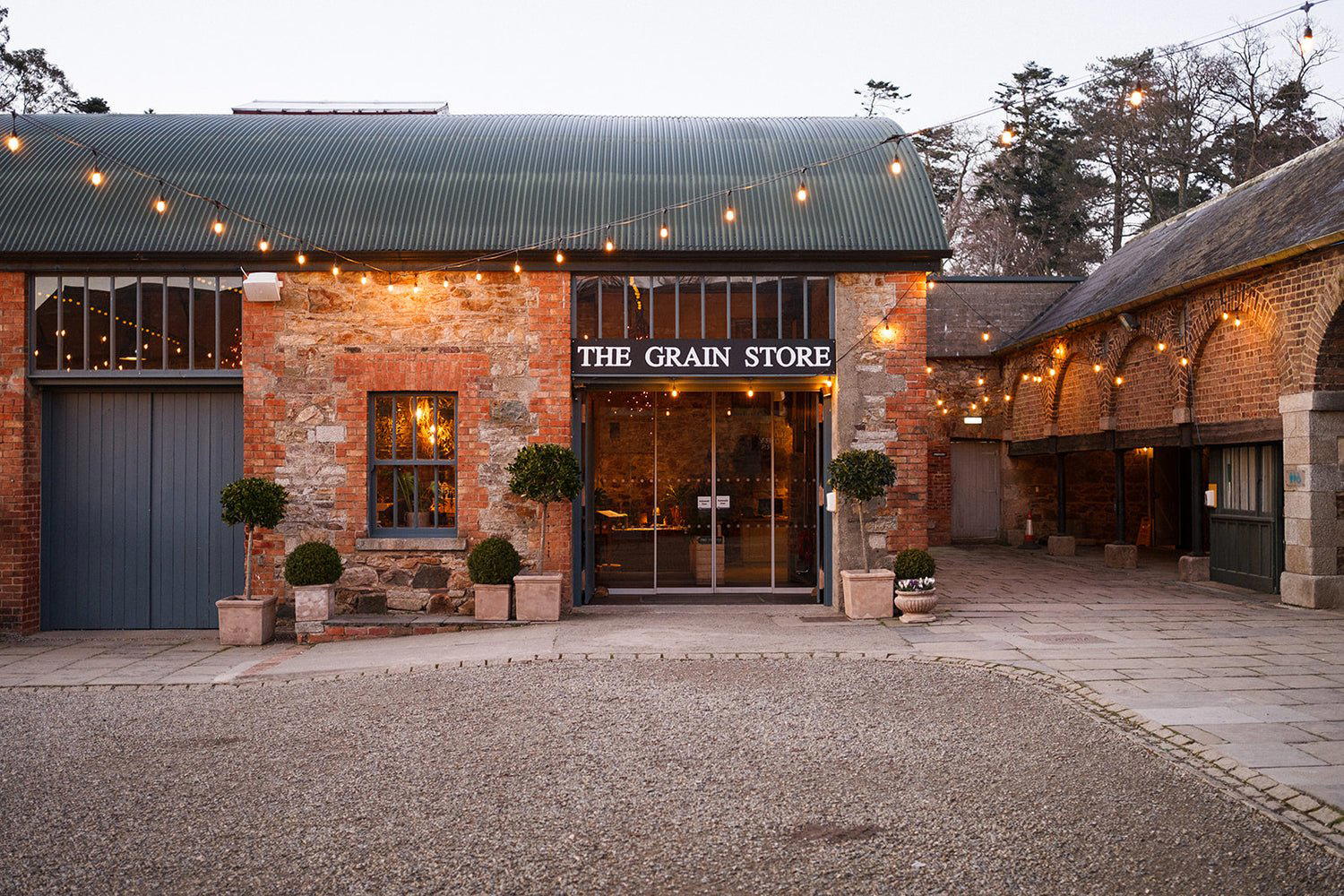
An Estate Setting That Shapes the Meal
County Wicklow's approach to dining has long been shaped by proximity to both Dublin's restaurant culture and some of Ireland's most productive agricultural land. The Sugarloaf mountain sits to the north, the Sally Gap moorland spreads westward, and the coastal strip from Bray to Wicklow town generates a density of growers, fishers, and smallholders that few Irish counties can match. Restaurants that operate here tend to carry that provenance as a structural element, not an afterthought.
The Grain Store sits inside the walled grounds of Killruddery House and Gardens, a Brabantine Revival estate that has been in the Brabazon family since 1618, making it one of the longest-unbroken aristocratic tenancies in Ireland. The building itself, a restored grain store on the estate, places the dining experience in a tradition of Irish country house hospitality that runs through properties like Lady Helen in Thomastown and The Oak Room in Adare, though the format here is shaped more by the working estate context than by formal hotel dining.
The Irish Country House Restaurant as a Format
Ireland has developed a distinct sub-category of destination dining over the past two decades: the estate or country house restaurant that draws on surrounding farmland, kitchen gardens, and centuries of land stewardship to construct a menu with demonstrable local grounding. This format differs from the urban tasting menu circuit in Dublin represented by Chapter One by Mickael Viljanen or the precision-driven coastal dining of Liath in Blackrock. The country estate model tends to privilege setting as experience, with the arrival, the grounds walk, and the architectural context functioning as part of the meal's narrative rather than its preamble.
Killruddery runs a kitchen garden within its walled grounds, and the estate model as a category across Ireland, from Terre in Castlemartyr to smaller operations in rural Connacht, tends toward seasonality that is literalised rather than rhetorical. When the kitchen garden produces, it appears on the plate. When it doesn't, the menu contracts or pivots. This cyclical relationship with production is one of the things that separates estate dining from restaurants that simply claim local sourcing.
Where Killruddery Fits the Irish Dining Conversation
Ireland's independent dining scene has fragmented productively over the past decade. The Michelin-starred circuit runs from city tasting counters like Aniar in Galway to rural destination rooms like Chestnut in Ballydehob and dede in Baltimore. But below that starred tier, and sometimes overlapping with it, a parallel circuit of estate, farm, and heritage-building restaurants has emerged that competes on a different axis: immersion rather than precision, atmosphere rather than technique as the primary draw.
The Grain Store operates within that second category. For visitors arriving from Dublin, it sits approximately 25 kilometres south of the city centre via the M11, making it one of the closer countryside dining destinations for a capital audience that increasingly treats Wicklow as a dining county rather than simply a day-trip landscape. The village of Kilmacanogue itself is a small settlement at the foot of the Sugarloaf, notable more for its position as a gateway to the Wicklow Mountains than for any independent dining concentration. The Grain Store, along with Pizza Shed nearby, represents the area's dining offer. Our full Kilmacanogue restaurants guide covers both in the context of what the area provides to visitors coming down from Dublin or through from the coast.
Cultural Roots: Irish Provenance Dining
The cultural argument behind provenance-led Irish cooking has deepened considerably since Jp McMahon's foundational work at Aniar articulated a theoretical and practical framework for Modern Irish cuisine in the early 2010s. What started as a reactive movement against decades of French-influenced Irish hotel cooking has evolved into something more textured: a dining philosophy that looks to pre-colonial Irish food culture, to monastic and agricultural traditions, and to the specific ecology of a given landscape as the basis for menu construction.
An estate like Killruddery, with its documented centuries of land use, its walled garden, its proximity to both the sea and upland grazing, offers a physical and historical substrate that newer restaurant projects have to manufacture or approximate. The Grain Store's cultural advantage is partly architectural: the building's original function as agricultural storage links it to a pre-industrial relationship with food production that most contemporary restaurants can only reference symbolically. Whether the kitchen program exploits that context fully is a question of execution, but the raw material of place is structurally stronger here than at most comparable venues. Restaurants like Homestead Cottage in Doolin, House in Ardmore, and Bastion in Kinsale each use their specific coastal or rural contexts as differentiators in a similar way.
For international diners who have spent time at property-embedded restaurants elsewhere, the reference points are places like Le Bernardin in New York City or the more technically demanding end of the New York scene represented by Atomix, venues where the dining proposition rests on a conceptual and cultural argument as much as a purely culinary one. The Irish country estate version of that argument is more vernacular, less self-conscious, and often more durable as an experience for exactly those reasons.
Planning a Visit
Killruddery House and Gardens operates with opening hours tied to the estate's seasonal schedule, and access to the grounds and the Grain Store should be confirmed in advance rather than assumed. For those driving from Dublin, the M11 south to the Bray exit and then south toward Kilmacanogue is the standard route, and the estate sits on the Southern Cross Road with signage from the main road. The experience lends itself to combining with a garden walk, particularly when the formal gardens and the walled kitchen garden are in their productive season from late spring through autumn. Those interested in the wider Wicklow dining corridor, which runs down toward Wicklow town and connects with a growing number of farm-to-table operations, will find the Grain Store a useful anchor for a longer itinerary. For a comparable mix of heritage setting and Irish provenance cooking in the Leinster region, The Morrison Room in Maynooth, Campagne in Kilkenny, and LIGИUM in Bullaun round out a picture of what Irish countryside dining is producing in the country's eastern half.
Frequently asked questions
Is The Grain Store good for families?
The Grain Store sits within Killruddery House and Gardens in Kilmacanogue, an estate setting that gives families access to grounds and gardens beyond the meal itself. Children who engage with outdoor spaces will find the broader estate context makes a visit more than a standard restaurant trip. Check the estate's current seasonal schedule before booking, as access to both the grounds and the Grain Store is tied to Killruddery's operating calendar.
What should I expect atmosphere-wise at The Grain Store?
The Grain Store occupies a working estate in Kilmacanogue, County Wicklow, which means the setting does most of the atmospheric work — stone buildings, agricultural heritage, and gardens rather than designed interior mood. The tone is informal by country house standards, closer to a farm-to-table producer lunch than a formal dining room. Expect the pace and feel to shift with the seasons, since the estate's schedule drives when the restaurant operates.
Is The Grain Store at Killruddery part of a wider estate experience, or a standalone restaurant?
The Grain Store is physically situated within Killruddery House and Gardens on Southern Cross Road in Kilmacanogue, placing it firmly inside the estate experience rather than operating as a separate venue. Access to the restaurant is tied to the estate's seasonal opening schedule, meaning a visit typically involves the gardens and historic house alongside the meal. This format places it within the broader Irish tradition of destination dining anchored to heritage estates in County Wicklow.
What should I order at The Grain Store?
Specific menu details for the Grain Store are not fixed in advance here, as the kitchen's output follows Killruddery estate's seasonal and agricultural rhythm — a common format among Irish provenance-led restaurants in the Wicklow region. The broader context of estate dining in Ireland suggests the menu draws on what the surrounding land and local producers supply at any given time. Contact Killruddery House directly or check the estate's current listings before visiting to confirm what's on offer.
Where do I go for The Grain Store?
The Grain Store is located at KILLRUDDERY HOUSE & GARDENS, Southern Cross Rd, Bray, Co. Wicklow, A98 W9F2, Ireland, Kilmacanogue.
How far ahead should I plan for The Grain Store?
Killruddery House and Gardens operates on a seasonal schedule, so the first step is confirming that the estate is open during your intended dates before any other planning. Country house restaurants in County Wicklow with estate access tend to see stronger demand during spring and summer garden seasons. Reaching out to Killruddery House directly is the most reliable way to align your visit with the Grain Store's current availability.
Pricing, Compared
Comparable venues nearby, for context on price, style, and recognition.
| Venue | Cuisine | Price | Notes |
|---|---|---|---|
| The Grain StoreThis venue — the venue you are viewing | Farm-to-Table International | Not listed | Not listed |
| Pizza Shed | Wood-fired Neapolitan Pizza | $20–30 | Kilmacanogue, Wood-fired Neapolitan Pizza |
| The Greenhouse | Modern French Fine Dining | $50–100 | Mansion House B, Modern French Fine Dining |
| 9 Below | Luxury Cocktail Bar | Not listed | Mansion House B, Luxury Cocktail Bar |
| The Terrace at The Shelbourne | Contemporary Irish | Not listed | Mansion House B, Contemporary Irish |
| Pearl Brasserie | Modern French Brasserie with Asian Fusion | $100–150 | Mansion House B, Modern French Brasserie with Asian Fusion |
Continue exploring
More in Kilmacanogue
Restaurants in Kilmacanogue
All restaurants in Kilmacanogue →
Bars in Kilmacanogue
Browse all →
Hotels in Kilmacanogue
Browse all →


Wineries in Kilmacanogue
Browse all →
Details
- Casual
- Relaxed
- Rustic
- Brunch
- Casual Hangout
- Garden
- Farm To Table
- Local Sourcing
- Garden
- A La Carte
Current opening hours
- Monday
- Closed
- Tuesday
- Closed
- Wednesday
- Closed
- Thursday
- Closed
- Friday
- 12–3 PM
- Saturday
- 12–3 PM
- Sunday
- 12–4 PM
Hours can change for holidays and private events. Last verified .
Casual atmosphere with a relaxing vibe in the original grain store building.