The Christiansborg's Tower
Christiansborg's Tower rises above Copenhagen's Slotsholmen island with one of the most arresting viewpoints in the Danish capital — a publicly accessible perch above the parliament building, the royal reception rooms, and centuries of political history. The experience sits outside the city's fine dining circuit but inside a conversation about how Copenhagen frames its public cultural spaces against a skyline few European capitals can match.
Pearl is the En Primeur Club membership app — saves, bookings, and concierge access live there. Same editors, same standards.
- Address
- Christiansborg Slotsplads, 1218 København, Denmark
- Phone
- +45 33 37 55 00
- Website
- taarnet.dk
- Directions
- Get directions
 Saves & bookings on Pearl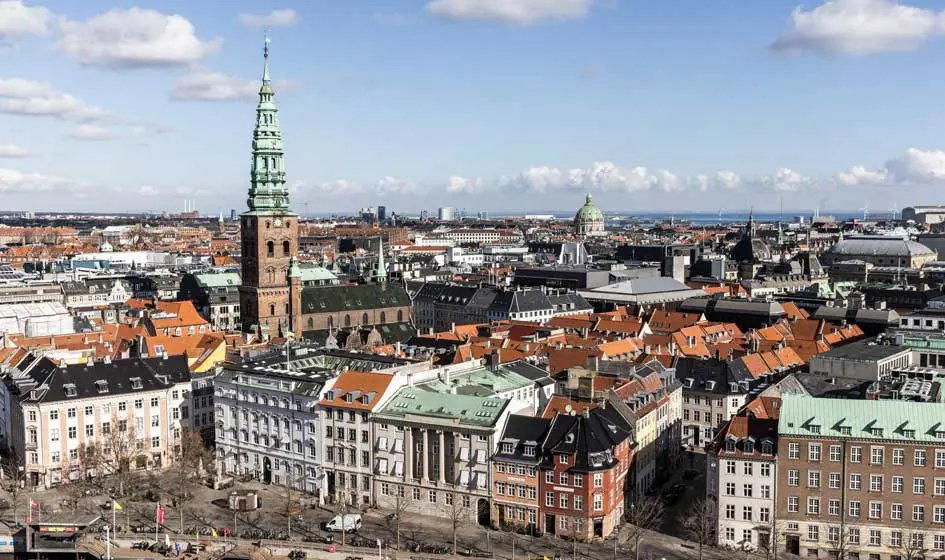
Above the Capital: What the Tower Signals About Copenhagen's Public Spaces
Copenhagen has spent two decades building an international reputation through its restaurant scene — Geranium, Noma, and Alchemist collectively repositioned the city as a serious gastronomic address — but the city's relationship with its own architecture and public institutions runs deeper and older than any tasting menu. Christiansborg's Tower sits at the centre of that longer story. The spire above the current palace complex, rebuilt in its present form after fires destroyed earlier structures, is the tallest tower in Copenhagen and the only one offering panoramic access across the entire city from a publicly accessible platform. That distinction matters: in a capital where prestige cultural experiences increasingly split between high-cost private formats and genuinely open civic spaces, the Tower holds an unusual position.
Approaching across Christiansborg Slotsplads, the scale of the palace complex reads differently depending on the season. In summer, the courtyard fills with visitors and the long Scandinavian daylight turns the copper rooflines into something approaching gold. In winter, particularly in the weeks around Christmas, when Copenhagen's light is low and blue well into the morning, the Tower's silhouette against a pale sky carries a different weight. The platform at the leading is open to the elements on all sides, which means the experience is inseparable from the weather. Come prepared accordingly, and come with time to stand still.
The Slotsholmen Context: Palace, Parliament, and Table
Christiansborg is not a single building so much as a civic institution compressed onto one island. The current palace, the third structure on the site, houses the Danish Parliament (Folketing), the Supreme Court, and the Prime Minister's Office alongside the Royal Reception Rooms. That compression of functions, legislative and ceremonial sharing the same address, gives the island a particular density of significance that few sites in Northern Europe replicate. The Tower rises from this complex not as an ornamental gesture but as a practical landmark: historically used for fire observation across the city, now the most direct way for a visitor to read Copenhagen's urban geography from a single fixed point.
The view from the leading places the city's major reference points in spatial relationship to one another, the green copper roofs of the old city, the harbour opening to the south, Frederiksberg and the residential density of the western districts, and, on a clear day, the Swedish coast across the Øresund. For visitors building a multi-day programme around Copenhagen's dining scene, including stops at Kadeau or Koan, the Tower provides a useful orienting exercise: the city's geography is compact and walkable, and seeing it whole from above before moving through it at street level changes how the neighbourhoods connect.
Free Entry and the Danish Model of Cultural Access
The Tower's entry is free of charge, a point that distinguishes it sharply from the ticketed Royal Reception Rooms and the other palace attractions on the same island. This reflects a broader Danish civic philosophy about public access to significant cultural and architectural sites, one that sits in instructive contrast to the premium-admission model common to comparable viewpoints in Paris or London. The free model does mean the experience is self-directed: there is no guided interpretation, no tasting menu equivalent of curatorial framing. What you bring in terms of historical knowledge shapes what you take from it.
For visitors whose Copenhagen programme also extends beyond the capital, the Tower visit pairs naturally with a broader exploration of Denmark's regional dining and cultural circuit. Jordnær in Gentofte sits north of the city centre; Frederikshøj in Aarhus, Henne Kirkeby Kro in Henne, and Frederiksminde in Præstø represent the country's serious dining addresses outside the capital. Further afield, Ti Trin Ned in Fredericia, Dragsholm Slot Gourmet in Hørve, LYST in Vejle, Tri in Agger, Pearl by Paul Proffitt in Kruså, and Syttende in Sønderborg extend that network across Jutland and the islands. Copenhagen's role as a hub for that national conversation is visible from the Tower in a way that a map does not quite communicate.
Placing the Tower in a Wider Travel Framework
Premium travel increasingly organises itself around experiences that require presence in a specific place at a specific time, the counter seat at a twelve-person omakase, the cellar visit by appointment, the private cultural access that cannot be replicated online. The Tower operates on a different logic, one that is available to anyone who arrives during opening hours and is willing to climb. That accessibility does not diminish what it offers; it simply places it in a different category of experience, one where the quality of attention you bring determines what you receive.
Internationally, comparable civic viewpoints, the panoramic terraces of public institutions in cities like Paris, Vienna, or Berlin, tend to operate with ticketing and timed entry. Copenhagen's approach here aligns with the city's broader commitment to low-barrier cultural participation, a quality that extends into the dining world at the lower price tiers even as the leading end, represented by venues like Geranium and Alchemist, competes against international reference points like Le Bernardin in New York City or Lazy Bear in San Francisco for the attention of serious travellers.
Planning Your Visit
The Tower is located on Christiansborg Slotsplads in the Slotsholmen district, reachable on foot from the city centre in under ten minutes. Entry is free and the platform is open to all. The experience is weather-dependent in a meaningful way: overcast or foggy days reduce the view significantly, and the open-air platform makes wind and cold factors at any time outside summer. The Tower is leading visited in the morning before the midday foot traffic on the island peaks, and in clear conditions the Øresund crossing to Sweden is visible on the horizon. For a full picture of Copenhagen's dining and cultural programming, the EP Club Copenhagen guide covers the city's serious addresses across all categories.
How The Christiansborg's Tower Copenhagen compares with similar nearby venues.
| Venue | Cuisine | Price |
|---|---|---|
| Ved Straden 10 | Wine Bar | Not listed |
| Admiralgade 26 | Nordic-Japanese, Modern Cuisine | €€ |
| Krogs Fiskerestaurant | Seafood | Not listed |
| Marv & Ben | Modern Cuisine | € |
| Norrlyst | Danish | € |
Continue exploring
More in Copenhagen
Restaurants in Copenhagen
Browse all →
Bars in Copenhagen
Browse all →
Hotels in Copenhagen
Browse all →

At a Glance
- Scenic
- Elegant
- Well Known
- Sophisticated
- Special Occasion
- Date Night
- Panoramic View
- Historic Building
- Extensive Wine List
- Skyline
Current opening hours
- Monday
- Closed
- Tuesday
- 11 AM–9 PM
- Wednesday
- 11 AM–9 PM
- Thursday
- 11 AM–9 PM
- Friday
- 11 AM–9 PM
- Saturday
- 11 AM–9 PM
- Sunday
- 11 AM–5:30 PM
Hours can change for holidays and private events. Last verified .
Dramatic historic space with high ceilings, monumental stone lions, and plaster statuary models overlooking the city skyline.
Know Before You Go
- Getting there
- Christiansborg Slotsplads, 1218 København, Denmark