
Tenteko Mukonosou ten belongs to Amagasaki’s everyday okonomiyaki culture rather than the destination-tasting-menu circuit. Its repeated selection for Tabelog’s Okonomiyaki 100 list, including 2025, gives it a clear quality signal in a category where local regulars, griddle technique, and ingredient handling matter more than ceremony.
Pearl is the En Primeur Club membership app — saves, bookings, and concierge access live there. Same editors, same standards.
- Address
- 兵庫県尼崎市南武庫之荘3-36-11
- Phone
- +81664329300
- Website
- tabelog.com
 Saves & bookings on Pearl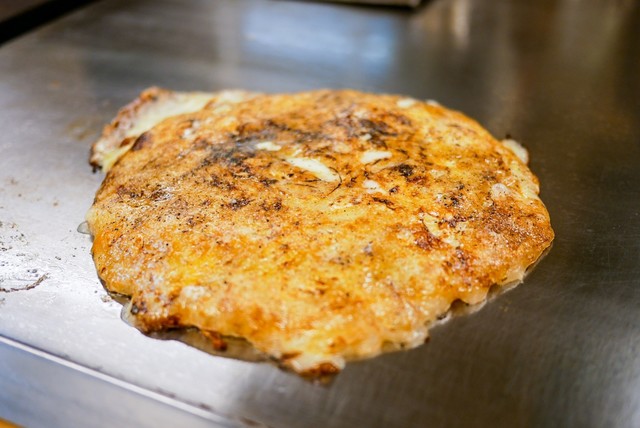
Approaching a neighbourhood okonomiyaki counter in Mukonosou means entering a different register of Japanese dining: less ceremony, more heat, more attention to what happens on the iron plate. The room is compact, the format is direct, and the food belongs to a Kansai tradition built from batter, cabbage, sauce, protein, and timing rather than luxury ingredients. In that setting, Tenteko Mukonosou ten reads as a serious local address because it has been selected for Tabelog’s Okonomiyaki 100 in 2018, 2019, 2022, 2023, 2024, and 2025. That continuity matters. Okonomiyaki recognition is not usually about spectacle; it rewards consistency in a dish that punishes shortcuts.
Amagasaki sits between Osaka and Kobe, and its dining character reflects that geography. The city is practical, commuter-shaped, and strong on foods that work for repeat neighbourhood use: ramen, udon, yakiniku, izakaya cooking, and griddle dishes. Readers mapping the area should treat our full Amagasaki restaurants guide as the wider frame, with nearby options such as Butanohoshi, Honkaku Sanuki Udon Honoka, Gyoraku Karakara, Dairen, and Angle showing how broad the local table can be without leaning on formal dining codes.
Okonomiyaki here is about ingredient control, not ornament
Kansai okonomiyaki depends on a narrow set of decisions: how finely the cabbage is cut, how much water the vegetables release, how the batter binds without turning heavy, and how the griddle sets the surface before the centre loses lift. Those details rarely appear on a menu as luxury signals, but they are the difference between a casual pancake and a disciplined one. The ingredient question is not only provenance; it is handling. Cabbage has to retain sweetness and structure, batter has to carry rather than smother, and additions need to integrate into the whole instead of turning the dish into a pile-up.
That is why repeated Tabelog Okonomiyaki 100 selection carries weight in this category. The list narrows a national field of everyday specialists, many of them modest in format, and places attention on consistency rather than expense. Tenteko Mukonosou ten’s Tabelog score of 3.61 and recurring appearances on the list put it in the serious-okonomiyaki lane, distinct from broader casual restaurants where the griddle is only part of the offer. It is also priced in the neighbourhood bracket, with lunch and dinner budgets sitting below the cost of Amagasaki’s higher-spend yakiniku addresses such as Gyoraku Karakara. The comparison is useful: both can be local meals, but one is built around ingredient procurement and meat quality, the other around everyday materials transformed by technique.
The stronger way to read this table is through restraint. Okonomiyaki can absorb almost anything, which is why weak versions often become overloaded. The better Kansai style keeps the structure legible: vegetable, batter, protein or seafood, sauce, and heat. Nothing in the public menu detail supports naming a single house specialty, so the editorial signal is broader: come for a category where the craft sits in proportion, griddle management, and the ability to repeat the same result across service.
A small Mukonosou room suits the way this food should be eaten
The physical scale reinforces the cooking. A 16-seat setup, including counter seating, keeps the meal close to the plate and away from the performance language of luxury counters. That matters for okonomiyaki because the dish is social but time-sensitive; it benefits from being eaten soon after the griddle has done its work. The room is also non-smoking, a practical point that changes the experience of sauce, heat, and batter in a compact space.
This is not a chef-biography restaurant, and that is a strength. Many premium dining pages overstate personality when the more interesting story is a regional format doing its job with discipline. Here, the evidence sits in category recognition, compact service, and a price level that keeps the meal connected to ordinary Kansai eating. The friends-occasion signal attached to the restaurant is apt: okonomiyaki is built for shared appetites, short decisions, and repeat visits rather than rare-event dining.
For visitors using Amagasaki as a base, the surrounding planning ecosystem is worth separating by purpose. Restaurants are the reason to focus here; our full Amagasaki hotels guide, our full Amagasaki bars guide, our full Amagasaki wineries guide, and our full Amagasaki experiences guide help sort the rest of the stay. The restaurant itself is tied to Mukonosou rather than central Osaka or Kobe, which makes it a sharper choice for travellers already moving through Hyogo’s local rail corridors rather than chasing a single dining stop across the region.
How to place it in a Kansai eating itinerary
Tenteko Mukonosou ten works as a category-specific stop: choose it when the point is okonomiyaki, not when a group needs a long menu covering every preference. That sounds narrow, but Kansai dining rewards focus. Udon specialists, ramen counters, grill rooms, and okonomiyaki houses each protect their own logic. In Amagasaki, a lower-priced ramen meal at Ramen Senmon Nagomi Mukonosou ten, a casual bracket meal at majide hamal, and a higher-spend dinner at Gyoraku Karakara all answer different questions. This address answers the griddle question.
That specificity also makes it a useful counterweight to more polished urban dining elsewhere in Japan. Travellers building a broader route can pair local Kansai meals with city-specific stops such as.cafe in Osaka. 鮪と炭火焼き うお炭 秋葉原店 in Tokyo, -Grilled beef Sukiyaki- KAMAKURA TANUKIAN 鎌倉 たぬき庵 in Kamakura.know in Kumamoto, (Shoku) Vietnam in Kawasaki, and [Curry Senmon Ten] Maruyama Kyoju. in Sapporo. For readers comparing Japanese comfort-food formats abroad, Jōdo Saké Bar in Los Angeles and Onigiri Time in Pasadena show how tightly defined Japanese categories translate outside Japan.
The editorial call is simple: this is a compact, recognised okonomiyaki specialist in a city where everyday food culture carries more interest than polished theatre. The draw is not rarity for its own sake. It is a Kansai staple handled with enough consistency to earn repeated category recognition, at a scale that keeps the meal close to its neighbourhood roots.
Side-by-Side Snapshot
Comparable venues by cuisine and price in the same metro.
| Venue | Cuisine | Price | Notes |
|---|---|---|---|
| Tenteko Mukonosou ten | Okonomiyaki | $$ | Mukonoso |
| Butanohoshi | Tonkotsu Ramen | $$ | Nagasu Nishidori |
| Miraku En | Yakiniku (Japanese BBQ) | $$ | / Amagasaki Station area |
| Gyoraku Karakara | Seafood-focused Japanese Izakaya | $$$ | Mukonoso |
| Shin Chan | Dining | Not listed | Amagasaki |
| Udon Kobo Yuuyu | Udon and Tempura Shop | $ | Tsukaguchi |
Recognition history
Dated appearances from independent guides and award organizations, with the underlying list record or original source where available.
Tabelog 100 #13 · No. 13
Tabelog · Tabelog 100 - Okonomiyaki - 2025
Continue exploring
More in Amagasaki
Restaurants in Amagasaki
Browse all →




Bars in Amagasaki
Browse all →


Hotels in Amagasaki
Browse all →



Wineries in Amagasaki
Browse all →
At a Glance
- Cozy
- Classic
- Casual Hangout
- Group Dining
- Standalone
- Beer Program
A small, non-smoking neighborhood okonomiyaki spot with a casual, intimate feel and counter-and-table seating.